
Arriving at a meeting or wedding with a wrinkle-free suit is entirely achievable, but only if you pick the right garment bag for the way you actually travel.
Convertible carry-on duffel vs hanging tri-fold
These are the two dominant formats, and they solve different problems.
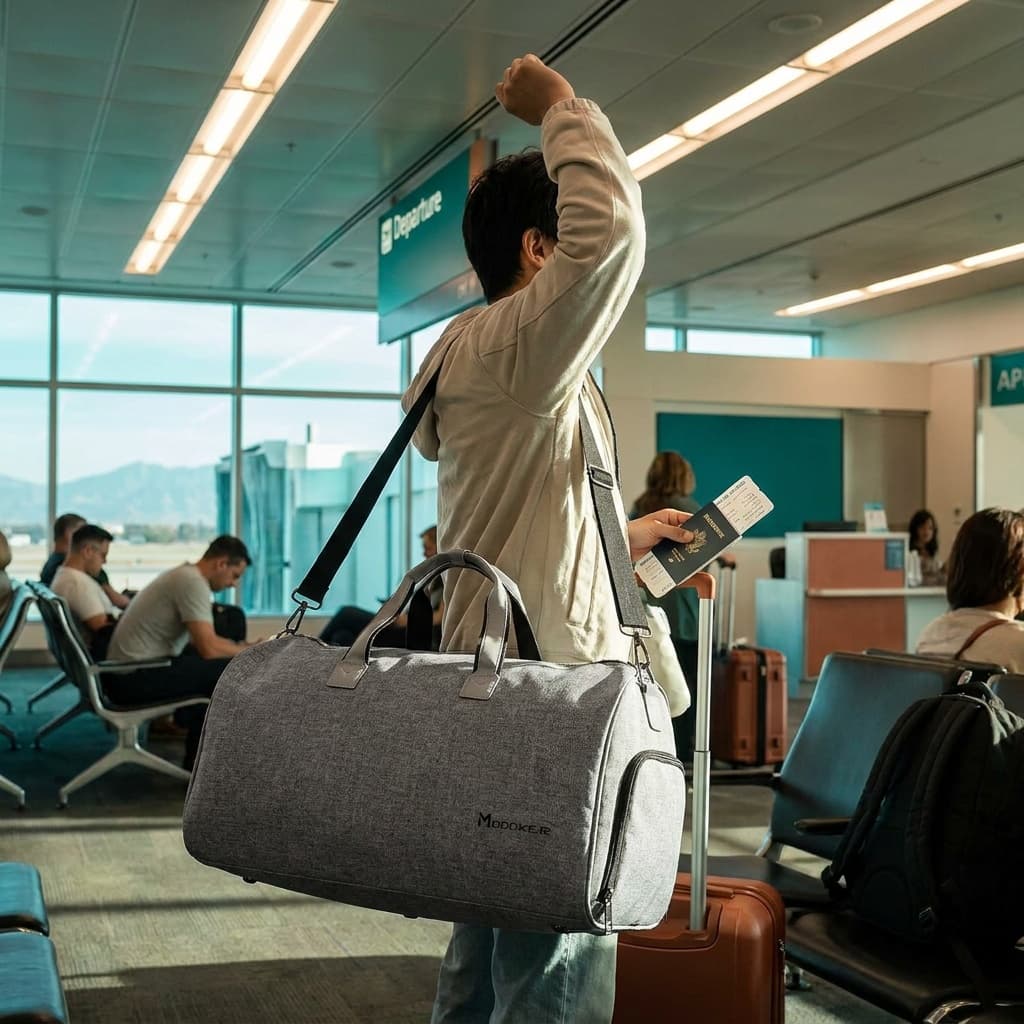
A convertible carry-on duffel folds your suits inside the bag, which then zips into a duffel or roller-compatible shape. You carry it like luggage, store it overhead, and unzip it in your hotel room. The best versions, like the Modoker Convertible Garment Duffel, are built around a structured gusset (typically 5–7 inches deep) that keeps the garment fold clean during overhead stowage. The trade-off: the bag is bulkier when packed, and the fold point is fixed, so very long jackets or gowns can still crease at the bottom.
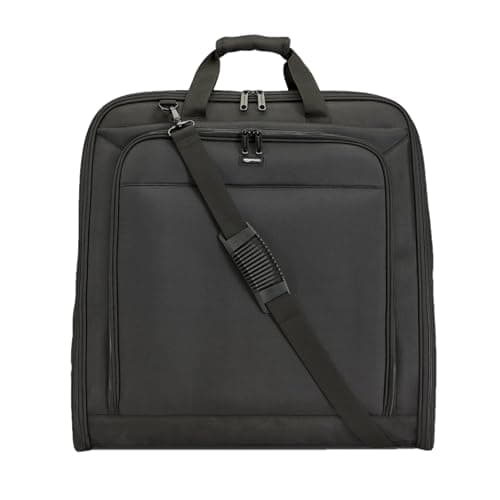
A hanging tri-fold like the Amazon Basics 46-Inch Trifold stays in garment-bag form the entire trip. You fold it into thirds, carry it over your shoulder or on a hook, and hang it in the hotel closet to let gravity release minor wrinkles. It travels well in a car, on a train, or as a checked bag. The downside is that most airlines will not accept a hanging garment bag as a standard carry-on, and carrying it through a busy terminal is awkward.
The format you choose should match your most common travel scenario, not your ideal one.
Suit and shirt capacity: what the numbers mean
Manufacturers rate bags in "suits," but that number assumes a flat fold with nothing else inside. In practice, you lose one suit equivalent for every two dress shirts you pack alongside a jacket and trousers.
Look for internal compression straps or a zippered panel that presses the stack flat. Without them, the contents shift in transit and the folds multiply. Some bags include a dedicated shoe pocket or a wet/dry compartment for accessories; these are useful additions but reduce the usable garment space, so account for them when comparing capacity claims.
Structure, padding, and wrinkle protection
A soft-shell bag with no internal frame offers no protection against crush in an overhead bin. For carry-on use, prioritize bags with a semi-rigid back panel or a structured base. This is the single feature most worth paying for.
What to check before you buy
Back panel
A semi-rigid or foam-backed panel keeps the fold plane flat and resists compression from adjacent bags in the bin.
Compression straps
Internal straps hold the garment stack in place so the fold does not migrate during handling.
Hook quality
A stainless or reinforced plastic hook that fits over a standard closet rod (typically 1–1.5 inches diameter) matters for hanging tri-folds; a flimsy hook is a real failure point.
Gusset depth
Measured when fully packed, 5–7 inches accommodates two suits plus a few shirts without forcing a second fold.
Exterior padding
Padded handles and reinforced corners add durability without meaningful weight penalty.
Carry-on compliance: what the rules actually say
The FAA does not regulate carry-on dimensions. Each airline sets its own limits, and they vary. As of 2026, the most common US carrier limit for a personal item or standard carry-on is roughly 22 x 14 x 9 inches, though Southwest, Delta, United, and American all publish slightly different numbers.
A convertible garment bag marketed as "carry-on compliant" typically measures in at 22 x 14 x 8–9 inches when packed to its rated capacity. When overpacked, it exceeds that. The hanging tri-fold, when folded, often clears the dimensional limit on paper, but many gate agents flag it as an irregular item and ask you to check it.
One reliable workaround for the tri-fold format: many airlines allow a garment bag as a carry-on if it can be laid flat in the overhead bin. Call ahead or check the carrier's FAQ directly rather than assuming.
Material durability: what holds up over years of travel
Most garment bags use 600D or 1680D polyester, ballistic nylon, or coated nylon oxford. Here is how they compare in real use:
600D polyester is light and inexpensive but pills and abrades at stress points after two to three years of weekly travel. It is fine for occasional use.
1680D ballistic nylon (used by Briggs and Riley, the TUMI Alpha Garment Bag, and similar lines) resists abrasion, holds its shape longer, and is worth the price premium if you travel in formalwear more than a dozen times a year.
Coated nylon oxford sits between those two in both cost and durability, and it tends to be water-resistant rather than waterproof. Check whether the DWR coating is durable or a single-wash finish.
For occasional travelers, a mid-range 600D or coated nylon bag in the $50–$120 range is entirely sufficient. For frequent business travelers who are carrying the bag through airports every week, a 1680D or ripstop nylon bag in the $150–$300 range will outlast two or three cheaper replacements.
Frequently asked questions
Can I use a garment bag as my only carry-on?
Yes, if it meets your airline's size limit when packed. A convertible carry-on duffel style is easiest to make work: it packs into a standard rectangular shape that fits overhead bins. A hanging tri-fold is harder to use as a sole carry-on because its irregular shape attracts gate-agent scrutiny even when the dimensions technically comply.
How do I fold a suit so it does not wrinkle in a garment bag?
Turn one jacket shoulder inside out, nest the second jacket inside it so both shoulders align, then fold the combined stack in half at the waist. Lay trousers flat on top with the crease aligned, fold them lengthwise once, and place them over the jacket. This technique, sometimes called the ranger roll for jackets, distributes the fold stress evenly and keeps the lapels from taking a hard crease.
What is the difference between a garment bag and a suit bag?
The terms are used interchangeably in retail, but "suit bag" typically refers to a thin, zipper-front bag (often the kind a dry cleaner returns your clothes in) with no structure or padding. A garment bag implies a travel-specific bag with structure, a carry handle, and often a duffel or roller conversion. For any trip involving air travel, the structured garment bag is what you want.
For specific picks, see our guide to the best travel garment bags. Browse all travel guides or read how we research and rate gear.
Recommended gear
Our current top picks from the The best travel garment bags for wrinkle-free suits guide, if you are ready to buy.

MODOKER
Modoker Convertible Garment Duffel Bag
Best Overall
Kit Score 7.7/10
$35.99 Price checked Oct 23, 4:16 PM CDT
Best for: Business travelers who want one carry-on bag that doubles as both a garment carrier and an overnight duffel.
- True carry-on compliance: duffel mode fits overhead bins at standard airline dimensions
- Shoulder strap attachment hardware has a documented failure rate; some owners report breakage on the first trip
- Style
- 2-in-1 convertible: garment bag + duffel
- Garment bag length
- 37.5 inches
- Duffel dimensions
- 22.8" x 11" x 11.8" (carry-on compliant)
- Duffel capacity
- 45 liters
- Weight
- 2.5 lbs
- Material
- Water-resistant polyester and jacquard
About this pick
The Modoker converts from a 37.5-inch hanging garment bag to a 45-liter carry-on duffel in one motion, letting business travelers skip the checked-bag line while keeping suits flat. The folded duffel fits standard overhead bins and includes a shoe pouch and dedicated small-item pocket.
Strengths
- True carry-on compliance: duffel mode fits overhead bins at standard airline dimensions
- 2-in-1 flexibility suits both short business trips and weekend travel without a second bag
- Lightweight at 2.5 lbs, leaving more room in your carry-on weight budget
Weaknesses
- Shoulder strap attachment hardware has a documented failure rate; some owners report breakage on the first trip
- Zippers are functional but not heavy-duty, so careful packing technique matters for longevity
Kit Score breakdown
AMAZON BASICS
Amazon Basics 46" Premium Trifold Garment Bag
Best Value
Kit Score 8.0/10
$43.15 Price checked Oct 23, 4:16 PM CDT
Best for: Travelers who need a capable, no-frills garment bag for occasional trips and want to spend as little as possible without sacrificing structure.
- 1680D polyester outer fabric and leather-reinforced corners deliver durability well above the price point
- No rolling luggage attachment point, so it requires a separate carry when paired with a roller suitcase
- Style
- Trifold hanging garment bag
- Open length
- 45 inches (unfolded)
- Capacity
- Up to 3 suits or dresses
- Outer material
- 1680D polyester with leather-reinforced corners
- Lining
- 210D polyester
- Shoulder strap
- Adjustable and detachable
About this pick
Amazon's trifold garment bag holds up to three suits or dresses in a rugged 1680D polyester shell with leather corner reinforcements and a full interior organizer panel. A detachable shoulder strap and carry handle give you two hands-free options once you fold it down for the overhead bin.
Strengths
- 1680D polyester outer fabric and leather-reinforced corners deliver durability well above the price point
- Three-suit capacity with room for shoes, belts, and ties in separate pockets
- Trifold design folds compactly for carry-on overhead storage
Weaknesses
- No rolling luggage attachment point, so it requires a separate carry when paired with a roller suitcase
- The open length suits taller travelers but may be more than needed for shorter dresses
Kit Score breakdown
ZEGUR
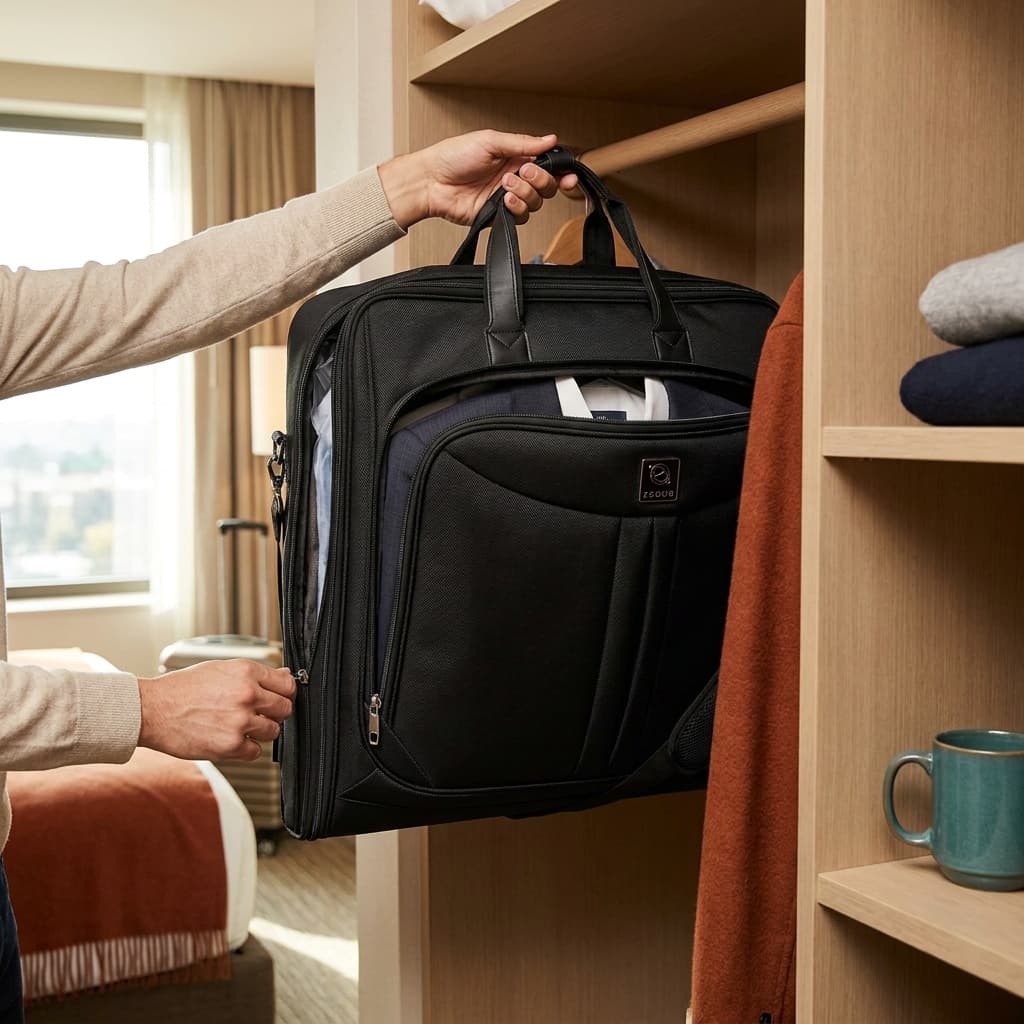
ZEGUR Premium Suit Carry On Garment Bag
Editor's Choice
Kit Score 7.8/10
$69.75 Price checked Oct 23, 4:16 PM CDT
Best for: Business travelers who check bags often enough to care about shoulder and lapel shape, not just wrinkles, and want a semi-structured carry-on that fits real overhead bins.
- Semirigid piping protects suit shoulders and lapels in a way that soft bags cannot
- Shoulder strap anchor hardware has a documented reliability problem; treat the strap as a convenience, not a structural feature
- Style
- Semi-rigid structure garment bag
- Folded dimensions
- 22.99" x 22.01" x 4.02"
- Carry-on compliance
- Fits carry-on size limits on most major airlines when folded
- Capacity
- Up to 4 suits plus shoes and accessories
- Material
- 1800D polyester with semirigid structure piping
- Weight
- Under 3 lbs (1.3 kg)
About this pick
The ZEGUR uses semirigid structure piping to keep your suit shoulders from collapsing during transit, a feature usually found on bags costing far more. It folds to approximately 23 inches square that clears carry-on size limits on most major airlines, and the padded interior bar prevents hanger-point creasing across up to 4 hanging garments.
Strengths
- Semirigid piping protects suit shoulders and lapels in a way that soft bags cannot
- Folds to a 23-inch square that fits carry-on size limits on most airlines
- Rolling luggage attachment point keeps it secure when stacked on a suitcase
Weaknesses
- Shoulder strap anchor hardware has a documented reliability problem; treat the strap as a convenience, not a structural feature
- 40-inch open length works well for suits but is on the shorter side for full-length gowns
Kit Score breakdown
See all picks in The best travel garment bags for wrinkle-free suits
Keep going
Complete loadoutCarry-on travel kitA one-week suitcase system with the bag, organization, laundry, toiletries, security, scale, and power.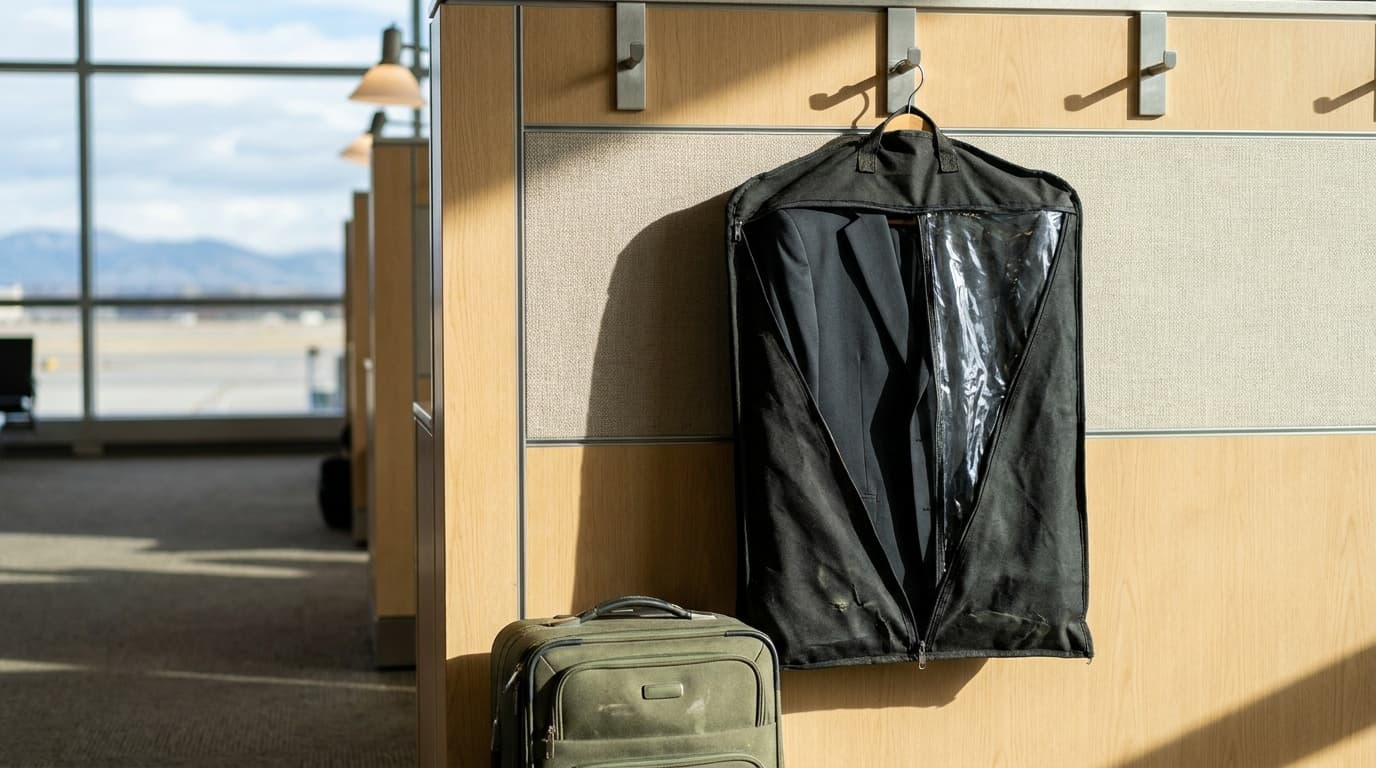
Researched, not hands-on tested
Updated Jun 4, 2026Our recommendations draw on manufacturer documentation, retailer listings, owner feedback, and comparisons with alternatives.
As an Amazon Associate I earn from qualifying purchases. We may earn a commission from links here, at no extra cost to you. How we research →