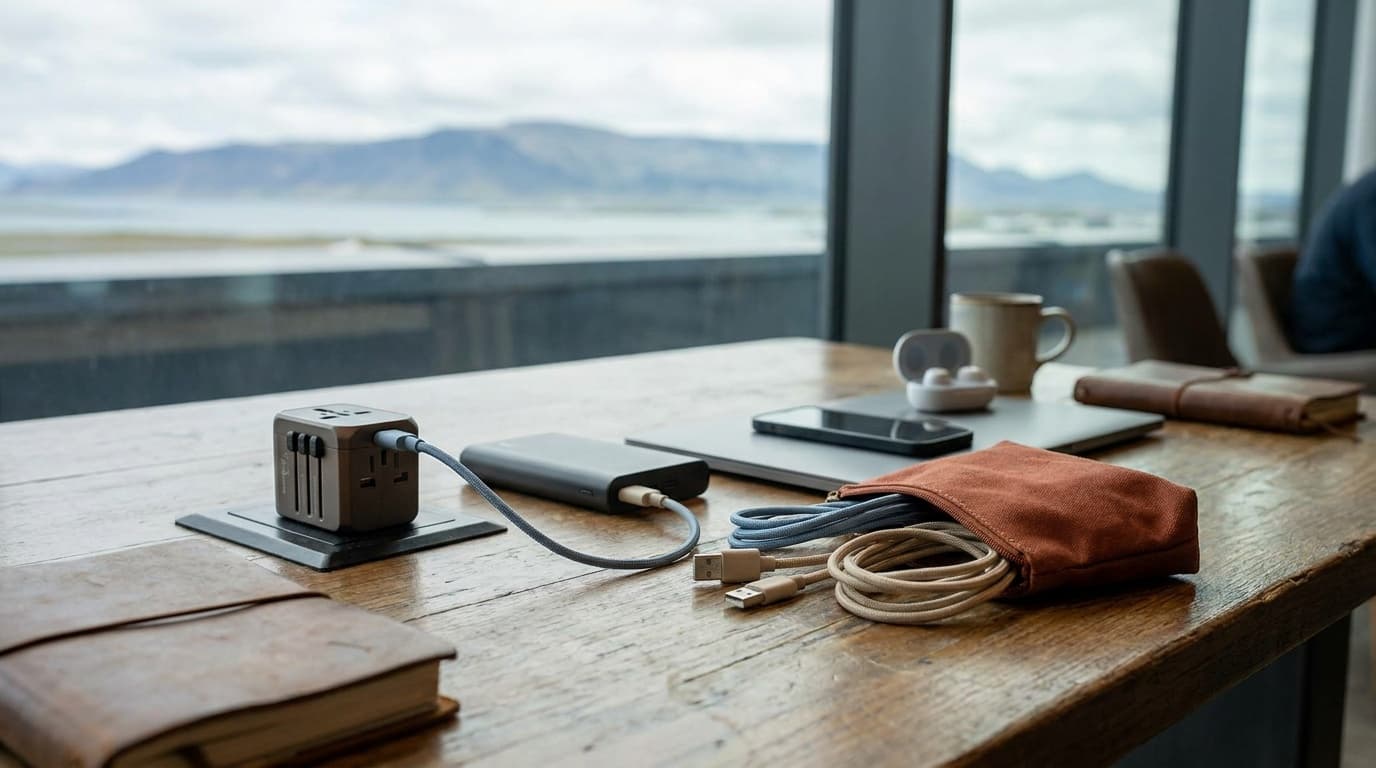
Most hotel rooms give you exactly one outlet in a useful location, and you are almost certainly traveling with more than one device that needs it.
The hotel-outlet problem is real
Budget and mid-range hotels in the US commonly provide two to four outlets total in the room, with one or two placed near the bed and the rest behind furniture or near the desk. International hotels are often worse: a single outlet near the bathroom mirror is not unusual in older European properties. When you are traveling with a phone, tablet, laptop, wireless earbuds, a smartwatch, and a camera battery, the math does not work.
High-end hotels have improved. Many newer rooms include USB-A and USB-C ports built into the nightstand or desk, which changes the calculation. Before you pack a strip, check recent reviews of your specific property on Google or TripAdvisor and look for outlet comments.
When a multi-port USB charger is enough
If your household charges phones, earbuds, a tablet, and a smartwatch, almost none of those require a full AC outlet anymore. A single 65W GaN charger with three or four USB-C ports handles that entire list from one wall socket. These chargers have gotten small enough to fit in a palm, weigh under 100 grams, and cost $25–$50.
The case for stopping here: fewer items to pack, no surge-protection complexity, and universal voltage (100–240V) is standard on quality GaN chargers, so one adapter tip is all you need internationally.
Where this breaks down: a CPAP machine, a laptop that will not charge over USB-C, a camera that charges only via its proprietary AC adapter, or hair tools. If any of those are in your bag, you need AC outlets, and a USB charger alone will not solve the problem.
The single-adapter-plus-domestic-strip trick
This is the approach most experienced travelers land on for international trips: bring one universal plug adapter like the EPICKA TA-105 (the kind with interchangeable tips for Type A, B, C, G, and so on) and a compact domestic-style power strip rated for 100–240V input.
The adapter converts the wall socket shape. The strip multiplies outlets. Because the strip itself is dual-voltage rated, it handles whatever voltage the wall delivers without a transformer. You end up with three to five AC outlets and sometimes built-in USB ports, all running through a single adapter.
How to set this up safely
Check strip voltage rating
The strip's spec label must read "100–240V input" before you plug it into anything outside North America.
Bring one universal adapter
A single quality adapter (not a cheap no-brand one) is all you need between the wall and the strip.
Plug the adapter into the wall
Seat it fully; a loose connection causes arcing on high-current draws like laptops.
Plug the strip into the adapter
Now every outlet on the strip is live at local voltage, correctly converted for your dual-voltage devices.
Verify each device
Confirm every device plugged into the strip is also dual-voltage rated, or use a voltage converter for the exceptions.
Surge protection abroad: honest caveats
Travel strips marketed with surge protection sound reassuring, but the practical limits are worth knowing before you rely on them.
Surge protectors work by clamping voltage spikes above a threshold (typically using MOVs, metal-oxide varistors). They absorb the surge energy and degrade over time. The protection rating, measured in joules, tells you how much total surge energy the strip can absorb across its life, not per event.
A 200-joule consumer strip that has already absorbed a few spikes on a developing-world grid may offer almost no protection the next time you plug in.
International grids in some regions produce more frequent and larger voltage fluctuations than North American grids. A low-joule consumer strip provides some protection for a phone charger; it is not an industrial UPS. For expensive gear like a mirrorless camera, a laptop, or medical equipment, the more reliable approach is using devices with robust internal power supplies and not leaving them plugged in unattended during electrical storms.
For domestic US travel, surge protection in a travel strip is a reasonable feature to have. Internationally, treat it as a minor bonus, not a primary safety layer.
What to actually pack based on your trip
The right choice depends on your device mix and destination.
For a solo domestic trip with mostly USB devices: a 65W GaN multi-port charger is enough, no strip needed.
For a couple or family on a US trip with a mix of AC and USB needs: a compact travel strip with two to three AC outlets and two to three USB ports, like the Anker PowerPort Strip PD 2 Mini, solves the problem cleanly.
For international travel: pair one universal plug adapter with a dual-voltage-rated compact strip such as the Ceptics Travel Power Strip PS-2U+. Confirm every device is dual-voltage before plugging it in directly. Leave the $10 no-name strip at home.
For international travel with a CPAP or other medical device: check the device's own voltage rating first. Many modern CPAPs are dual-voltage and need only an adapter. If not, a dedicated step-down transformer is the right tool, not a consumer strip.
Frequently asked questions
Can I bring a power strip on a plane?
Yes, with one important rule: the TSA requires that power strips be packed in carry-on baggage, not checked bags. Lithium battery-powered strips are subject to additional watt-hour limits; a standard corded strip with no internal battery is straightforward to carry on. Airlines may also restrict strips with surge protection circuitry on some routes, so check your specific carrier's policy if you are on an international flight.
Will my US power strip work in Europe?
Only if the strip itself is rated for 100–240V input, which most standard US power strips are not. A typical US strip is rated for 120V only. Plugging it into a 220–240V European outlet without a step-down transformer will damage or destroy the strip and potentially the devices plugged into it. Check the label before you travel, and if it says 120V only, leave it home and buy a dual-voltage travel strip instead.
How many outlets do I actually need for a family of four?
Count your devices before you pack, not after. A family of four commonly travels with 4 phones, 2 tablets, 2 laptops, 4 sets of earbuds or headphones, 2–4 smartwatches, and a camera or two. That is 14–18 charging needs for devices that mostly charge over USB-C or USB-A, but still require at least 2–4 AC outlets for laptops and camera chargers. A strip with 3 AC outlets and 3–4 USB ports, combined with a GaN multi-port charger for the remaining USB devices, typically handles the whole group from two wall sockets.
For specific picks, see our guide to the best travel power strips. Browse all travel guides or read how we research and rate gear.
Recommended gear
Our current top picks from the Best travel power strips 2026: compact charging for hotels guide, if you are ready to buy.
ANKER
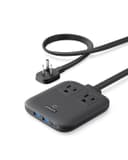
Anker Nano Charging Station (6-in-1, 67W)
Best Overall
Kit Score 8.8/10
$39.99 Price checked Oct 23, 4:16 PM CDT
Best for: Travelers who want one device that replaces the laptop charger and adds two outlets on any hotel nightstand.
- 67W USB-C charges a 13-inch or 14-inch laptop at full speed, so the laptop brick stays home
- Cord is not detachable, so it packs as one 13.7 oz piece
- AC outlets
- 2 (125V, 15A, 1,875W max)
- USB-C ports
- 2 (67W max single port; 45W + 20W when both in use)
- USB-A ports
- 2 (2.4A single; 15W shared)
- Cord length
- 5 ft (1.5 m), flat, not detachable
- Size and weight
- 3.94 x 3.66 x 0.75 in; 13.7 oz
- Input voltage
- 100 – 240V for the USB module; AC outlets rated 125V
About this pick
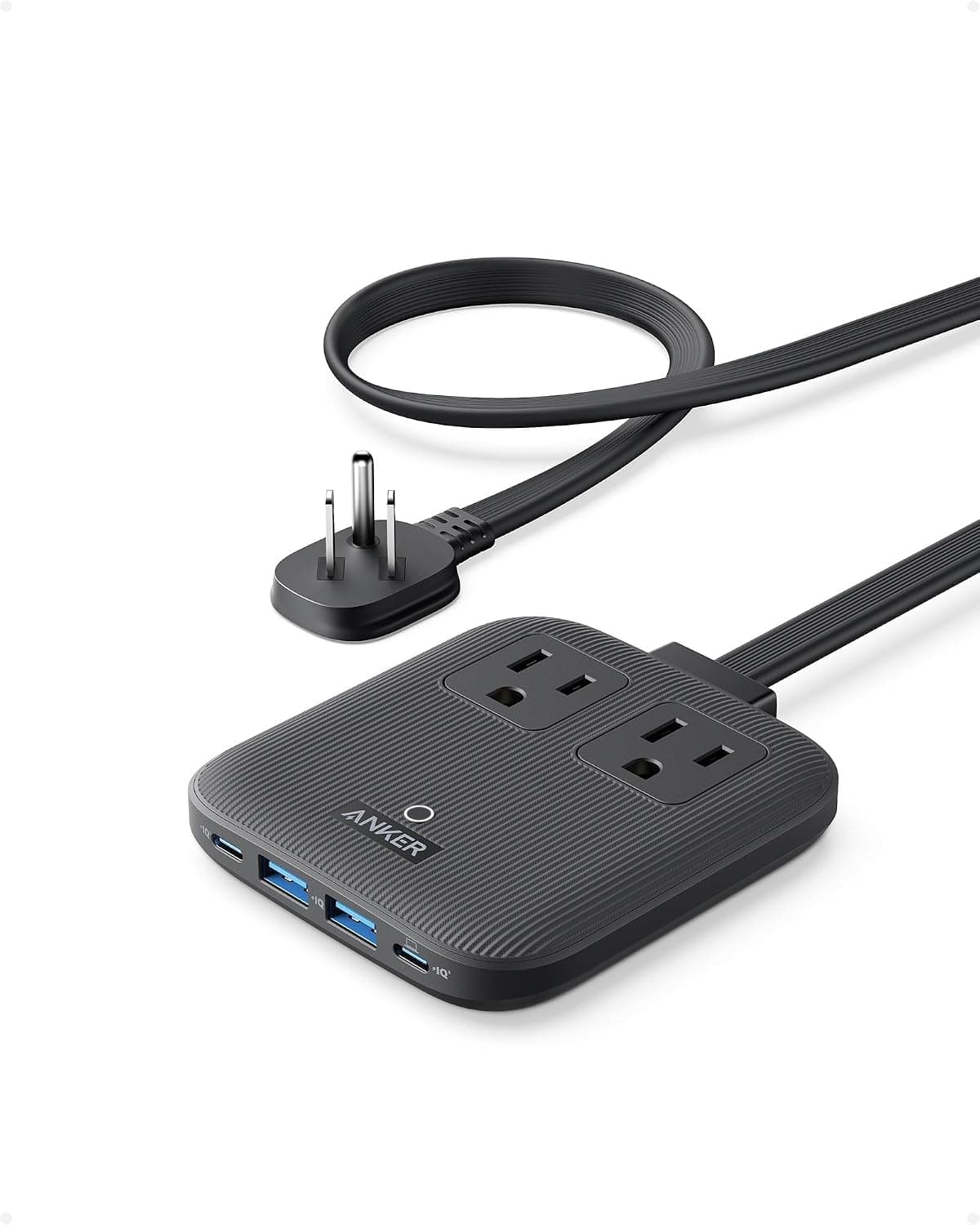
The Anker Nano Charging Station is the current version of Anker's travel power strip: two AC outlets, two USB-C ports with 67W Power Delivery on a single port, and two USB-A ports in a slab 0.75 in thick. The flat 0.35 in plug clears the neighbouring outlet, the 5 ft cord reaches across a hotel room, and the whole thing weighs 13.7 oz. It replaced the discontinued 615 GaNPrime as Anker's compact travel strip.
More specifications
- Surge protection
- None rated in joules (over-voltage, short-circuit, and ActiveShield 2.0 thermal protection)
Strengths
- 67W USB-C charges a 13-inch or 14-inch laptop at full speed, so the laptop brick stays home
- Flat plug and 0.75 in body fit behind hotel furniture where a boxy strip will not
- 5 ft cord reaches from the outlet behind the bed to the nightstand; the old 615 had 3 ft
Weaknesses
- Cord is not detachable, so it packs as one 13.7 oz piece
- No joule-rated surge protection; AC outlets are 125V-rated, so only plug dual-voltage bricks into them abroad
Kit Score breakdown
CEPTICS
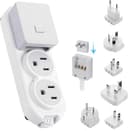
Ceptics Travel Power Strip PS-2U+
Editor's Choice
Kit Score 8.3/10
$34.99 Price checked Oct 23, 4:16 PM CDT
Best for: Frequent international travelers who want one device that adapts to any country's wall socket while keeping US outlets and USB ports available simultaneously.
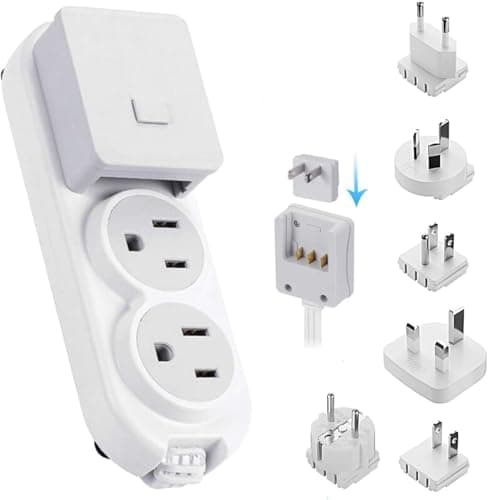
- Modular plug adapters for Europe, UK, Japan, Australia, and more snap on and off without tools, replacing a whole adapter kit
- Ceptics does not publish a joule rating, so the surge protection level cannot be compared directly to the Accell or Anker strips
- AC outlets
- 2 (US standard NEMA 5-15, grounded)
- USB-C port
- 1 (up to 2.1A)
- USB-A ports
- 1 (up to 2.1A)
- Surge protection
- Built-in (joule rating not published by Ceptics); ETL Listed, RoHS Compliant
- Input voltage
- 100 – 240V; max 1500W, 10A
- International plug coverage
- Interchangeable SWadAPt adapters for Type A (JP), Type B (US), Type C (EU), Type E/F, Type G (UK), Type I (AU)
About this pick
The Ceptics PS-2U+ packages two US-outlet sockets, one USB-C port, one USB-A port, built-in surge protection, and a modular international plug system into a sub-5-oz form factor. The swappable adapter heads cover more than 150 countries without a separate adapter pouch, and the 100 – 240V input handles any hotel grid voltage automatically.
More specifications
- Dimensions
- 5.35 x 2.0 x 1.0 in, under 5 oz
Strengths
- Modular plug adapters for Europe, UK, Japan, Australia, and more snap on and off without tools, replacing a whole adapter kit
- Built-in surge protection is confirmed in listing and the unit is ETL Listed and RoHS Compliant
- Under 5 oz and 5.35 inches long; fits in a jacket pocket with a travel pouch included
Weaknesses
- Ceptics does not publish a joule rating, so the surge protection level cannot be compared directly to the Accell or Anker strips
- No cord: the strip plugs directly into the wall, so it does not extend reach to a distant outlet across the room
- Only one USB-A port (listing description: '1 USB inputs'); candidate data overstated this as two
Kit Score breakdown
See all picks in Best travel power strips 2026: compact charging for hotels
Keep going


Researched, not hands-on tested
Updated Jun 4, 2026Our recommendations draw on manufacturer documentation, retailer listings, owner feedback, and comparisons with alternatives.
As an Amazon Associate I earn from qualifying purchases. We may earn a commission from links here, at no extra cost to you. How we research →