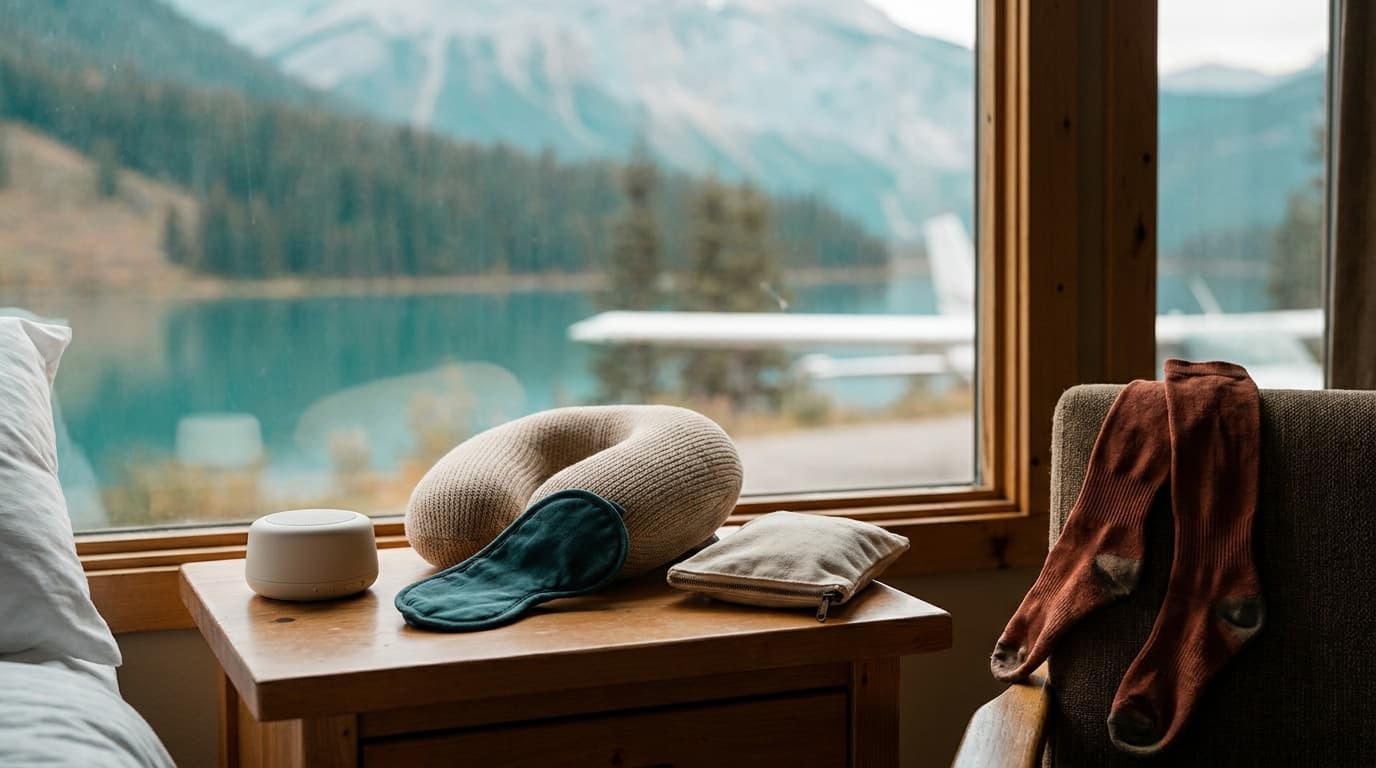
A noisy hotel room, a snoring roommate, or street traffic at 3 a.m. can unravel an otherwise perfect trip. White noise machines work on a simple, well-supported principle: a constant, steady sound raises the acoustic floor of the room so that sudden spikes, a slamming door, a car horn, no longer jolt you awake.
How white noise actually masks disruptive sounds
The mechanism is psychoacoustic, not magical. Your brain does not respond uniformly to sound level; it responds to change. A sudden noise that is 20 dB louder than the ambient floor is far more arousing than the same sound heard against a background that is already 15 dB louder. White noise raises that background floor consistently across the frequency spectrum, shrinking the perceptible contrast of any intrusion.
This is sometimes called the signal-to-noise ratio of sleep. A door slam at 70 dB against a 30 dB quiet room is a 40 dB spike. The same slam against a 50 dB white noise background is only a 20 dB spike. Your auditory cortex keeps monitoring for threats even during deep sleep; a smaller relative jump is less likely to cross the arousal threshold.
What the evidence actually shows
The research base is real but modest. A 2021 systematic review published in Sleep Medicine Reviews examined multiple randomized and observational studies and found consistent (though not dramatic) improvements in sleep-onset latency and wakeup frequency when white or broadband noise was present, particularly in noisy environments like hospitals and urban settings.
A widely cited 1990 study in a neonatal ICU found infants fell asleep significantly faster with white noise compared to silence. Studies in adult ICU patients, college students, and shift workers show similar directional results. The effect size is typically modest (shaving 10–15 minutes off sleep onset, reducing arousals by a measurable but not transformative margin), but in the context of a difficult sleep environment on the road, modest and real is worth having.
The evidence is not that white noise creates deep sleep; it is that it removes a specific obstacle to sleep that noise-disrupted environments create.
White vs pink vs brown noise: does the color matter
These terms describe the frequency distribution of the sound:
Noise colors explained
White noise
Equal energy at every frequency; sounds hiss-like, similar to a detuned radio
Pink noise
Energy weighted toward lower frequencies; sounds fuller and more natural, like steady rain
Brown noise
Even more low-frequency emphasis; sounds like a rumble or strong wind
Nature sounds
Not a single color but often approximate pink noise; rivers and rain skew lower-frequency
For masking purposes, all three cover the frequency range of common disruptors (speech, footsteps, traffic). The practical difference is subjective comfort. Many people find white noise fatiguing over a full night and tolerate pink or brown noise better. A few small studies suggest pink noise may have a slight edge for sleep quality, possibly because its spectrum more closely matches natural ambient sounds humans evolved alongside, but the evidence is preliminary. The actionable takeaway: try brown or pink first if white noise has ever felt grating to you.
Volume safety, especially for babies and children
The single most important parameter is volume, and this is where careless use creates real risk. The American Academy of Pediatrics recommends keeping infant sleep environments below 50 dB. A 2014 study in Pediatrics tested 14 infant white noise machines and found all 14 exceeded 50 dB at 30 cm; three exceeded 85 dB. The risk is not immediate hearing damage from a single night but cumulative exposure and potential interference with auditory cortex development.
For adults traveling, keeping a device across the room rather than on the nightstand is the right default. Most travel machines, like the Yogasleep Hushh 2, top out around 75–80 dB at maximum; at 1–2 meters, that drops to a comfortable and safe range.
Dependency concerns and who benefits most
A common worry is that using white noise regularly creates a dependency that makes sleeping without it harder. The concern is not without basis: conditioned sleep associations are real, and some users do report difficulty sleeping in quiet environments after months of regular use. The practical risk on a trip is low, since you can simply not bring the device when you want to reset.
The people who benefit most are specific and predictable:
- Light sleepers in noisy urban hotels or guesthouses
- Parents of infants sharing a room while traveling
- Shift workers or travelers dealing with significant jet lag and disrupted circadian timing
- Anyone whose sleep environment features irregular, unpredictable noise (traffic, thin walls, air conditioning cycling)
If you sleep deeply through most disruptions already, a white noise machine is solving a problem you do not have. If hotel noise is a recurring issue on your trips, a palm-size unit like the LectroFan Micro2 is one of the better value-to-weight additions to your kit.
Frequently asked questions
Can I use a white noise app on my phone instead of a dedicated machine?
Yes, and for occasional use a phone works fine. The practical limitations are battery drain overnight, notifications or calls interrupting playback, and speaker quality (phone speakers often lack the low-frequency output that makes pink and brown noise effective). A dedicated device solves all three and typically costs under $30 for a travel model.
Is white noise safe to use every night long-term?
For adults at reasonable volumes (below 65 dB at ear level), current evidence does not identify a hearing risk from nightly use. The main documented concern is the conditioned-dependency effect described above. If you want to avoid dependency, use it situationally (noisy environments only) rather than as a nightly default at home.
Will TSA flag a white noise machine at airport security?
No. White noise machines are standard consumer electronics and go through the X-ray belt like any other small device. You do not need to remove them separately (unlike laptops in many lines). Battery-powered and USB-powered models are both carry-on friendly.
For specific picks across price points and form factors, see our guide to the best portable white noise machines. Browse all travel guides or read how we research and rate gear.
Recommended gear
Our current top picks from the Best portable white noise machines: 4 travel sound machines compared guide, if you are ready to buy.
ADAPTIVE SOUND TECHNOLOGIES
LectroFan Micro2 Portable White Noise Machine and Bluetooth Speaker
Best Overall
Kit Score 8.8/10
$54.95 Price checked Oct 23, 4:16 PM CDT
Best for: Solo travelers, backpackers, and light sleepers who need the smallest possible machine with the longest battery run time.
- Rated for up to 40 hours as a sound machine, the longest in this group
- No auto-off sleep timer, which some travelers rely on for battery conservation
- Battery life
- Up to 40 hours (white noise), 20 hours (Bluetooth)
- Sounds
- 11 non-looping (4 white noise, 5 fan, 2 ocean)
- Weight
- Not published; independent reviews report about 6 oz
- Dimensions
- 2 x 2 x 2.1 inches
- Charging
- USB, cable and carry case included
- Timer
- None
About this pick
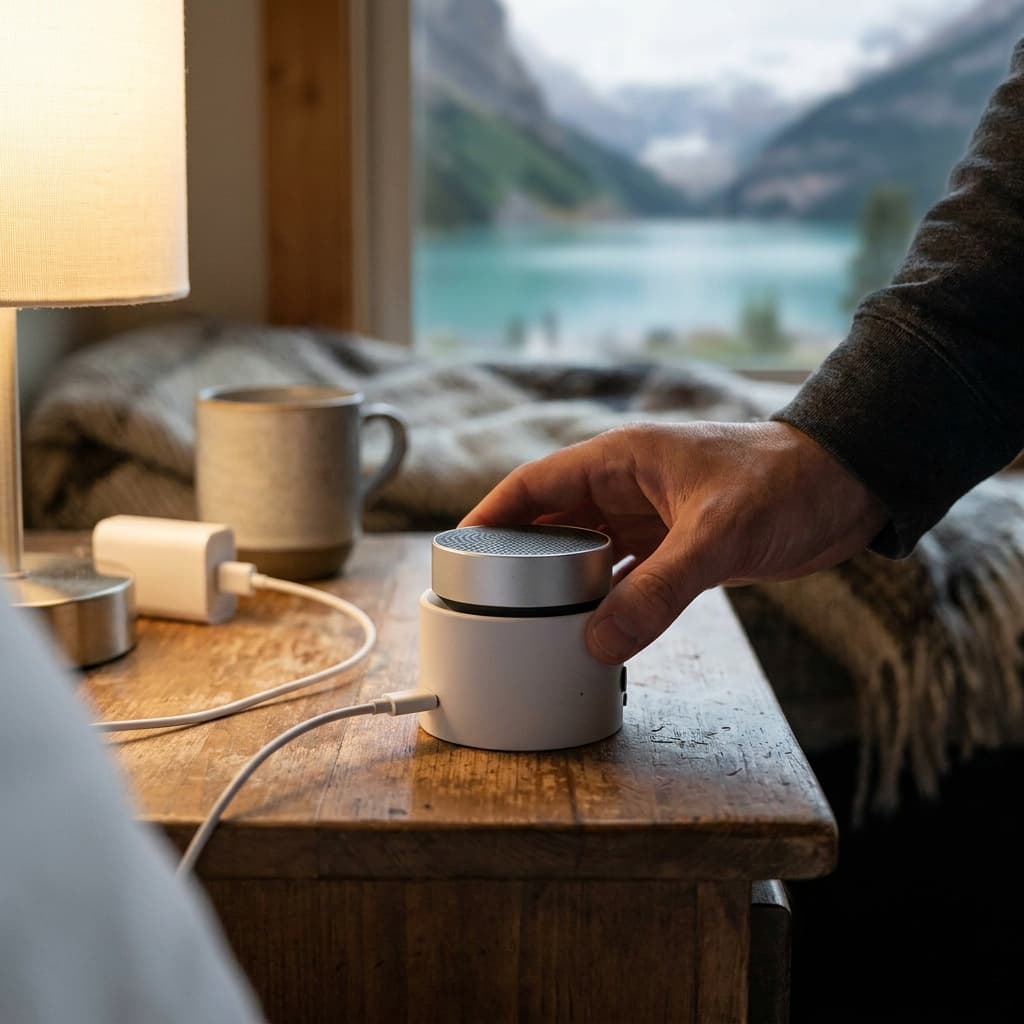
The Micro2 packs 11 digitally generated, non-looping sounds into a 2-inch cube (Adaptive Sound does not publish a weight; independent reviews put it near 6 oz), making it the go-to compact machine for hikers, frequent fliers, and anyone who counts every gram. It doubles as a Bluetooth speaker, so it earns its carry weight twice over.
Strengths
- Rated for up to 40 hours as a sound machine, the longest in this group
- Digitally generated sounds mean zero audible loops, unlike recorded-sample machines
- Tiny footprint fits any kit bag or carry-on pocket
Weaknesses
- No auto-off sleep timer, which some travelers rely on for battery conservation
- Limited bass means it cannot fully mask low-frequency city traffic or footsteps from upstairs neighbors
Kit Score breakdown
DREAMEGG
Dreamegg D11 Max Portable White Noise Machine
Best Value
Kit Score 8.8/10
$20.99 Price checked Oct 23, 4:16 PM CDT
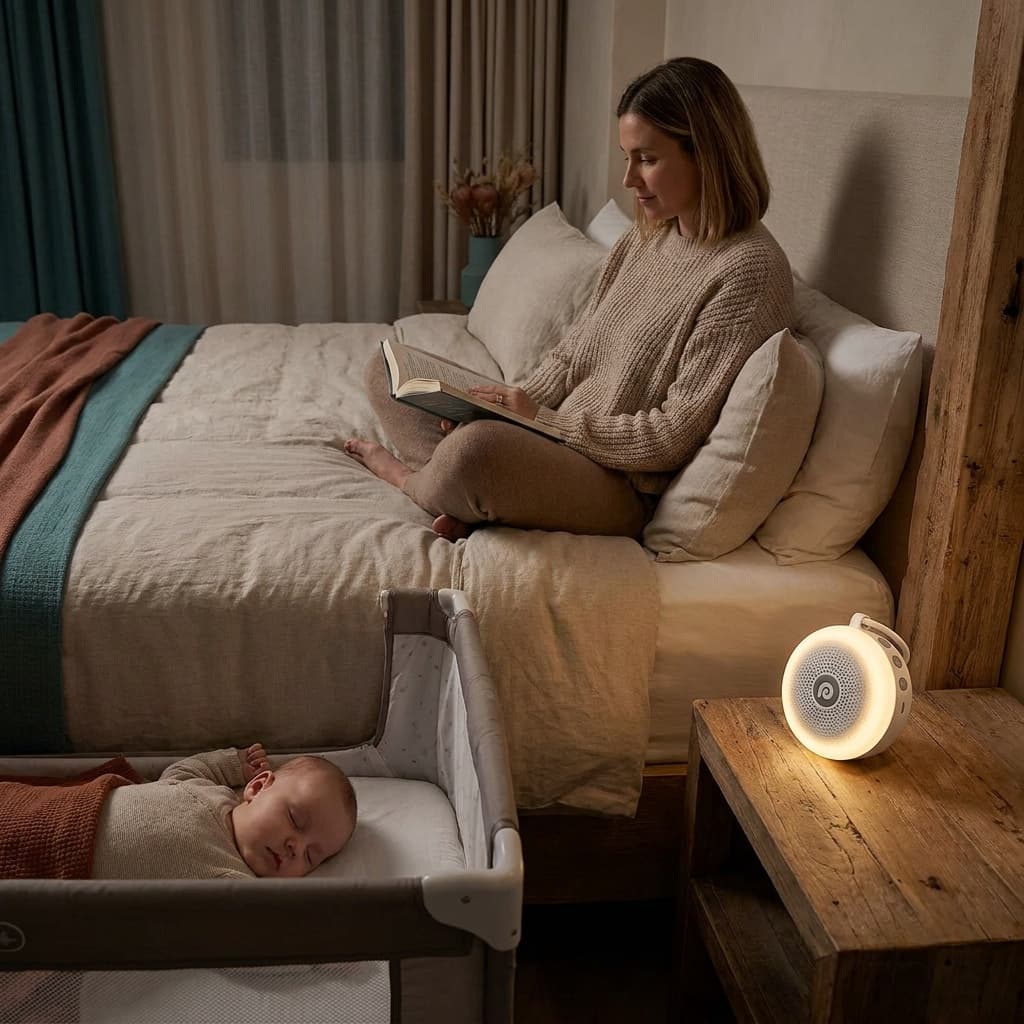
Best for: Families traveling with babies or toddlers who need powerful, bass-rich white noise and do not mind the extra weight.
- Owners describe the bass-forward white noise as enough to cover hotel hallway noise and outdoor traffic
- Heavier and bulkier than ultra-compact options like the Micro2
- Battery life
- 1800 mAh; no hour rating published (owners report a full night at medium volume)
- Sounds
- 21 (white noise, fan, nature, lullabies)
- Weight
- 10.2 oz (290 g)
- Dimensions
- 4 x 3.7 x 1.8 inches
- Timer
- 30, 60, 90 minutes, or continuous
- Memory
- Remembers last sound, volume, and timer setting
About this pick
The D11 Max delivers noticeably bass-rich white noise (Dreamegg publishes no decibel rating), with 21 sounds, a child lock, and a built-in memory function that recalls your settings between charges. It rides the sweet spot between sound quality and price for families who travel with young children.
Strengths
- Owners describe the bass-forward white noise as enough to cover hotel hallway noise and outdoor traffic
- Memory function retains sound and volume between uses, unlike most budget machines
- USB-C charging, clip, and lanyard included for stroller or bag attachment
Weaknesses
- Heavier and bulkier than ultra-compact options like the Micro2
- Bright LED status light requires covering in a dark room
Kit Score breakdown
YOGASLEEP
Yogasleep Hushh 2 Portable Sound Machine
Editor's Choice
Kit Score 8.8/10
$29.98 Price checked Oct 23, 4:16 PM CDT
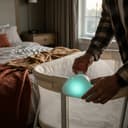
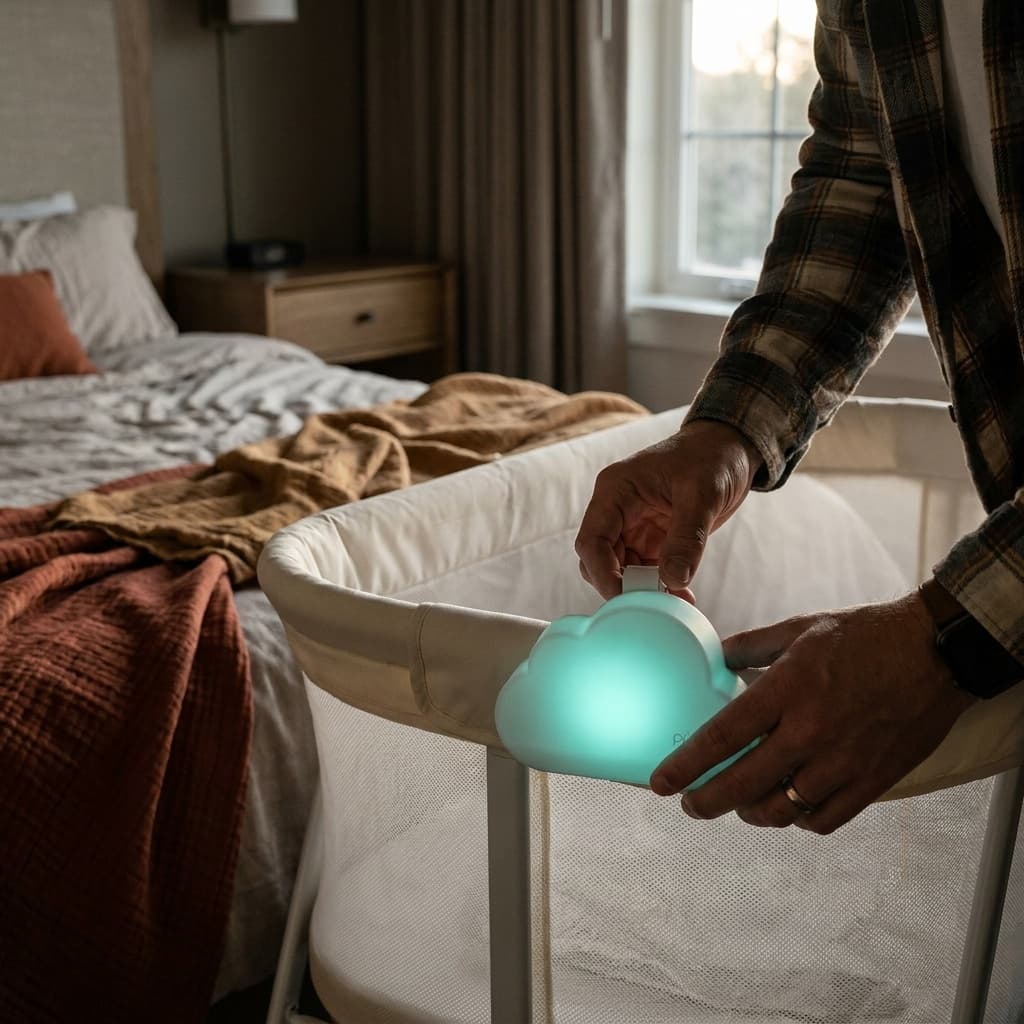
Best for: Parents traveling with infants or toddlers who want a trusted brand, a night light, and a machine that handles rough diaper-bag treatment.
- 33-hour rated battery in a 5.6 oz body strikes the best balance of longevity and portability in this group
- Only 6 sounds, so adults who want a broad library of fan types or nature options will find it limiting
- Battery life
- Up to 33 hours per charge
- Sounds
- 6 (signature Dohm fan sound, white noise, nature, melodies)
- Weight
- 5.6 oz (159 g)
- Dimensions
- 1.34 x 3.39 x 4.02 inches
- Timer
- 30, 60, or 120 minutes
- Extras
- Dimmable night light, backlit buttons, reinforced clip, toddler lock
About this pick
The Hushh 2 is the updated version of one of the most-trusted portable machines in the Yogasleep line, adding a reinforced clip, backlit buttons, a dimmable night light, USB-C charging, and a doubled sound library over the original. Yogasleep lists it as HSA/FSA eligible.
Strengths
- 33-hour rated battery in a 5.6 oz body strikes the best balance of longevity and portability in this group
- Backlit buttons and dimmable night light are genuinely useful for middle-of-the-night adjustments without waking a baby
- Reinforced clip, wipe-clean body, and toddler lock suit daily parent-and-baby travel
Weaknesses
- Only 6 sounds, so adults who want a broad library of fan types or nature options will find it limiting
- Wall adapter not included; USB-C cable only, and Yogasleep asks you to use that cable
Kit Score breakdown
See all picks in Best portable white noise machines: 4 travel sound machines compared
Keep going
Complete loadoutLong-flight comfort kitFive packable pieces for neck support, darkness, quieter cabins, leg comfort, and more consistent sleep away from home.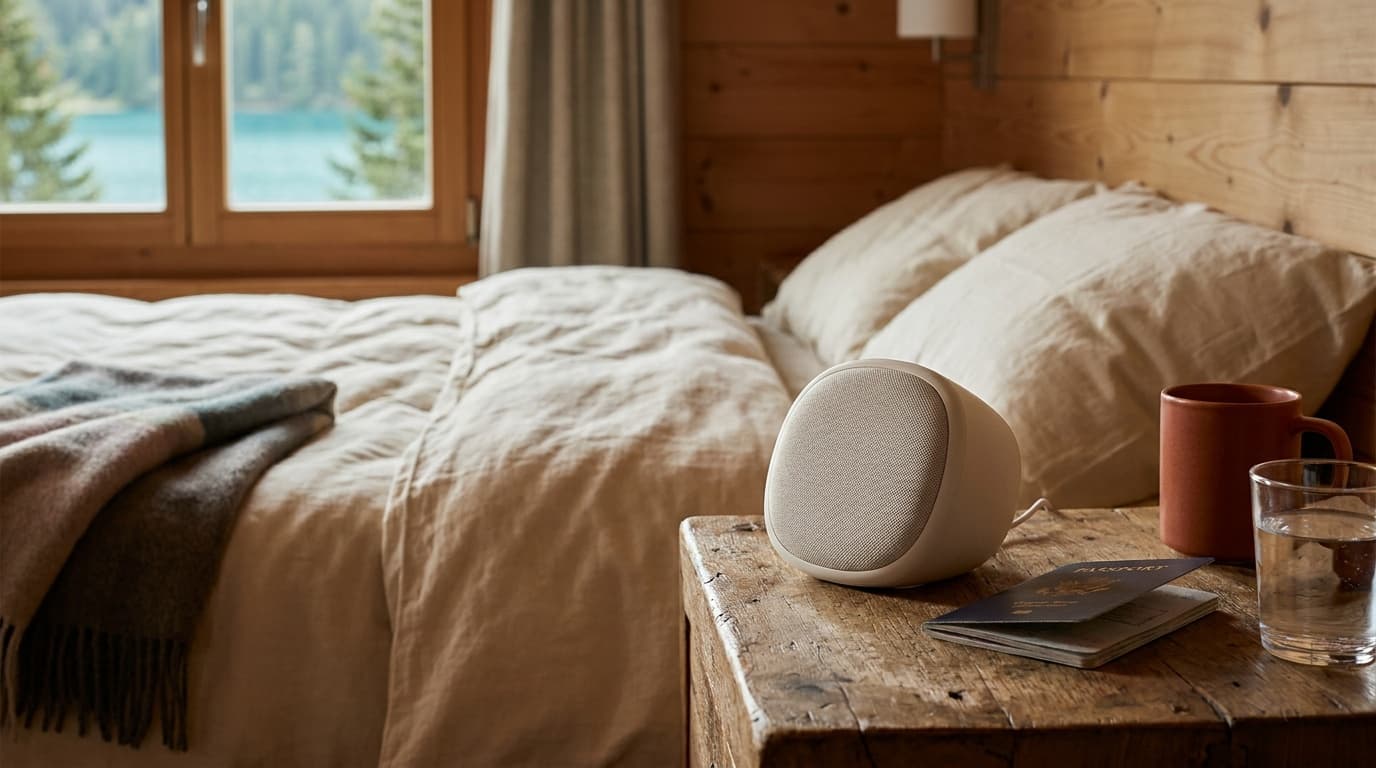
Researched, not hands-on tested
Updated Jun 5, 2026Our recommendations draw on manufacturer documentation, retailer listings, owner feedback, and comparisons with alternatives.
As an Amazon Associate I earn from qualifying purchases. We may earn a commission from links here, at no extra cost to you. How we research →