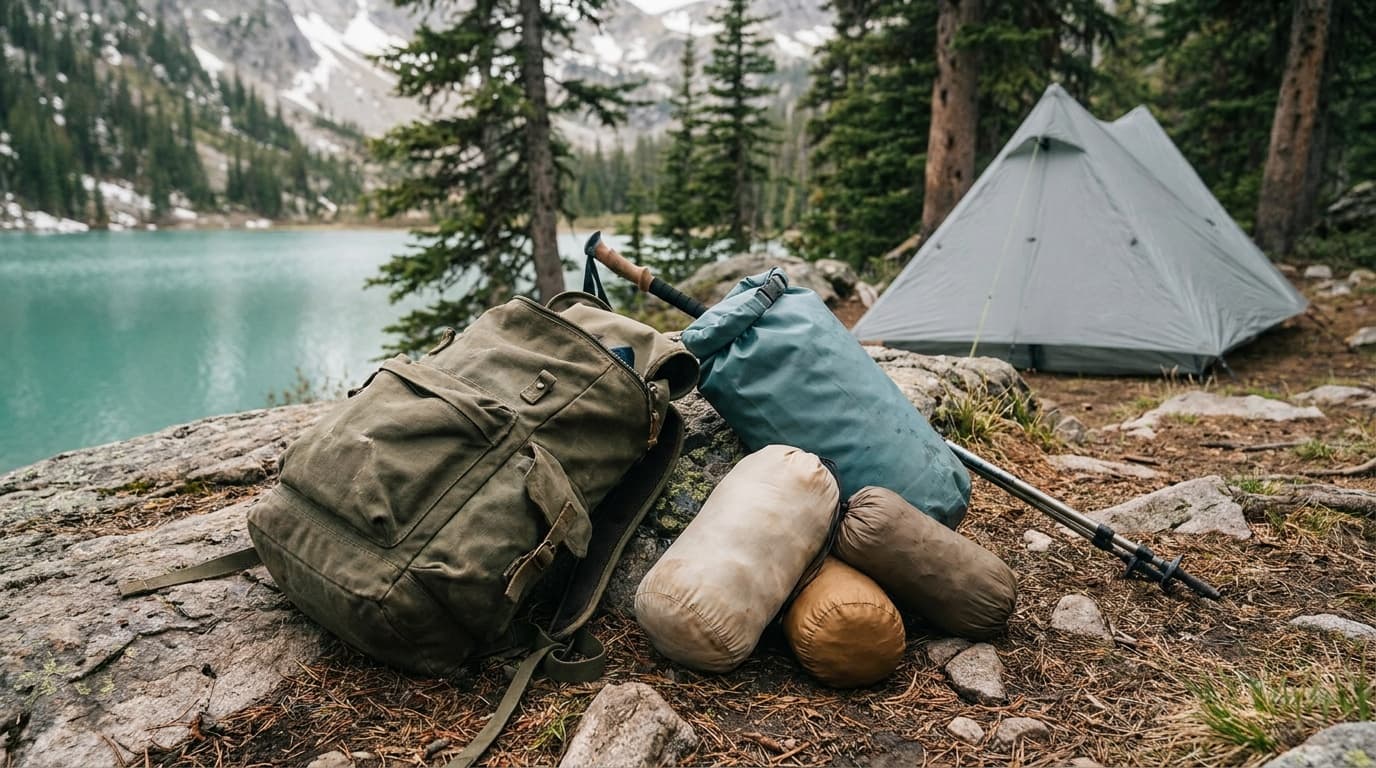
Pick the wrong size and you either can't close the bag or carry dead air for miles. Dry bag sizing is straightforward once you know which category each item falls into.
How roll-top closures reduce usable volume
Every roll-top dry bag requires three to four full rolls before the buckle clips. Those folds eat into the top 10–20 cm of the bag. On a 10L bag that typically translates to 1.5–2L of unusable space. On a 5L bag the loss is proportionally larger: you may only get 3.5L of practical capacity.
The fix is simple: when an item is borderline, go one size up. A sleeping bag that just barely fits a 20L bag will fight you every morning. A 25L bag gives you working room and a proper seal.
Sizing by use case
2–5L (small valuables): A 2L bag fits a phone, a folded bandana, and a small wallet with room to seal. A 5L bag handles a point-and-shoot camera, a passport wallet, and a headlamp. These small bags are also where quality matters most: look for welded seams rather than glued seams at this size.
10–20L (clothing): A synthetic mid-layer and a base-layer top fit comfortably in a 10L bag. A full set of camp clothes (top, bottom, socks, underwear) fits in 15L with a clean seal. If you're packing a rain jacket alongside other soft layers, step up to 20L.
20–35L (sleeping bag): Most three-season down bags (rated 15°F to 32°F) compress into the 20–25L range. A bulkier synthetic bag in the same temperature range needs 30–35L. Check your bag's packed size before you buy a dry bag for it; manufacturers list this dimension on the product page.
35L+ (pack liner): A 35–45L roll-top dry bag like the Sea to Summit Lightweight Dry Bag 35L used as a pack liner protects everything inside your main pack. It is not a stuff sack for one item; it is a waterproof envelope for the whole load. Size it to match your pack's main compartment, not to the brim.
Kayaking vs backpacking: different priorities
Sizing approach by activity
Kayaking day hatch
One 20–30L bag like the [Earth Pak Waterproof Dry Bag 20L](/api/go?product=earth-pak-original-20l&retailer=amazon&article=what-size-dry-bag-do-i-need) for clothes and one 5L for valuables; hatch volume is the constraint
Kayaking multi-day
10L + 20L + 5L system fills a stern hatch without dead space or compression fights
Backpacking (UL)
One 35–45L liner replaces individual bags; saves weight and keeps the pack organized
Backpacking (standard)
Liner plus a 2–5L valuables bag; the liner handles bulk, the small bag stays accessible
Raft support
55–65L rolltop duffels; designed for this, not oversized backpacking bags
Kayakers face a hard volume ceiling. A sea kayak day hatch is typically 50–80L total, and you share that space with safety gear. Oversized bags mean wasted air pockets that shift in following seas. Backpackers face a weight ceiling instead: extra dry bag material adds up, which is why a single liner is often the smarter call for multi-day trips.
In a kayak, dead air is dead weight; in a pack, too many small bags become a sorting puzzle at camp.
The multi-bag organization system
Using one giant bag for everything creates a problem: you have to unpack to find anything. A three-bag system solves this without adding meaningful weight.
- Sleeping bag in its own 20–35L bag. It goes in last, at the bottom of the pack or in the stern hatch, and you don't dig through it until camp.
- Clothing in a 10–20L bag. Mid-pack or in the bow hatch. You reach this once at camp, not throughout the day.
- Valuables and navigation in a 2–5L bag. Top of the pack or a hip belt pocket. You reach this constantly.
This system means the bag you open most often is the smallest and lightest. It also means a hatch flood or a river swim compromises at most one category of gear.
Frequently asked questions
Can I use a dry bag as a stuff sack for my sleeping bag to save weight?
Yes, and many backpackers do exactly this. A 25–30L roll-top dry bag adds roughly 60–90 grams compared to a mesh stuff sack, but it replaces a separate waterproof bag you would otherwise need. The trade-off makes sense on any route with significant rain or stream crossings. Just confirm the compressed size of your sleeping bag before buying the dry bag.
What size dry bag fits a 15-inch laptop?
A 15-inch laptop (roughly 34 cm x 24 cm x 2 cm) fits in a 10L dry bag with a snug roll. If you also need to pack the charger or a small notebook alongside it, use a 13–15L bag. Laptop-specific dry bags exist with padded interiors; they are worth the extra few dollars for anything you're actually depending on.
Do dry bag sizes vary by brand?
The liter rating is consistent across brands (it reflects water displacement volume), but the shape varies significantly. Two 10L bags can have very different openings and aspect ratios. A tall, narrow 10L bag is better for a rain jacket; a short, wide 10L bag fits a camera kit more naturally. Check the dimensions (height and diameter when open) on the product listing, not just the liter number.
For specific picks, see our guide to the best dry bags. Browse all hike guides or read how we research and rate gear.
Recommended gear
Our current top picks from the Best dry bags for hiking, kayaking, and travel (2026) guide, if you are ready to buy.
EARTH PAK
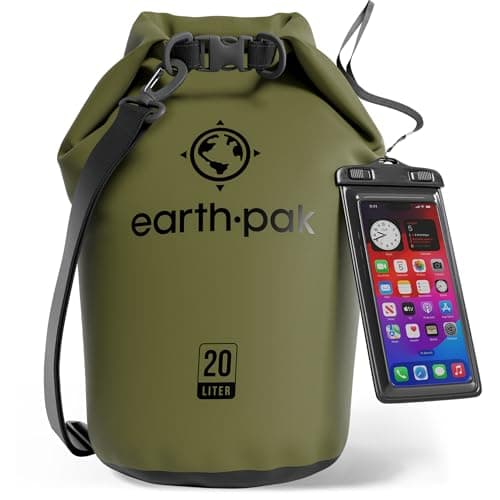
Earth Pak Waterproof Dry Bag 20L
Best Budget
Kit Score 7.4/10
$24.69 Price checked Oct 23, 6:22 AM CDT
Best for: Casual paddlers, beach days, and festival-goers who need reliable splash protection without spending more than $25.
- Available in multiple colors and sizes from 5L to 55L, with a transparent option so you can see contents without opening
- IPX6 rating means it handles heavy splashes but is not rated for prolonged submersion
- Volume
- 20L
- Material
- 500D PVC
- Closure
- Roll-top
- Waterproof rating
- IPX6
- Carry
- Single shoulder/crossbody strap
- Warranty
- 5 years
About this pick
The Earth Pak Original is a no-frills 500D PVC roll-top sack that keeps gear splash-proof and float-ready at a price well under $25. It ships with a bonus IPX8 phone pouch, making it a practical first dry bag for kayak day trips, beach outings, and festival weekends.
Strengths
- Available in multiple colors and sizes from 5L to 55L, with a transparent option so you can see contents without opening
- Includes IPX8 phone pouch that fits phones up to 6.5 inches
- Over 32,000 owner reviews with a strong value reputation and a 5-year warranty
Weaknesses
- IPX6 rating means it handles heavy splashes but is not rated for prolonged submersion
- Shoulder strap becomes uncomfortable under heavier loads or on long carries
Kit Score breakdown
SEA TO SUMMIT
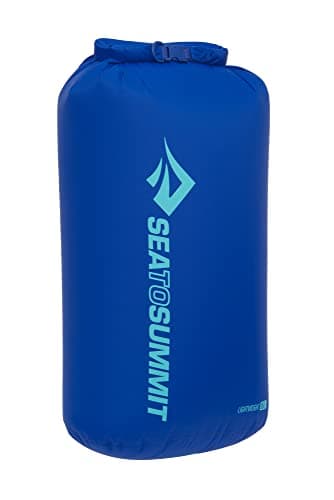
Sea to Summit Lightweight Dry Bag 35L
Editor's Choice
Kit Score 8.0/10
$36.75 Price checked Oct 23, 6:22 AM CDT
Best for: Backpackers, packrafters, and paddlers who prioritize weight savings and want a versatile dry bag that doubles as a stuff sack or travel organizer.
- Ultralight at 5.8 oz for 35L, making it practical for backpacking, packrafting, and travel where grams add up
- 70D nylon is significantly less abrasion-resistant than 1000D vinyl or TPU-coated fabrics; avoid dragging across rough surfaces
- Volume
- 35L
- Material
- Recycled 70D nylon, PU-coated
- Closure
- Roll-top, tape-sealed seams
- Weight
- 5.8 oz
- Interior
- White lining for visibility
- DWR finish
- PFC-free, bluesign approved
About this pick
Sea to Summit's Lightweight Dry Bag uses recycled 70D nylon with a PU coating and tape-sealed seams to deliver reliable IPX7-equivalent waterproofing at roughly one-third the weight of PVC alternatives. The white interior makes it easy to locate gear at dusk or inside a dark cockpit, and seven size options let you build a matched system.
Strengths
- Ultralight at 5.8 oz for 35L, making it practical for backpacking, packrafting, and travel where grams add up
- White interior lining improves visibility and helps locate items quickly in low light
- bluesign-approved recycled fabric and PFC-free DWR are a lower-impact choice than conventional PVC
Weaknesses
- 70D nylon is significantly less abrasion-resistant than 1000D vinyl or TPU-coated fabrics; avoid dragging across rough surfaces
- Not rated for prolonged submersion; best treated as splash-proof and rain-proof rather than truly submersible
Kit Score breakdown

YETI
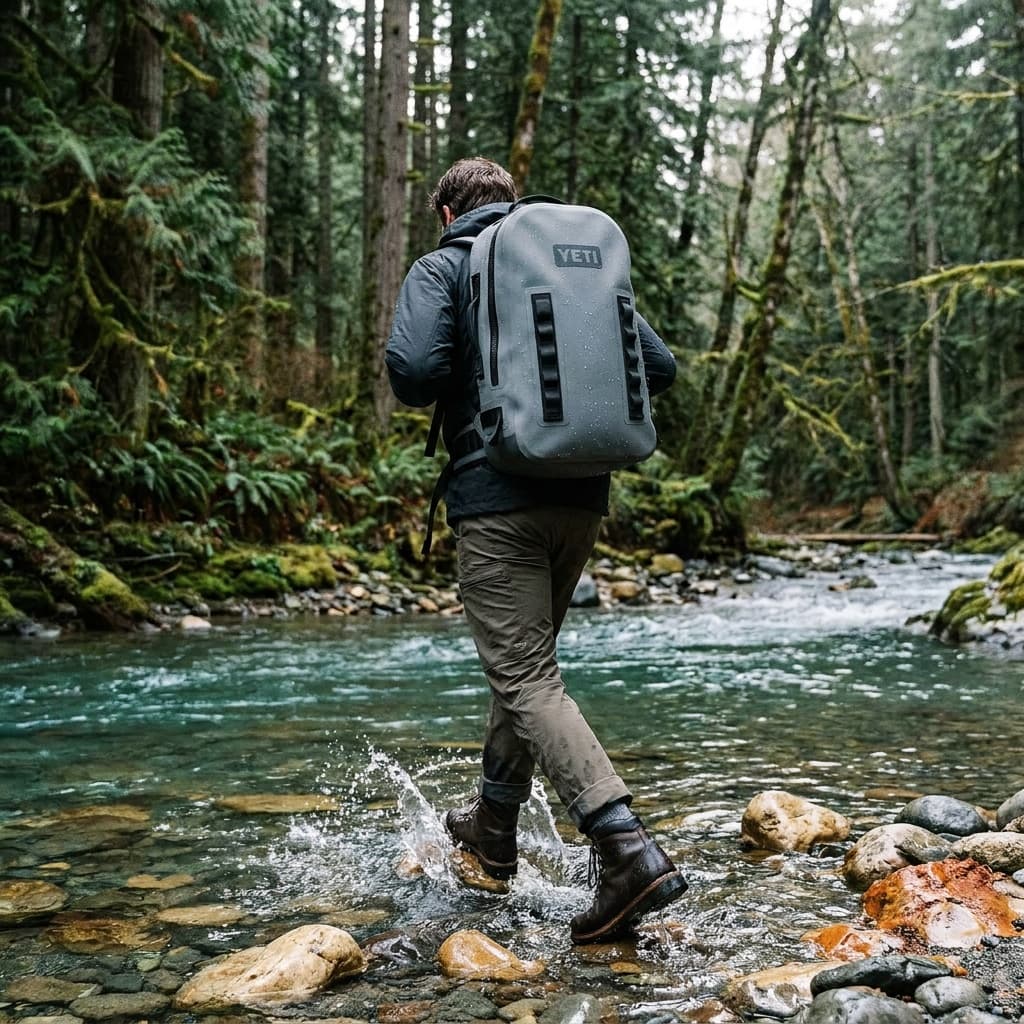
YETI Panga 28 Airtight Waterproof Backpack
Best Premium
Kit Score 9.0/10
$325.00 Price checked Oct 23, 6:22 AM CDT
Best for: Photographers, fly fishers, and sea kayakers who carry expensive electronics in wet environments and need verified submersion protection rather than splash resistance.
- Fully airtight and submersible construction: RF-welded seams and HydroLok zipper confirmed watertight at 1 m depth for 30 minutes
- At 3.9 lbs and $300+, it is heavy and expensive compared to roll-top dry bags; overkill for casual splashing
- Volume
- 28L
- Material
- High-density nylon, TPU laminated (ThickSkin Shell)
- Closure
- HydroLok waterproof zipper
- Weight
- 3.9 lbs (62.4 oz)
- Dimensions
- 19.7 x 12.5 x 7 in
- Submersion rating
- 30 min at 1 m depth
About this pick
The YETI Panga 28 is an airtight, submersible backpack built from TPU-laminated high-density nylon with RF-welded seams and YETI's HydroLok zipper. It is rated to one meter for 30 minutes and scored 96/100 at OutdoorGearLab, where reviewers confirmed zero water infiltration across all conditions. It is the go-to choice when electronics, cameras, or critical gear cannot get wet under any circumstances.
Strengths
- Fully airtight and submersible construction: RF-welded seams and HydroLok zipper confirmed watertight at 1 m depth for 30 minutes
- Ergonomic DryHaul shoulder straps with removable chest strap and waist belt provide genuine comfort for a waterproof pack
- 96/100 from OutdoorGearLab and a 4.7-star average on REI across hundreds of reviews, making it one of the most trusted waterproof packs available
Weaknesses
- At 3.9 lbs and $300+, it is heavy and expensive compared to roll-top dry bags; overkill for casual splashing
- Rigid shape and minimal internal organization limit packing flexibility; harness can feel bulky on smaller-framed users
Kit Score breakdown
See all picks in Best dry bags for hiking, kayaking, and travel (2026)
Keep going
Related guides
 Complete hike loadoutDay hike kitBuild the complete kit
Researched, not hands-on tested
Updated Jun 4, 2026Our recommendations draw on manufacturer documentation, retailer listings, owner feedback, and comparisons with alternatives.
As an Amazon Associate I earn from qualifying purchases. We may earn a commission from links here, at no extra cost to you. How we research →