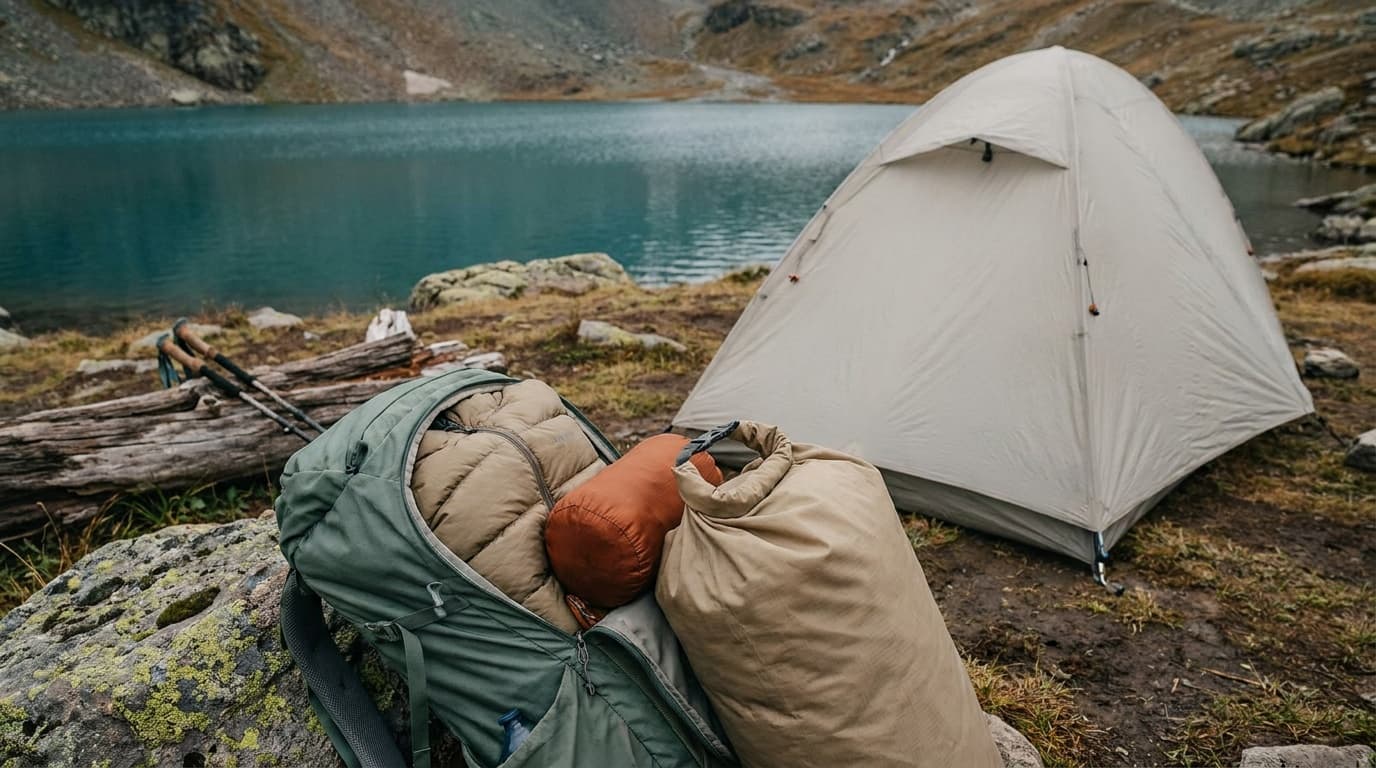
A dry bag is only as waterproof as your technique: even a bomber welded-seam bag leaks if you fold it twice and clip it loosely. Here is how to do it right.
The roll-top closure: do it in four steps
The roll-top is the only moving part on a dry bag, and getting it right takes about ten seconds.
How to seal a roll-top dry bag
Flatten the top
Pinch the opening flat so both walls touch, removing any gaps or puckers along the seam.
Purge the air
Starting from the bottom of the bag, squeeze or roll upward to push air out before you start folding.
Roll three to four times
Fold the flattened top over itself at least three full rotations. Each fold adds a barrier. Two folds is the minimum; four is better for river crossings or heavy rain.
Clip the buckle
Bring the two side tabs together and snap the sternum-style buckle. The clip keeps the roll from unwinding, it is not the seal itself.
The most common mistake is treating the buckle clip as the waterproofing. The clip just holds the roll in place. The seal is the roll.
Air: purge it or keep it?
For most situations, purge as much air as you can before rolling. Less air means the bag compresses tighter against your gear, the top roll holds more firmly, and the bag fits better inside a pack.
The exception is flotation: if your dry bag is serving as a float for a packraft, a canoe thwart bag, or a swimmer's kit, leave a full air cushion. A bag with trapped air becomes a buoy. For those uses, seal with minimal purging and the air acts as insurance if the bag goes overboard.
For backpacking and kayaking day use where you are stuffing the bag into a pack, always purge.
The roll is the seal; the buckle just keeps it honest.
What belongs inside a dry bag
Prioritize by consequence of getting wet:
- Sleep system. A wet sleeping bag on a cold night is a genuine safety problem. A 5-liter dry bag around a compressible down bag is standard practice on any river trip or wet-weather thru-hike.
- Electronics and documents. Phone, GPS unit, emergency beacon, permits, and cash go in first, ideally in their own small inner bag.
- Insulating layers. A wet puffy jacket loses nearly all its insulating value. Pack it before you need it.
- Dry clothes to sleep in. Even on dry trips, a bag of clean sleep clothes you have never worn during the day is a comfort and safety margin.
Leave things that do not mind getting wet outside the bag: water bottles, trowels, tent stakes, sandals.
Using a dry bag as a pack liner
A pack liner turns your entire pack into a dry bag, which is more reliable than relying on a pack's built-in water resistance (most packs are shower-resistant at best).
For a 50-liter pack, a liner in the 30-liter range, like the Sea to Summit Lightweight Dry Bag 35L, fits inside the main compartment with enough extra material to fold down at the top once you load it. The side pockets and hip-belt pockets stay outside the liner, so keep anything in those pockets expendable.
When using a liner, pack the bag first, purge air, roll and seal it, then tuck the roll down into the pack and close the pack lid over it. The liner should sit sealed inside a closed pack, not with the roll exposed at the top.
Splash resistance vs submersion: know the difference
Most roll-top dry bags are rated for brief immersion (typically to 1 meter for 30 minutes under IPX7-style testing) when sealed correctly with four folds. That covers a bag tipping out of a canoe and being retrieved quickly.
Sustained submersion at depth, like a bag sitting on the bottom of a river for several minutes, will eventually push water past the roll. Welded-seam construction (no stitch holes, as on the SealLine Baja 20L) helps, but no roll-top bag is a scuba-rated pressure vessel.
Splash alone, meaning rain, wave spray, or a wet tent floor, is well within what a properly rolled bag handles. Two folds is enough for splash. Go to four folds any time submersion is possible.
Double-bagging is the right answer for truly irreplaceable items. Put the phone in a small waterproof phone case or a zip-lock-style inner bag, then put that inside the dry bag. The inner layer catches anything the outer layer misses, and the outer layer keeps abrasion away from the inner.
Frequently asked questions
How many folds do I really need?
Three is the working minimum for kayaking and river crossings. Four folds is the standard recommendation from most dry bag manufacturers and adds meaningful protection without taking extra time. Two folds handles rain and splash but is not adequate if the bag might go underwater.
Can I use a dry bag in saltwater?
Yes, the material (typically TPU-coated nylon or PVC) handles saltwater fine. Rinse the bag with fresh water after ocean or tidal use, paying attention to the buckle hardware, which can corrode and seize over time if salt is left to dry in the mechanism.
My dry bag has a clear window or zip pocket on the outside. Is that still waterproof?
The main roll-top chamber is waterproof when sealed correctly. External zip pockets and clear windows are not, treat them as splash-resistant storage for maps, sunscreen, or snacks you need quick access to, not for anything that cannot get wet.
For specific picks, see our guide to the best dry bags. Browse all hike guides or read how we research and rate gear.
Recommended gear
Our current top picks from the Best dry bags for hiking, kayaking, and travel (2026) guide, if you are ready to buy.
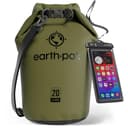
EARTH PAK
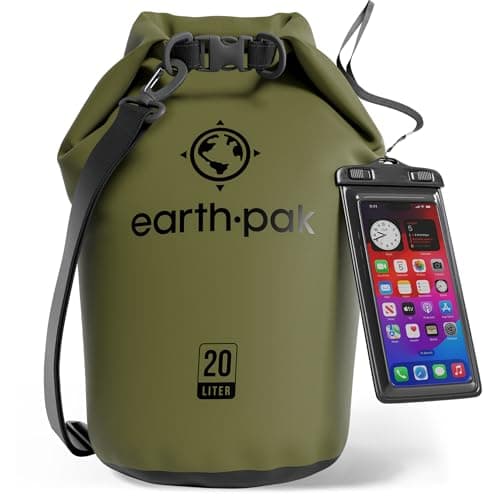
Earth Pak Waterproof Dry Bag 20L
Best Budget
Kit Score 7.4/10
$24.44 Price checked Oct 23, 4:16 PM CDT
Best for: Casual paddlers, beach days, and festival-goers who need reliable splash protection without spending more than $25.
- Available in multiple colors and sizes from 5L to 55L, with a transparent option so you can see contents without opening
- IPX6 rating means it handles heavy splashes but is not rated for prolonged submersion
- Volume
- 20L
- Material
- 500D PVC
- Closure
- Roll-top
- Waterproof rating
- IPX6
- Carry
- Single shoulder/crossbody strap
- Warranty
- 5 years
About this pick
The Earth Pak Original is a no-frills 500D PVC roll-top sack that keeps gear splash-proof and float-ready at a price well under $25. It ships with a bonus IPX8 phone pouch, making it a practical first dry bag for kayak day trips, beach outings, and festival weekends.
Strengths
- Available in multiple colors and sizes from 5L to 55L, with a transparent option so you can see contents without opening
- Includes IPX8 phone pouch that fits phones up to 6.5 inches
- Over 32,000 owner reviews with a strong value reputation and a 5-year warranty
Weaknesses
- IPX6 rating means it handles heavy splashes but is not rated for prolonged submersion
- Shoulder strap becomes uncomfortable under heavier loads or on long carries
Kit Score breakdown
SEA TO SUMMIT
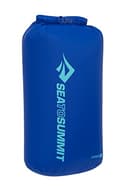
Sea to Summit Lightweight Dry Bag 35L
Editor's Choice
Kit Score 8.0/10
$36.44 Price checked Oct 23, 4:16 PM CDT
Best for: Backpackers, packrafters, and paddlers who prioritize weight savings and want a versatile dry bag that doubles as a stuff sack or travel organizer.
- Ultralight at 5.8 oz for 35L, making it practical for backpacking, packrafting, and travel where grams add up
- 70D nylon is significantly less abrasion-resistant than 1000D vinyl or TPU-coated fabrics; avoid dragging across rough surfaces
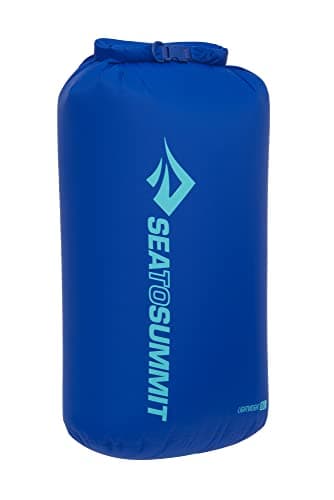
- Volume
- 35L
- Material
- Recycled 70D nylon, PU-coated
- Closure
- Roll-top, tape-sealed seams
- Weight
- 5.8 oz
- Interior
- White lining for visibility
- DWR finish
- PFC-free, bluesign approved
About this pick
Sea to Summit's Lightweight Dry Bag uses recycled 70D nylon with a PU coating and tape-sealed seams to deliver reliable IPX7-equivalent waterproofing at roughly one-third the weight of PVC alternatives. The white interior makes it easy to locate gear at dusk or inside a dark cockpit, and seven size options let you build a matched system.
Strengths
- Ultralight at 5.8 oz for 35L, making it practical for backpacking, packrafting, and travel where grams add up
- White interior lining improves visibility and helps locate items quickly in low light
- bluesign-approved recycled fabric and PFC-free DWR are a lower-impact choice than conventional PVC
Weaknesses
- 70D nylon is significantly less abrasion-resistant than 1000D vinyl or TPU-coated fabrics; avoid dragging across rough surfaces
- Not rated for prolonged submersion; best treated as splash-proof and rain-proof rather than truly submersible
Kit Score breakdown

YETI
YETI Panga 28 Airtight Waterproof Backpack
Best Premium
Kit Score 9.0/10
$325.00 Price checked Oct 23, 4:16 PM CDT
Best for: Photographers, fly fishers, and sea kayakers who carry expensive electronics in wet environments and need verified submersion protection rather than splash resistance.
- Fully airtight and submersible construction: RF-welded seams and HydroLok zipper confirmed watertight at 1 m depth for 30 minutes
- At 3.9 lbs and $300+, it is heavy and expensive compared to roll-top dry bags; overkill for casual splashing
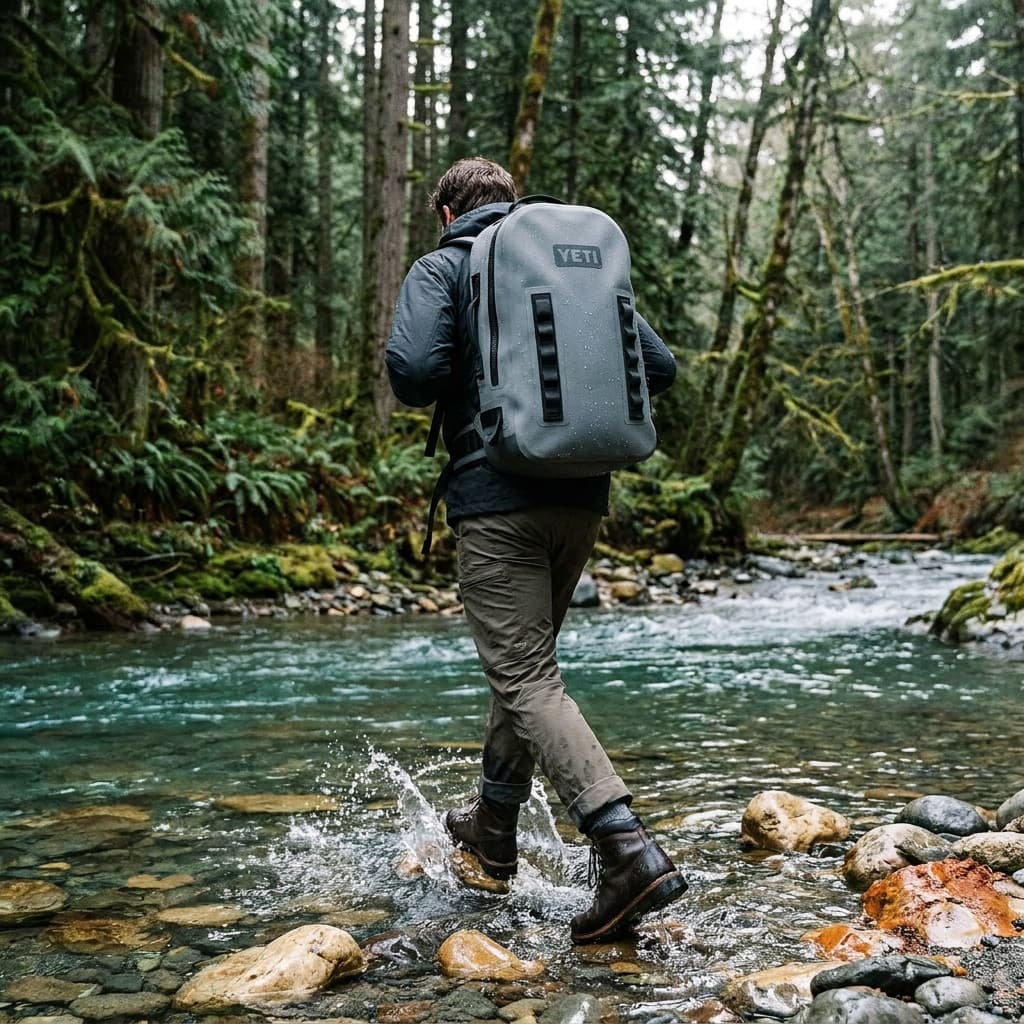
- Volume
- 28L
- Material
- High-density nylon, TPU laminated (ThickSkin Shell)
- Closure
- HydroLok waterproof zipper
- Weight
- 3.9 lbs (62.4 oz)
- Dimensions
- 19.7 x 12.5 x 7 in
- Submersion rating
- 30 min at 1 m depth
About this pick
The YETI Panga 28 is an airtight, submersible backpack built from TPU-laminated high-density nylon with RF-welded seams and YETI's HydroLok zipper. It is rated to one meter for 30 minutes and scored 96/100 at OutdoorGearLab, where reviewers confirmed zero water infiltration across all conditions. It is the go-to choice when electronics, cameras, or critical gear cannot get wet under any circumstances.
Strengths
- Fully airtight and submersible construction: RF-welded seams and HydroLok zipper confirmed watertight at 1 m depth for 30 minutes
- Ergonomic DryHaul shoulder straps with removable chest strap and waist belt provide genuine comfort for a waterproof pack
- 96/100 from OutdoorGearLab and a 4.7-star average on REI across hundreds of reviews, making it one of the most trusted waterproof packs available
Weaknesses
- At 3.9 lbs and $300+, it is heavy and expensive compared to roll-top dry bags; overkill for casual splashing
- Rigid shape and minimal internal organization limit packing flexibility; harness can feel bulky on smaller-framed users
Kit Score breakdown
See all picks in Best dry bags for hiking, kayaking, and travel (2026)
Keep going
Related guides
 Complete hike loadoutDay hike kitBuild the complete kit
Researched, not hands-on tested
Updated Jun 4, 2026Our recommendations draw on manufacturer documentation, retailer listings, owner feedback, and comparisons with alternatives.
As an Amazon Associate I earn from qualifying purchases. We may earn a commission from links here, at no extra cost to you. How we research →