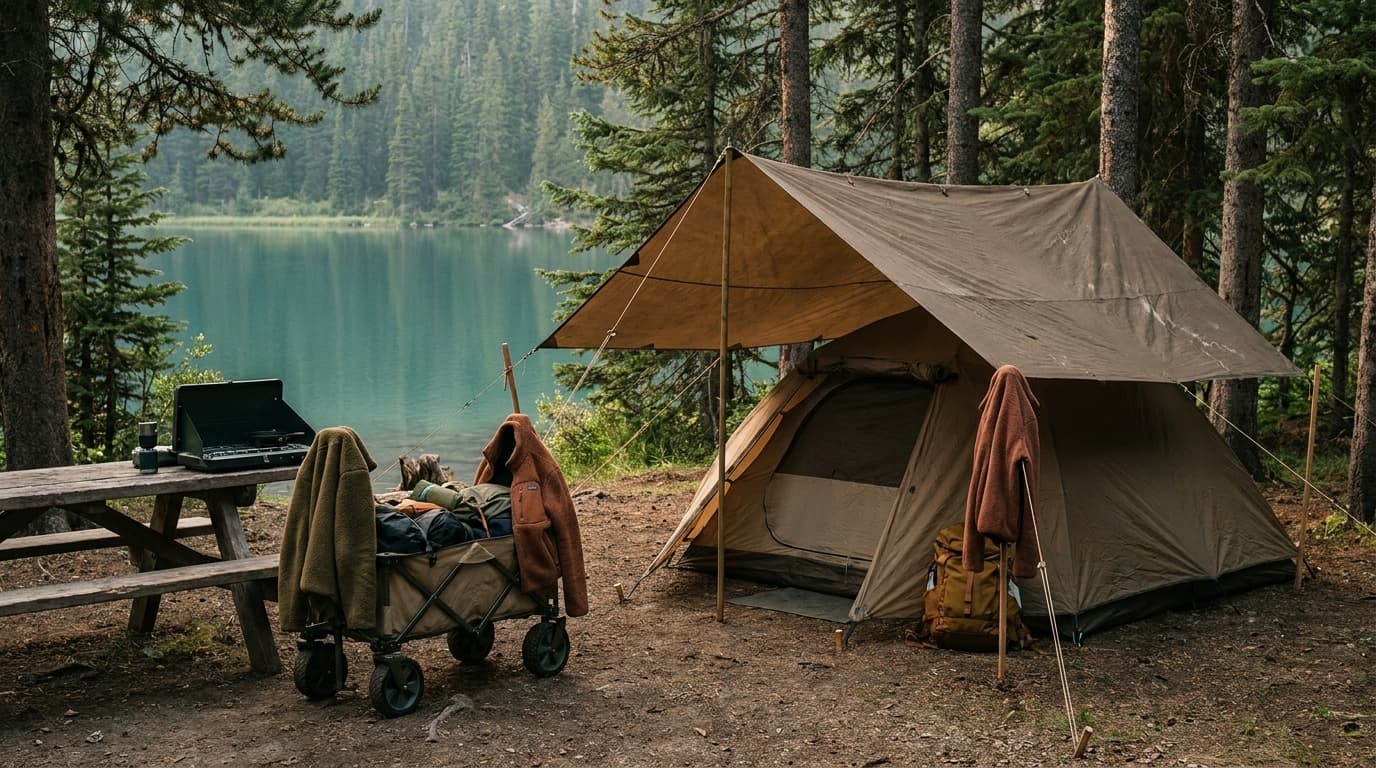
A camping wagon sounds simple until you hit loose sand with standard plastic wheels and grind to a halt 200 feet from the car. The right wagon depends almost entirely on where you camp, not how much you spend.
All-terrain vs standard wheels: the spec that actually matters
Standard camping wagons like the Amazon Basics Collapsible Heavy Duty Utility Wagon ship with hard plastic wheels, typically 6–8 inches in diameter. They roll fine on pavement, packed gravel, and concrete campground pads. On sand, loose dirt, or soft grass, those narrow wheels dig in and the wagon stops moving.
All-terrain wagons use one of two wheel types. Pneumatic (air-filled) tires, usually 10–12 inches in diameter with knobby tread, give the best roll on uneven and soft surfaces. They handle roots, ruts, and wet grass the way a mountain bike handles a trail. The trade-off: they can go flat, and you need a pump.
Wide EVA foam wheels (sometimes called "no-flat" or "never-flat") split the difference. They are wider than standard plastic, resist flats completely, and work well on sand and grass. They do not absorb bumps as well as pneumatics on rocky ground, but for most car campers and beach trips they are the more practical choice.
If you camp at beach sites or any campground without paved pads, all-terrain wheels are not an upgrade, they are a requirement.
Load capacity and bed size
Most camping wagons advertise 150 lb to 300 lb capacity (heavy haulers like the RTIC Ultra-Tough Wagon sit at the top of that range). For a family camp haul (cooler, two camp chairs, a bag of firewood, a gear bag) you will rarely exceed 150 lb total. Capacity becomes important when you are hauling a loaded 100-qt cooler plus firewood: that alone can approach 120–130 lb, leaving little margin.
Bed dimensions are arguably more useful than raw capacity numbers. A full-size 60-qt cooler is roughly 26 inches long and 16 inches wide. Most wagons have a 33 x 20-inch interior, which fits it fine. Compact wagons (folded dimensions under 20 inches) often have a 26 x 18-inch interior, meaning that same cooler fits only if you orient it carefully and it may crowd everything else out.
Check sidewall height too. Tall sidewalls (8–10 inches) keep round or awkward items from rolling out during transit. Low sidewalls (4–5 inches) make loading and unloading easier but require strapping down anything that shifts.
Folded packed size: measure your trunk first
Camping wagons fold for transport, but "folds flat" means different things across models. A full-size all-terrain wagon typically folds to about 33 x 20 x 9 inches. A compact collapsible model might reach 19 x 18 x 7 inches. Neither is right or wrong, but if your trunk is already carrying a sleeping bag and a tent, the difference matters.
Choosing the right folded size
Measure your cargo area
Record the length, width, and available height in your trunk or SUV before you shop.
Account for vertical stacking
Wagons often get stacked under or beside other gear, so folded height can matter more than footprint.
Check unfolded setup time
Most quality wagons set up in under 30 seconds with a single pull. Look for one-handed or one-step deployment if you are managing kids at the same time.
Confirm wheel removal
Some all-terrain models let you pop the wheels off to reduce folded width, which can be the difference between fitting and not fitting.
Look at carrying weight
Wheels add weight. Pneumatic all-terrain wagons typically weigh 22–28 lb. A lighter standard wagon runs 14–18 lb. If you carry it to the trunk alone, weight adds up fast.
Bed material and drainage
The bed liner determines how the wagon holds up after a wet day at the beach or a rainy campsite. Look for 600D polyester or ripstop Oxford fabric. Both resist abrasion, dry quickly, and handle the UV exposure that comes with outdoor use. Cheap wagons use thin polyester that pills and tears within a season.
Drainage holes in the bed floor are important for any beach, lake, or rain-exposed use. Without them, standing water collects and the liner mildews. Most all-terrain beach-focused wagons include at least two drain holes. If the wagon you are considering does not mention drainage and you plan to use it near water, that is a real limitation.
Handle design, accessories, and practical fit
Push-pull handles on quality wagons telescope to multiple heights and lock at each position. A handle that locks at hip height makes pulling easy on flat ground; lower positions give more control on hills. Some wagons include a separate push bar as an accessory or in the box. On a loaded wagon, pushing is almost always easier than pulling.
Accessories worth evaluating before you buy rather than after: a canopy, a side table, and a cup holder rail. Canopies are useful for shade at beach sites but catch wind badly if not staked or removed on breezy days. Side tables (typically small fabric trays that clip to the sidewall) are genuinely convenient at the campsite; the MacSports All Terrain Beach Wagon with Side Table builds one in.
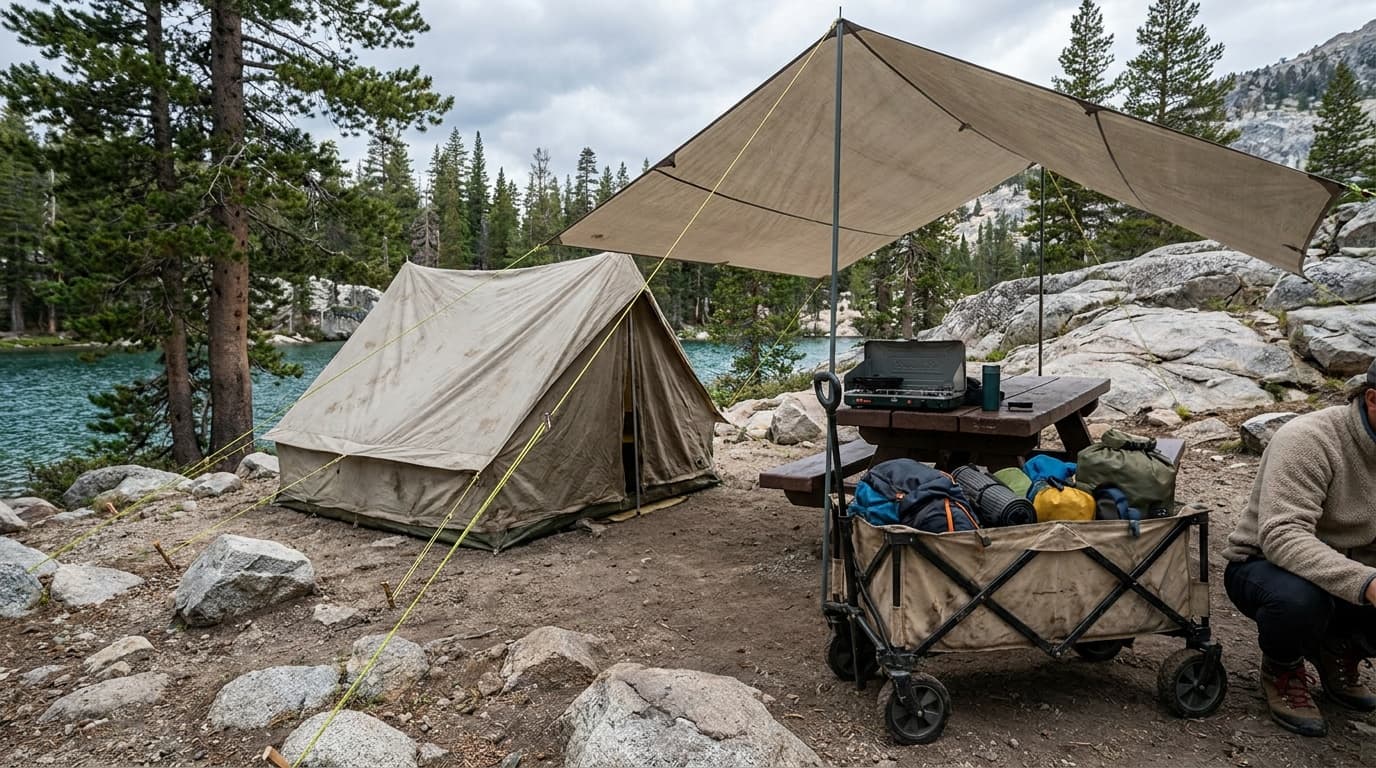
If you plan to use the wagon as a stationary camp station (food prep, gear staging), prioritize a stable footprint and tall sidewalls. If you are mostly hauling gear from car to campsite and back, pull weight and folded size matter more than camp-mode features.
Frequently asked questions
Can I use a beach wagon at a standard campground?
Yes. All-terrain wheels handle packed gravel and dirt pads without issue. The wagon is slightly heavier than a standard model, but it rolls fine on any surface a standard wagon rolls on, plus the soft-surface terrain a standard wagon cannot handle. If you camp in multiple environments, an all-terrain model is the more versatile buy.
What load capacity do I actually need?
For most families, 150 lb is sufficient. Add up the weight of your heaviest single haul: full cooler (50–80 lb depending on size), camp chairs (10–20 lb for two), firewood (20–30 lb for a bundle), and a gear bag (15–25 lb). That puts a full load around 95–155 lb. A 150 lb rated wagon handles this, but only just. If you regularly haul close to that limit, size up to a 200 lb or 300 lb rated model for the structural margin.
Are pneumatic tires or EVA foam wheels better for beach camping?
Both work well in sand. Pneumatic tires roll with less effort on soft sand because the larger diameter and air cushion let the wheel float over loose material. EVA foam wheels are maintenance-free and never go flat, which matters if you are far from a pump. For the occasional beach trip, wide EVA foam is the practical pick. If most of your camping is on soft terrain, pneumatic tires reward the extra maintenance.
For specific picks, see our guide to the best camping wagons. Browse all camp guides or read how we research and rate gear.
Recommended gear
Our current top picks from the Best camping wagons for sand, gravel, and campgrounds guide, if you are ready to buy.
MACSPORTS
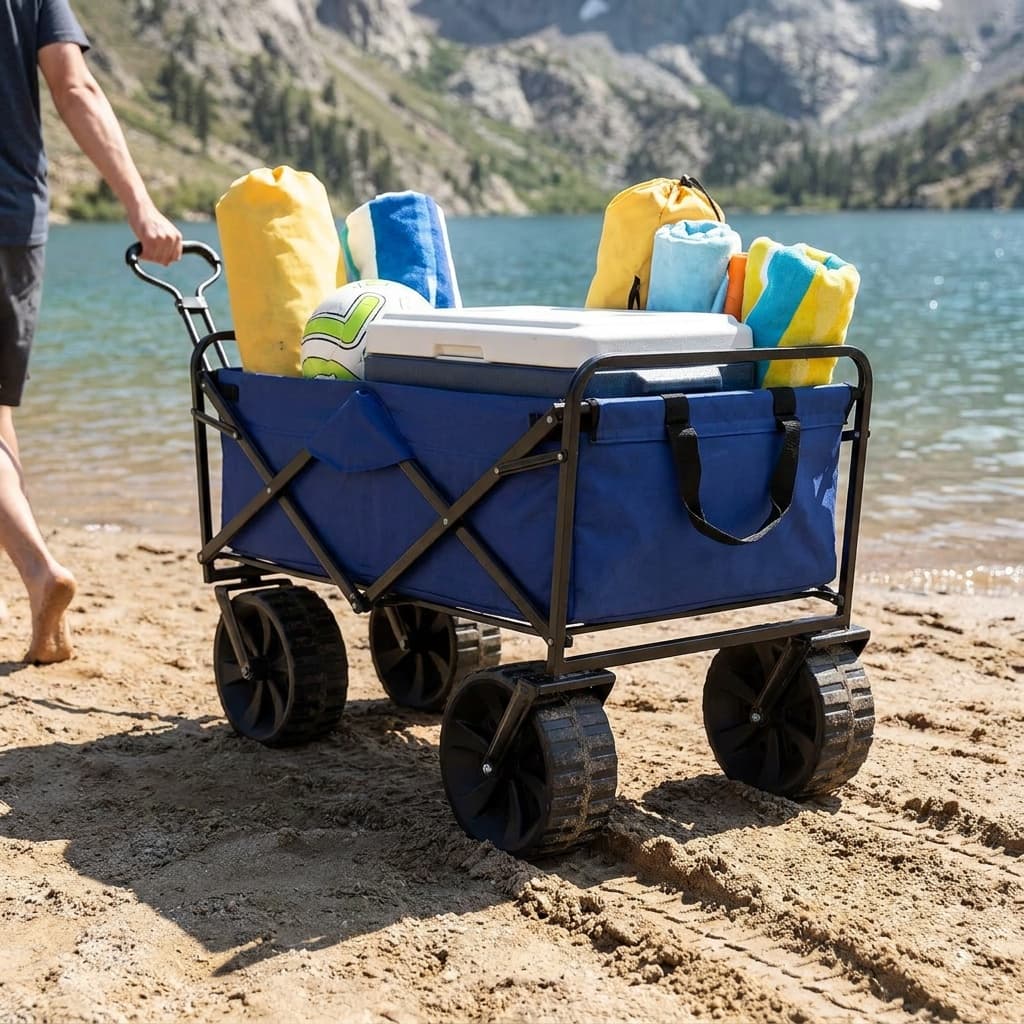
Mac Sports Heavy Duty Collapsible Folding All Terrain Utility Beach Wagon Cart
Best Overall
Kit Score 8.5/10
Best for: Campers and beachgoers who need a proven all-terrain wagon for mixed surfaces (sand, grass, gravel) and moderate loads up to 150 lbs.
- Pneumatic wide-tread wheels with articulating front axle navigate soft sand, wet grass, and gravel with notably less effort than smaller-wheel wagons
- 150-lb limit is lower than some competitors, so it is not the right pick for hauling full family coolers plus chairs simultaneously
- Load capacity
- 150 lbs
- Wheel type
- Pneumatic, wide-tread
- Folded thickness
- 9.7 in.
- Folded footprint
- 31.5 in. x 21.5 in.
- Wagon weight
- 24.5 lbs
- Fabric
- 600D polyester, alloy steel frame
About this pick
The MacSports All-Terrain wagon is the benchmark in the folding camping wagon category: large pneumatic wide-tread wheels handle packed sand, wet grass, and gravel better than nearly any competitor at this price, and the 150-lb-rated alloy steel frame has proven durability across years of owner use. It folds to under 10 inches thick for trunk storage and deploys in seconds with no assembly required.
Strengths
- Pneumatic wide-tread wheels with articulating front axle navigate soft sand, wet grass, and gravel with notably less effort than smaller-wheel wagons
- Folds to under 10 inches thick, fits upright in most car trunks alongside other gear
- Alloy steel frame and 600D fabric rated for long-term outdoor use
Weaknesses
- 150-lb limit is lower than some competitors, so it is not the right pick for hauling full family coolers plus chairs simultaneously
- Front wheels positioned closely together can tip on sharp turns when heavily loaded toward the front
Kit Score breakdown
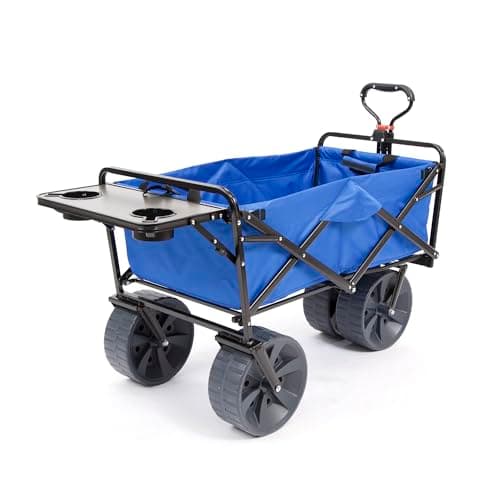
Best for: Car campers and beach families who want the all-terrain wagon platform plus a convenient side surface for snacks and drinks without packing a separate folding table.
- Fold-out side table keeps food, sunscreen, and drinks off the ground at camp or the beach without carrying a separate table
- 150-lb capacity is unchanged from the base model, so the table adds convenience rather than capability
- Load capacity
- 150 lbs
- Wheel type
- Pneumatic, wide-tread
- Folded dimensions
- 31.5 in. x 21.4 in. x 9.7 in.
- Open dimensions
- 44.9 in. x 21.4 in. x 24.6 in.
- Wagon weight
- 27 lbs
- Fabric
- 600D polyester, powder-coated steel frame
About this pick
The side-table version of MacSports' all-terrain wagon adds a fold-out surface and dual cup holders to the proven pneumatic wide-tread wheel platform, making it genuinely useful at a campsite or beach where you want food and drinks off the ground. The same 150-lb-rated steel frame and 600D polyester construction carry over, and it folds to under 10 inches thick for transport.
Strengths
- Fold-out side table keeps food, sunscreen, and drinks off the ground at camp or the beach without carrying a separate table
- Proven pneumatic wide-tread wheel platform handles sand, grass, and packed dirt well
- Folds to under 10 inches thick, same compact footprint as the base model
Weaknesses
- 150-lb capacity is unchanged from the base model, so the table adds convenience rather than capability
- At 27 lbs it is heavier than the base version; some owners note the table folds awkwardly if you are not careful
Kit Score breakdown
AMAZON BASICS
Amazon Basics Collapsible Heavy Duty Utility Wagon
Best Budget
Kit Score 7.4/10
$80.91 Price checked Oct 24, 5:42 AM CDT
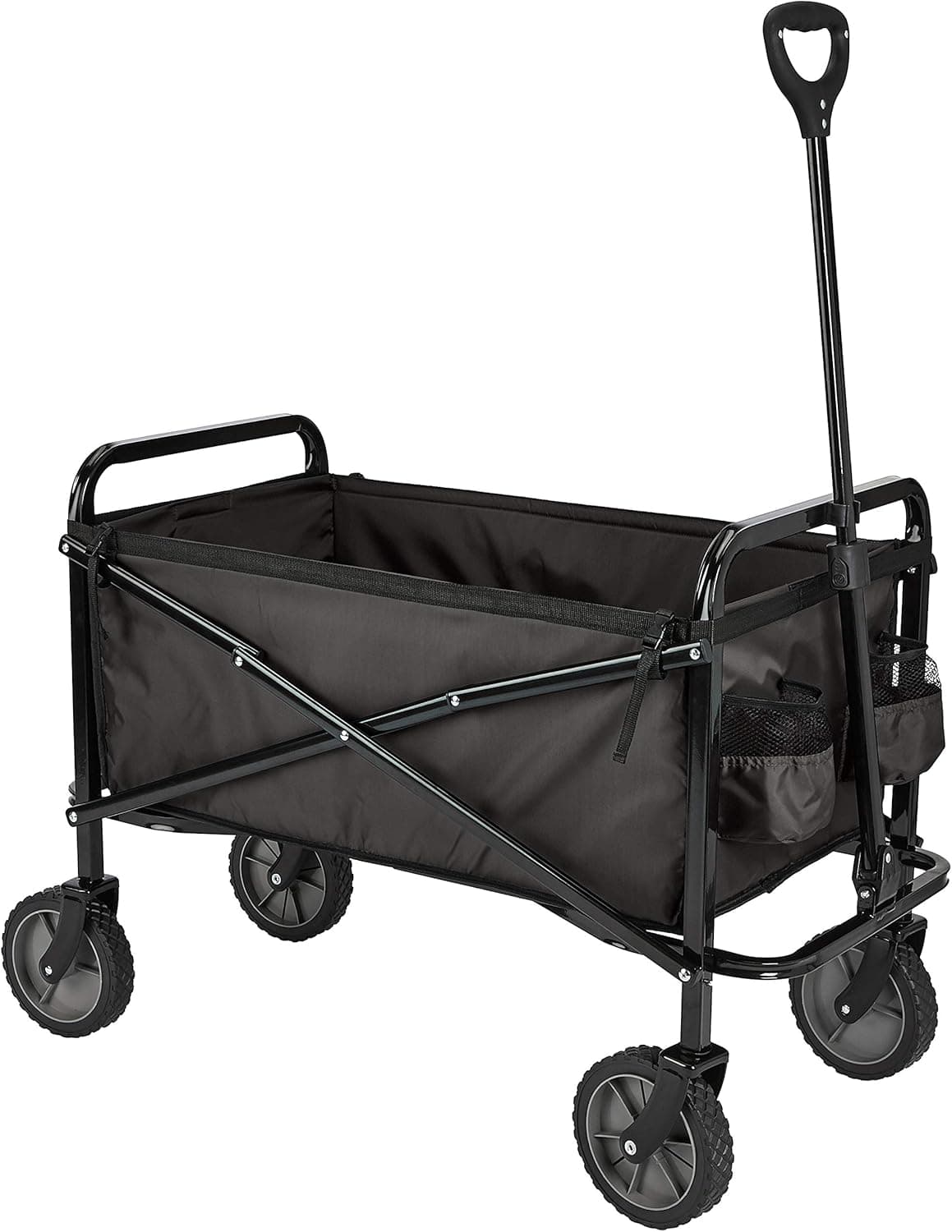
Best for: Budget-conscious campers who mainly haul gear from a paved or packed parking area to an improved campsite and do not need large all-terrain wheel performance.
- 265-lb capacity at a budget price is a strong value proposition for campgrounds with paved or packed-gravel access roads
- Smaller-diameter pneumatic wheels produce more drag and lose traction on soft sand and loose dirt compared to large-wheel all-terrain wagons
- Load capacity
- 265 lbs
- Wheel type
- Pneumatic (tubeless), smaller diameter
- Open dimensions
- 40.9 in. W x 20 in. D x 27.6 in. H
- Wagon weight
- 19.4 lbs
- Frame material
- Alloy steel
- Includes
- Cover bag for storage
About this pick
The Amazon Basics utility wagon delivers a 265-lb rated alloy-steel-frame cart at a budget price, making it a practical pick for flat-surface gear hauling from car to campsite. At 19.4 lbs with a cover bag included, it packs down reasonably for a wagon in this capacity class. The smaller-diameter pneumatic wheels are adequate on paved or packed surfaces but lose ground to larger-wheel wagons on soft sand or rough uneven terrain.
Strengths
- 265-lb capacity at a budget price is a strong value proposition for campgrounds with paved or packed-gravel access roads
- At 19.4 lbs it is the lightest wagon in this group, making it easy to lift in and out of a vehicle
- Comes with a cover bag for compact storage in a trunk or gear closet
Weaknesses
- Smaller-diameter pneumatic wheels produce more drag and lose traction on soft sand and loose dirt compared to large-wheel all-terrain wagons
- Not the right choice for beach hauling or off-pavement campsite access where wheel diameter matters
Kit Score breakdown
See all picks in Best camping wagons for sand, gravel, and campgrounds
Keep going
Related guides
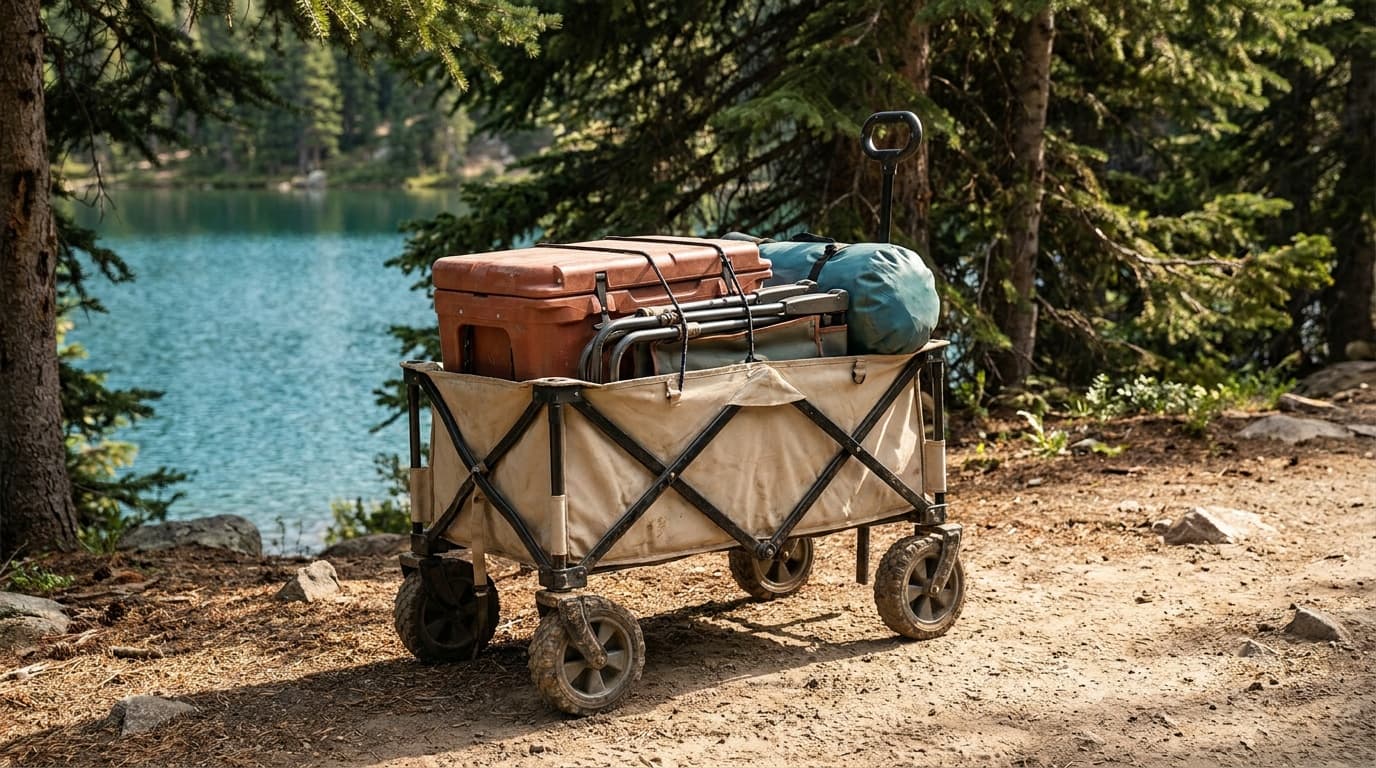
 Complete camp loadoutCar-camping starter kitBuild the complete kit
Researched, not hands-on tested
Updated Sep 13, 2026Our recommendations draw on manufacturer documentation, retailer listings, owner feedback, and comparisons with alternatives.
As an Amazon Associate I earn from qualifying purchases. We may earn a commission from links here, at no extra cost to you. How we research →