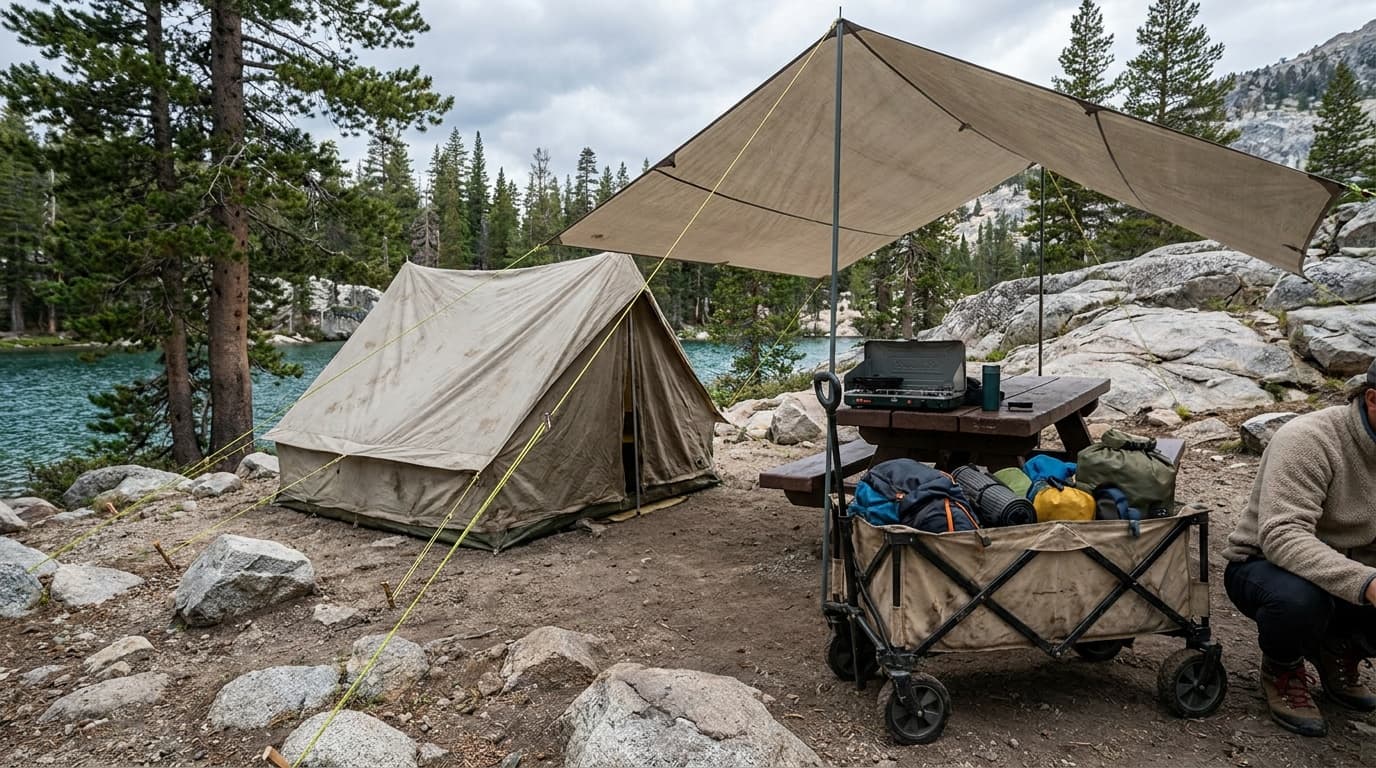
A camping wagon promises to turn a parking-lot stack of coolers, bags, and sleeping pads into a single, manageable load. Whether that promise is worth the trunk space and the price tag depends almost entirely on how far you are from your campsite.
When a camping wagon genuinely pays off
The clearest case is beach camping or any site with a long, flat carry from the parking lot. Sand-rated wagons with wide, balloon-style tires, like the MacSports All Terrain Beach Wagon, can roll a full load across soft ground that would stop a wheeled cooler or a standard luggage cart. Festival camping is a close second: multi-day setups with chairs, canopies, and coolers become a single haul rather than a relay race.
Families with young kids get outsized value because the wagon does double duty. It hauls gear on the way in, then carries tired toddlers on the way back to the car. That flexibility is worth something you cannot put a pure dollar figure on.
When to skip it
Walk-up sites, where your car parks directly beside the table, make a wagon redundant. The same goes for ultralight or backpacking-style car camping where your total gear load is a single pack and a small cooler. If your camp kit fits in two arms on one trip, a wagon adds bulk without solving a problem.
Terrain matters too. A wagon with standard wheels struggles on rocky ground, steep inclines, or muddy paths. If your campground is anything other than flat pavement or packed gravel, confirm the wheel spec before you buy. Many wagons marketed as "all-terrain" perform well only in the loosest sense of that phrase.
The one-trip-vs-three-trips math
This is where the wagon argument is strongest. A family of four with a weekend's worth of gear typically needs three to four trips between car and site without a cart. At a modest 150-foot carry, that is 900 feet of loaded walking just to set up, and then the same distance again to break camp. A wagon collapses that to one loaded trip each way.
One-trip math for a 150-foot carry
Trips without wagon
3–4 loaded, 3–4 empty returns = roughly 900–1,200 feet of hauling
Trips with wagon
1 loaded, 1 empty return = 300 feet total
Time saved
15–25 minutes on setup, same on teardown
Energy saved
Meaningful on day one; significant by the end of a 3-day weekend
Break-even uses
Most wagons pay for themselves in convenience within 3–5 camping trips
The math favors the wagon most when you camp frequently, carry a lot of gear, or camp with people who have limited mobility. It favors skipping it when you camp once a year with a minimal kit.
Durability and what actually wears out
The frame on most folding wagons is steel or aluminum and holds up well if you stay within the rated load. What fails first is usually the fabric liner, the folding hinge pins, or the wheel axles. Cheaper wagons use thin polyester liners that crack in UV exposure after two or three seasons. Better models like the RTIC Ultra-Tough Wagon use 600D canvas or coated Oxford fabric that lasts significantly longer.
Wheels are the second wear point. Standard hard plastic wheels are fine on pavement; they crack or wear flat on gravel over time. Foam-filled or pneumatic tires last longer and roll more smoothly, but pneumatic tires can go flat, which is a genuine inconvenience at a campsite.
The fabric liner and the hinge pins are the two places a cheap wagon falls apart; spend a little more there and the rest of the wagon will outlast the rest of your camp kit.
Storage at home is the trade-off few buyers think about until the wagon arrives. A folded wagon is typically 10–15 inches wide and 30–34 inches long. That fits in many cargo areas but displaces something, and it needs a dry storage spot to protect the liner between trips.
What to look for if you decide to buy
Focus on three things: wheel type for your typical terrain, fabric weight, and folded dimensions against your vehicle's cargo area. A 600D liner, foam-filled or all-terrain tires, and a folded footprint under 33 inches covers most car-camping use cases without overpaying for features you will not use.
Weight capacity listed on the box is a ceiling, not a recommendation. Consistently loading at 90 percent of rated capacity accelerates wear on the frame and hinges. Treat the rated limit as a short-term maximum rather than a daily target.
Frequently asked questions
Can a camping wagon handle sand and beach terrain?
Yes, if it is specifically built for it. Look for balloon-style tires, also called all-terrain or sand tires, with a wide footprint of 4 inches or more. Standard hard plastic wheels dig in and stall on soft sand. A beach-capable wagon is a specific product category, not a feature all wagons share.
How do folding wagons hold up in rain or wet conditions?
The steel frame on most wagons will rust at hinge points if stored wet repeatedly. Aluminum frames handle moisture better. After any wet camping trip, open the wagon fully and let it dry before folding it for storage. Wiping the hinge points and axles with a light lubricant once a season extends the life noticeably.
Is a camping wagon the same as a garden cart or utility wagon?
They overlap significantly. Many folding wagons sold as camping wagons are the same product sold through garden or home channels under a different name. The meaningful differences are wheel type, liner material, and whether the sides are collapsible for loading bulky items. A garden wagon with all-terrain tires works perfectly well for camping.
For specific picks across terrain types and budgets, see our guide to the best camping wagons. Browse all camp guides or read how we research and rate gear.
Recommended gear
Our current top picks from the Best camping wagons for sand, gravel, and campgrounds guide, if you are ready to buy.
MACSPORTS
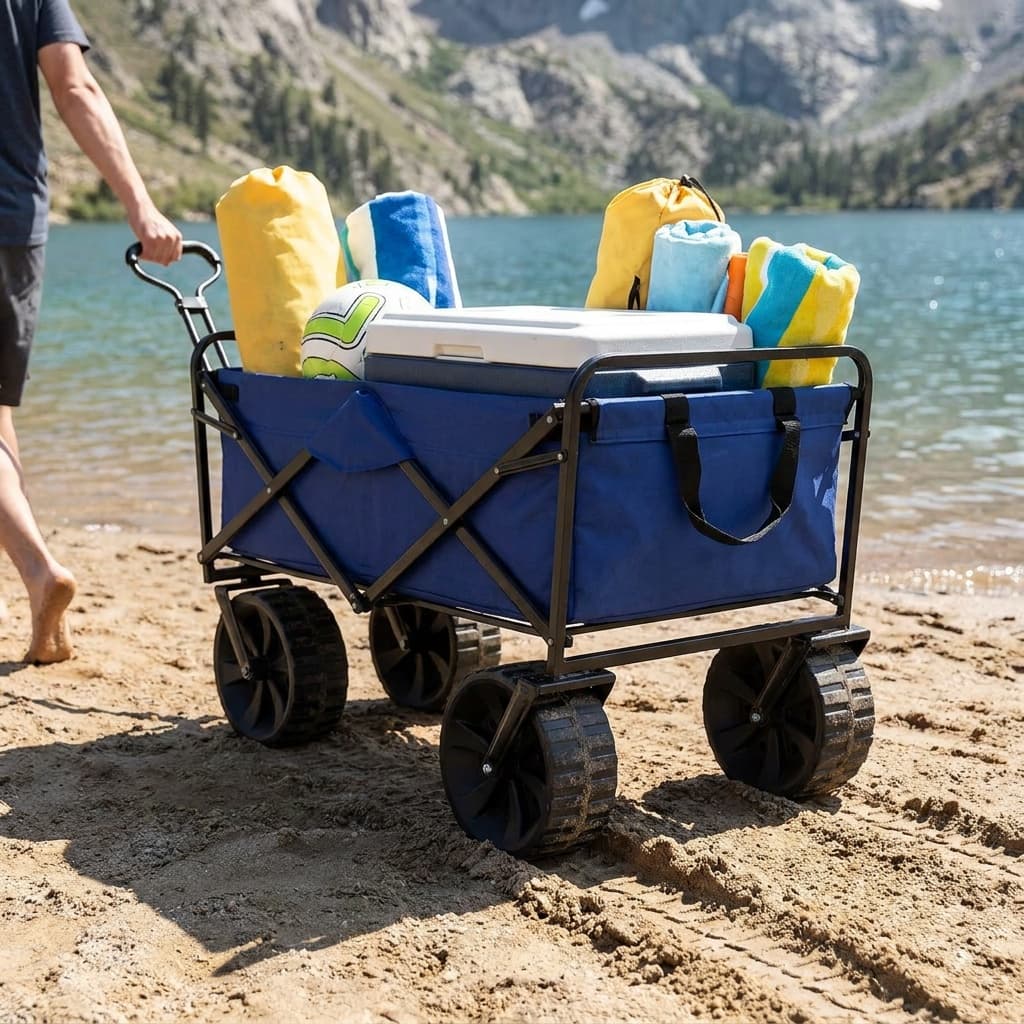
Mac Sports Heavy Duty Collapsible Folding All Terrain Utility Beach Wagon Cart
Best Overall
Kit Score 8.5/10
Best for: Campers and beachgoers who need a proven all-terrain wagon for mixed surfaces (sand, grass, gravel) and moderate loads up to 150 lbs.
- Pneumatic wide-tread wheels with articulating front axle navigate soft sand, wet grass, and gravel with notably less effort than smaller-wheel wagons
- 150-lb limit is lower than some competitors, so it is not the right pick for hauling full family coolers plus chairs simultaneously
- Load capacity
- 150 lbs
- Wheel type
- Pneumatic, wide-tread
- Folded thickness
- 9.7 in.
- Folded footprint
- 31.5 in. x 21.5 in.
- Wagon weight
- 24.5 lbs
- Fabric
- 600D polyester, alloy steel frame
About this pick
The MacSports All-Terrain wagon is the benchmark in the folding camping wagon category: large pneumatic wide-tread wheels handle packed sand, wet grass, and gravel better than nearly any competitor at this price, and the 150-lb-rated alloy steel frame has proven durability across years of owner use. It folds to under 10 inches thick for trunk storage and deploys in seconds with no assembly required.
Strengths
- Pneumatic wide-tread wheels with articulating front axle navigate soft sand, wet grass, and gravel with notably less effort than smaller-wheel wagons
- Folds to under 10 inches thick, fits upright in most car trunks alongside other gear
- Alloy steel frame and 600D fabric rated for long-term outdoor use
Weaknesses
- 150-lb limit is lower than some competitors, so it is not the right pick for hauling full family coolers plus chairs simultaneously
- Front wheels positioned closely together can tip on sharp turns when heavily loaded toward the front
Kit Score breakdown
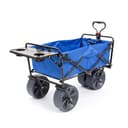
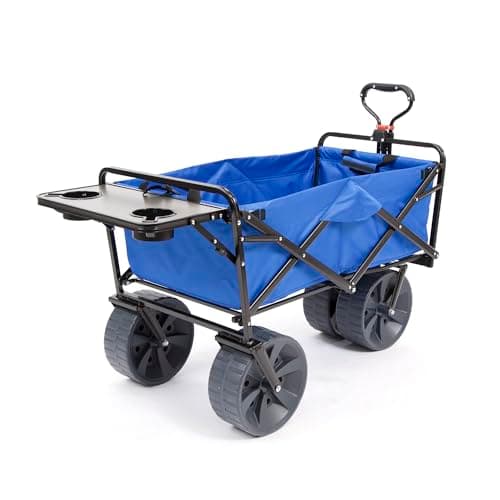
Best for: Car campers and beach families who want the all-terrain wagon platform plus a convenient side surface for snacks and drinks without packing a separate folding table.
- Fold-out side table keeps food, sunscreen, and drinks off the ground at camp or the beach without carrying a separate table
- 150-lb capacity is unchanged from the base model, so the table adds convenience rather than capability
- Load capacity
- 150 lbs
- Wheel type
- Pneumatic, wide-tread
- Folded dimensions
- 31.5 in. x 21.4 in. x 9.7 in.
- Open dimensions
- 44.9 in. x 21.4 in. x 24.6 in.
- Wagon weight
- 27 lbs
- Fabric
- 600D polyester, powder-coated steel frame
About this pick
The side-table version of MacSports' all-terrain wagon adds a fold-out surface and dual cup holders to the proven pneumatic wide-tread wheel platform, making it genuinely useful at a campsite or beach where you want food and drinks off the ground. The same 150-lb-rated steel frame and 600D polyester construction carry over, and it folds to under 10 inches thick for transport.
Strengths
- Fold-out side table keeps food, sunscreen, and drinks off the ground at camp or the beach without carrying a separate table
- Proven pneumatic wide-tread wheel platform handles sand, grass, and packed dirt well
- Folds to under 10 inches thick, same compact footprint as the base model
Weaknesses
- 150-lb capacity is unchanged from the base model, so the table adds convenience rather than capability
- At 27 lbs it is heavier than the base version; some owners note the table folds awkwardly if you are not careful
Kit Score breakdown
AMAZON BASICS
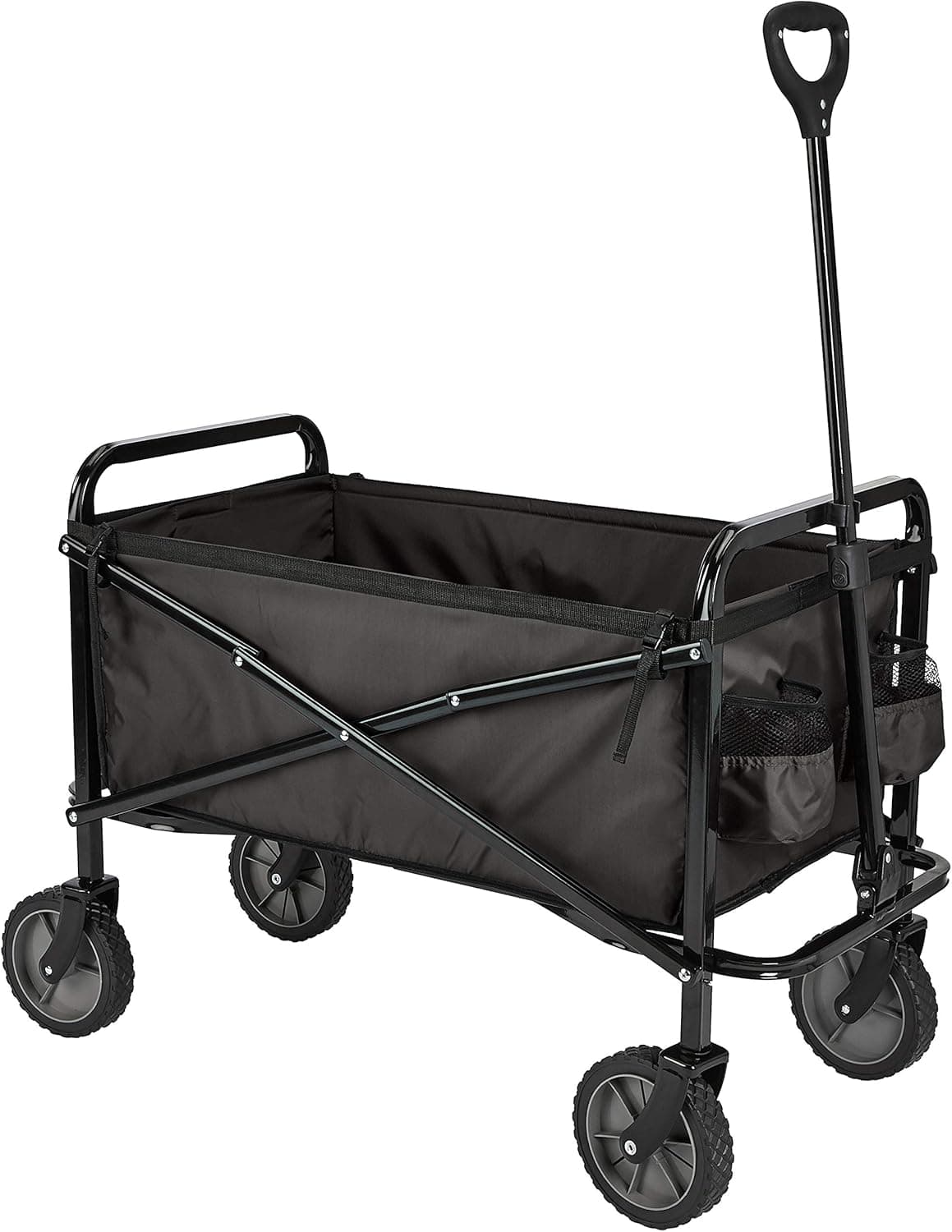
Amazon Basics Collapsible Heavy Duty Utility Wagon
Best Budget
Kit Score 7.4/10
$80.91 Price checked Oct 23, 4:16 PM CDT
Best for: Budget-conscious campers who mainly haul gear from a paved or packed parking area to an improved campsite and do not need large all-terrain wheel performance.
- 265-lb capacity at a budget price is a strong value proposition for campgrounds with paved or packed-gravel access roads
- Smaller-diameter pneumatic wheels produce more drag and lose traction on soft sand and loose dirt compared to large-wheel all-terrain wagons
- Load capacity
- 265 lbs
- Wheel type
- Pneumatic (tubeless), smaller diameter
- Open dimensions
- 40.9 in. W x 20 in. D x 27.6 in. H
- Wagon weight
- 19.4 lbs
- Frame material
- Alloy steel
- Includes
- Cover bag for storage
About this pick
The Amazon Basics utility wagon delivers a 265-lb rated alloy-steel-frame cart at a budget price, making it a practical pick for flat-surface gear hauling from car to campsite. At 19.4 lbs with a cover bag included, it packs down reasonably for a wagon in this capacity class. The smaller-diameter pneumatic wheels are adequate on paved or packed surfaces but lose ground to larger-wheel wagons on soft sand or rough uneven terrain.
Strengths
- 265-lb capacity at a budget price is a strong value proposition for campgrounds with paved or packed-gravel access roads
- At 19.4 lbs it is the lightest wagon in this group, making it easy to lift in and out of a vehicle
- Comes with a cover bag for compact storage in a trunk or gear closet
Weaknesses
- Smaller-diameter pneumatic wheels produce more drag and lose traction on soft sand and loose dirt compared to large-wheel all-terrain wagons
- Not the right choice for beach hauling or off-pavement campsite access where wheel diameter matters
Kit Score breakdown
See all picks in Best camping wagons for sand, gravel, and campgrounds
Keep going
Related guides
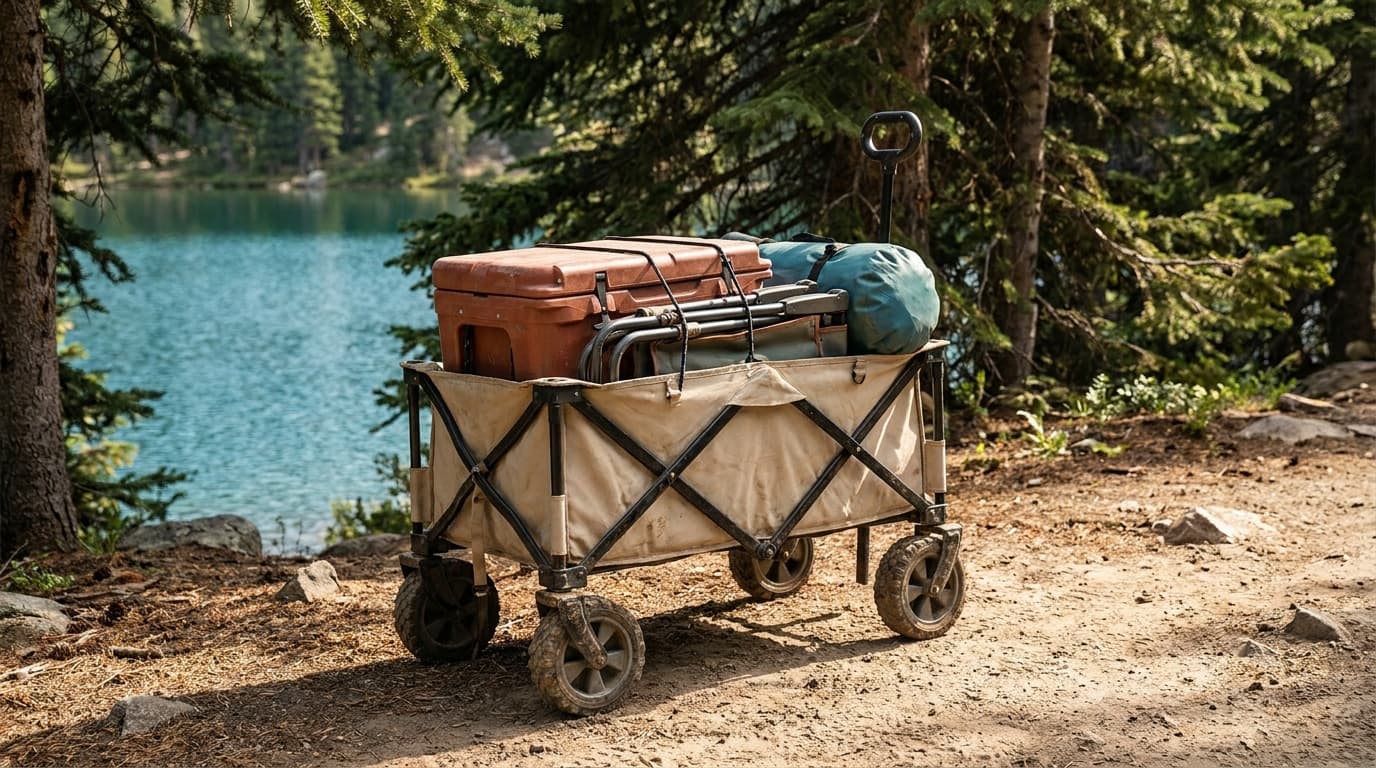
 Complete camp loadoutCar-camping starter kitBuild the complete kit
Researched, not hands-on tested
Updated Jul 8, 2026Our recommendations draw on manufacturer documentation, retailer listings, owner feedback, and comparisons with alternatives.
As an Amazon Associate I earn from qualifying purchases. We may earn a commission from links here, at no extra cost to you. How we research →