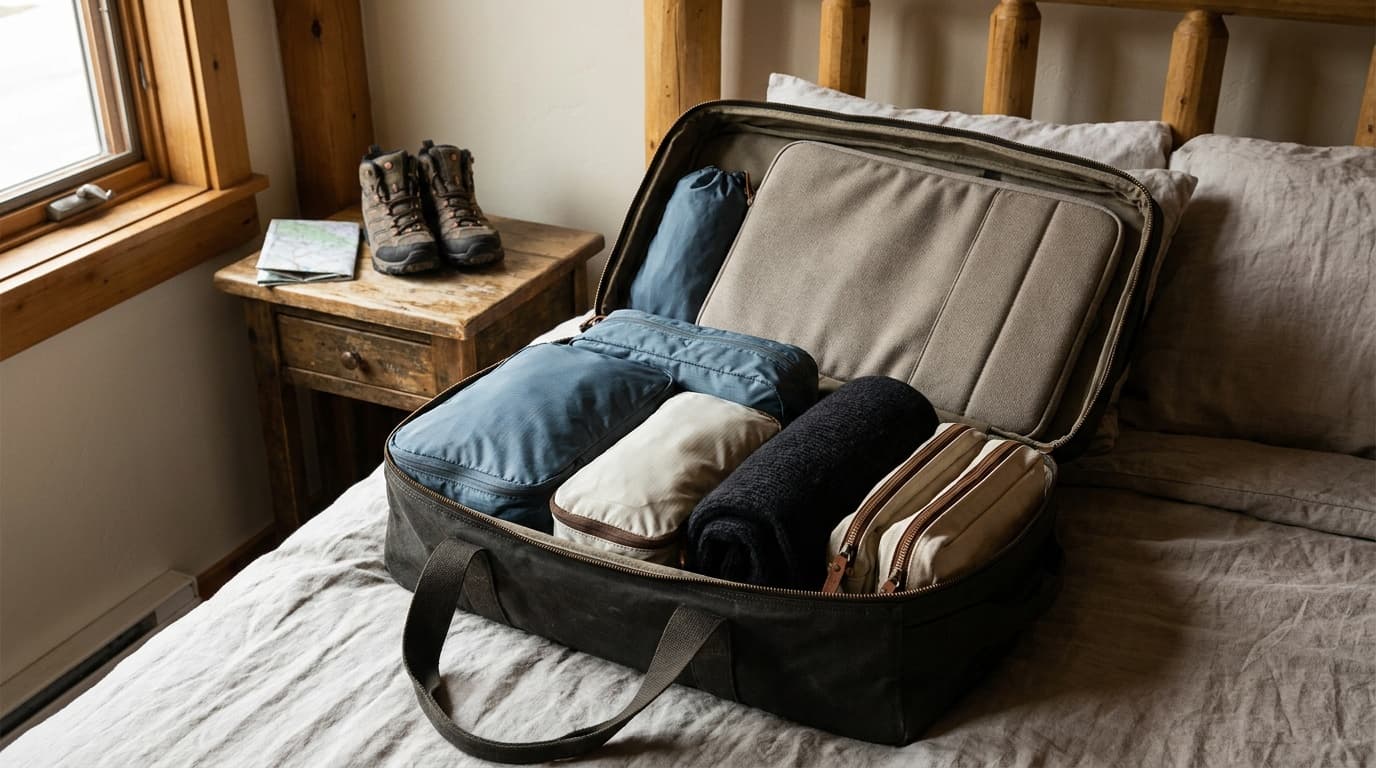
A duffel gives you more usable volume at fewer pounds than a comparably sized suitcase, and its soft body can compress into an overhead bin where a hard shell cannot. Getting that advantage requires building internal structure the suitcase ships with by default.
Carry-on sizing: what actually fits
Most major US airlines (United, Delta, American, JetBlue) cap carry-ons at 22 x 14 x 9 inches (56 x 36 x 23 cm). Southwest is slightly more generous at 24 x 16 x 10 inches. In practice, a 40–45 liter soft-sided duffel like the Osprey Transporter 40 lands within those limits when packed normally.
The practical edge over a rigid suitcase: soft sides compress slightly when the overhead bin is nearly full. A hard shell that measures one inch over the limit has no give at all. Budget carriers like Frontier enforce stricter personal item limits, so check the specific airline before you pack.
For trip length, the capacity guidance scales simply: 20–30 liters for day use or a short overnight, 30–45 liters for a weekend trip, and 45 liters or more for five or more days.
Build the cube system before you pack
A suitcase ships with a rigid base and built-in dividers. A duffel has neither. Without packing cubes, clothes collapse into one tangled pile and repacking at your destination takes twice as long.
Assign one cube per category (tops, bottoms, workout gear) or per outfit day. Roll clothes and stand them upright inside each cube so you can see everything at a glance without lifting items out. Compression cubes like the BAGAIL 6-Set Compression Packing Cubes are worth the extra cost for bulkier layers like fleece or a rain jacket; they can reclaim meaningful space without adding weight.
The packing order: heavy to light, bottom to top
Once your cubes are loaded, the layer order inside the duffel determines how the bag carries and how stable the load stays.
How to layer a travel duffel
Shoes and toiletries at the bottom
Place heavy, dense items at the bottom of the bag near the spine. This keeps the center of gravity low whether you are carrying by handle or wearing it as a backpack.
Clothing cubes in the middle
Stack your cubes with the heaviest cube closest to your back. Cubes fill out the bag's shape and prevent the middle layer from shifting in transit.
Electronics and documents at the top
Laptop, tablet, and any paperwork ride at the top or in an exterior zip pocket. You want these accessible without unpacking at TSA.
Dead space filled with socks and compressibles
Any gap between cubes or along the bag walls invites shifting. Stuff socks, a buff, or a flat packable layer into dead space so nothing moves.
Liquids in a waterproof zip pouch
Keep toiletry bottles together in a sealed pouch seated in the middle of the load rather than against the bag wall. If something leaks, the pouch contains it.
What duffels do better than suitcases
Removing wheels and a rigid frame saves real weight and unlocks up to 30% more usable volume at the same external dimensions compared to a hard-shell suitcase of equal footprint. That advantage shows up in three specific situations:
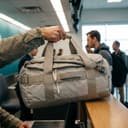
Overhead bins that are nearly full. A soft duffel can compress to fit. A rigid bag at or over the limit gets gate-checked.
Vehicles and boats. A duffel wedges into a car trunk, boat locker, or overhead bunk where a rectangular hard shell wastes corners and refuses to flex.
Destinations with uneven terrain or stairs. Dragging a wheeled suitcase over cobblestones, up a hostel staircase, or across a gravel campsite path is a liability. A duffel goes where you go.
Removing wheels and a rigid frame unlocks up to 30% more usable volume at the same external dimensions. The duffel earns that space back in the places a suitcase becomes a problem.
The tradeoff is organization. A suitcase defaults to orderly. A duffel requires you to create order, which is exactly what the cube system handles.
Backpack mode: when to use it and how to load for it
Many convertible travel duffels, like the North Face Base Camp Voyager 42L, stow padded backpack harness straps in a dedicated zip pocket, enabling hands-free carry in airports, transit, and rough terrain without adding bulk when the straps are not in use.
Backpack mode works best when the bag is loaded to 70–80% of capacity. An overstuffed duffel in backpack mode strains the harness attachment points and sits awkwardly high. Load with heavier items close to your back (the bottom-spine layer described above naturally achieves this), then tighten the sternum strap once the bag is on your back to transfer weight off your shoulders.
If you are using a personal item slot alongside your carry-on duffel, a 20–26 liter daypack there lets you move a camera or laptop into a bag with purpose-built padding, instead of relying on the duffel's soft body for protection.
Protecting fragile items without a hard shell
A duffel has no hard shell. Structure and protection must come from what is packed inside it.
Protecting fragile items in a soft-sided duffel
Keep fragile items near the center
The further from the bag wall, the more material surrounds it. Never pack a glass bottle or a lens against the outer fabric.
Use a padded sleeve for electronics
A slim padded laptop sleeve or camera insert adds structure and absorbs impact. It is lighter than relying on a thick clothing buffer alone.
Wrap bottles in rolled clothes, then pouch them
Roll a shirt around each fragile toiletry bottle. Place the bundle in a waterproof zip pouch and seat the pouch in the middle of the load.
Fill every gap
Dead space is the real enemy. When contents can shift, they will find the bag wall. Pack compressibles into every remaining gap before you zip.
Use your daypack for the most fragile items
A camera body, a glass lens, a full-frame laptop, all of these travel more safely in a dedicated padded bag than in the duffel's main cavity.
For specific duffel recommendations sorted by trip type and carry-on compliance, see our guide to the best travel duffel bags.
FAQ
What size duffel bag fits as a carry-on?
Most major US airlines cap carry-ons at 22 x 14 x 9 inches (56 x 36 x 23 cm). In practice, a 40–45 liter soft-sided duffel lands in that range when packed normally. Budget carriers are stricter, so check the specific airline before you pack. Soft sides help because the bag can compress slightly in a full overhead bin, where a rigid suitcase that measures one inch too large has no give.
Do packing cubes actually help in a duffel, or are they only for suitcases?
They help more in a duffel than in a suitcase. A suitcase has built-in dividers and a flat rigid base. A duffel has neither, so without cubes, clothes migrate into one tangled pile. Cubes give the bag internal structure, let you pull out one category without touching another, and make repacking at your destination fast. Use compression cubes for bulkier items like fleece layers to reclaim meaningful space.
How do I keep fragile items safe without a hard shell?
Put fragile items as close to the center of the bag as possible and surround them with soft material on all sides. A padded electronics sleeve handles laptops and cameras. For toiletries in glass or ceramic containers, wrap each bottle in a rolled shirt, place the bundle in a waterproof zip pouch, and seat that pouch in the middle of the load rather than against the bag wall. Fill any dead space around it with socks or other compressibles so nothing shifts.
Browse more travel gear, or read how we research and rate.
Recommended gear
Our current top picks from the Best travel duffel bags: top picks for every trip guide, if you are ready to buy.
Best for: Travelers who want one bag that covers weekend trips, checked luggage, and light backpacking without worrying about it falling apart.
- Top duffel pick at Outdoor Gear Lab and Switchback Travel
- One big compartment with little built-in organization
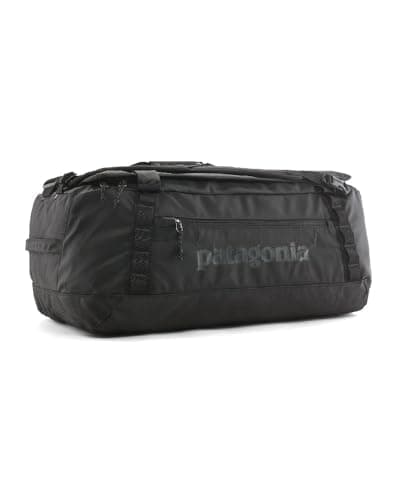
- Capacity
- 55L
- Dimensions
- 22.8 x 13.3 x 9.5 in
- Weight
- 2 lbs 9.6 oz (1,180 g)
- Material
- 900D recycled polyester ripstop with TPU-film laminate; 200D lining
- Carry options
- Haul handles, removable padded backpack straps
- Warranty
- Patagonia Ironclad Guarantee
About this pick
The Black Hole 55L is the duffel the testers keep picking: Outdoor Gear Lab's Editors' Choice for everyday use and Switchback Travel's best overall. Patagonia builds it from 900D recycled polyester ripstop with a TPU-film laminate that sheds rain, adds removable padded backpack straps, and backs it with the Ironclad Guarantee.
Strengths
- Top duffel pick at Outdoor Gear Lab and Switchback Travel
- Laminated 900D shell sheds rain and shrugs off baggage carousels
- Removable padded backpack straps for short walks
Weaknesses
- One big compartment with little built-in organization
- Backpack straps have no hip belt, so heavy loads ride on your shoulders
Kit Score breakdown
Best for: Travelers who prioritize organization and laptop protection in a carry-on-friendly bag that can also serve as a light checked bag.
- Padded laptop sleeve and zip pockets, rare in a duffel
- Backpack straps are lightly padded for heavy loads
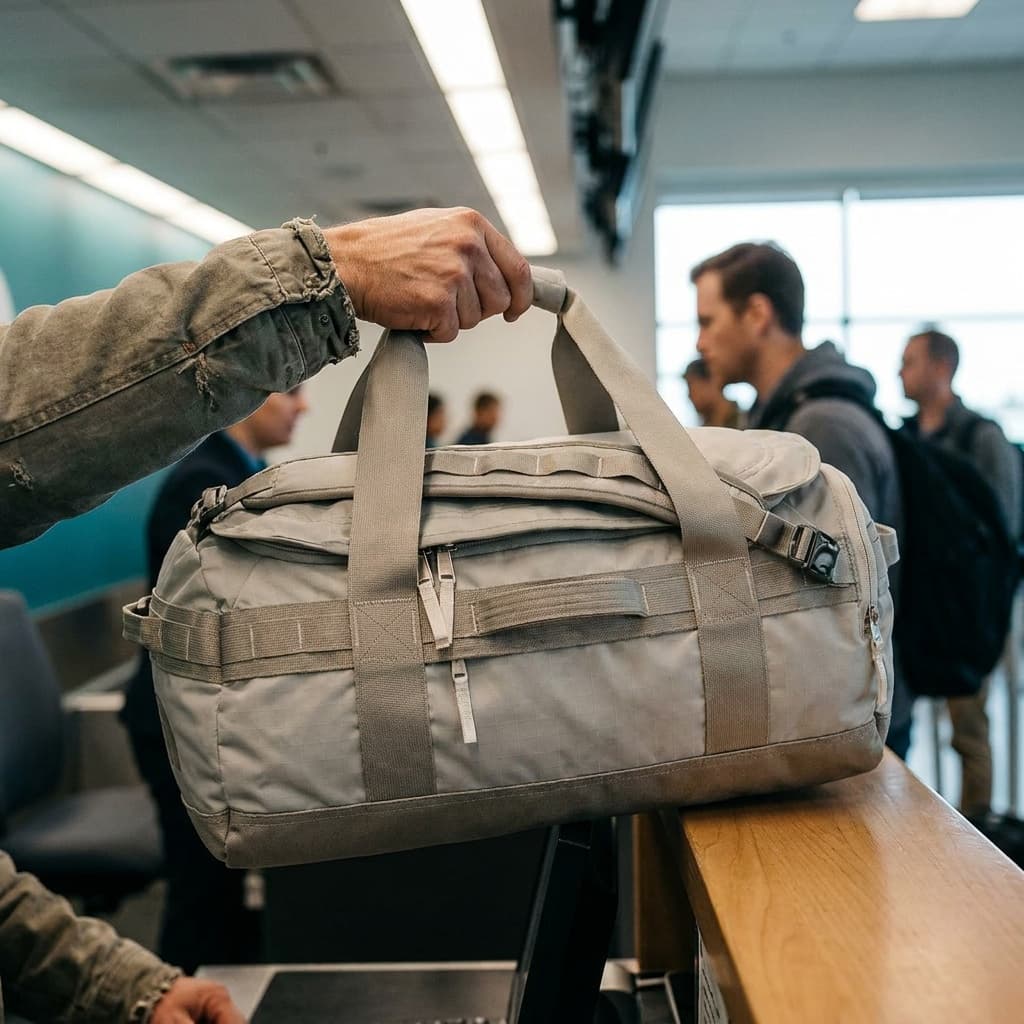
- Capacity
- 42L
- Dimensions
- 23 x 14.7 x 10.2 in
- Weight
- 2 lbs 8 oz (1,114 g)
- Material
- 300D recycled polyester with TPU coating; 840D recycled ballistic nylon base
- Carry options
- Stowable padded backpack straps, side handles
- Laptop sleeve
- Padded, 16.5 x 10.875 in
About this pick
The Base Camp Voyager 42L is the organized duffel: Outdoor Gear Lab's Editors' Choice for staying organized. The North Face adds a padded laptop sleeve, zip pockets, and stowable padded backpack straps to a TPU-coated 300D recycled polyester body with an 840D ballistic nylon base, at 2 lb 8 oz.
More specifications
- Warranty
- Limited lifetime
Strengths
- Padded laptop sleeve and zip pockets, rare in a duffel
- Outdoor Gear Lab's Editors' Choice for organization
- Light at 2 lb 8 oz for 42 L
Weaknesses
- Backpack straps are lightly padded for heavy loads
- 23 x 14.7 x 10.2 in, over the 22 x 14 x 9 carry-on limit when full
Kit Score breakdown
Best for: Travelers who walk with their bag and want a duffel that carries like a backpack, for trips where it can be checked or squeezed into the bin.
- Real stowaway backpack harness with a sternum strap
- 12.2 in deep, over the 9 in carry-on line when packed full
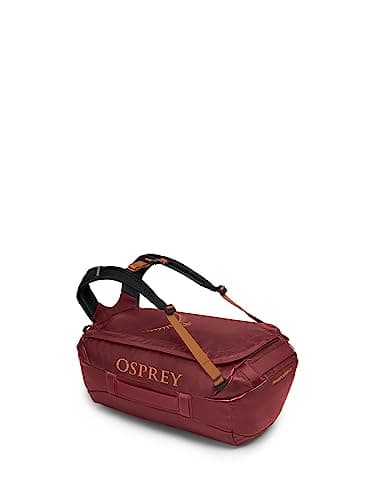
- Capacity
- 40L
- Dimensions
- 20.9 x 12.6 x 12.2 in
- Weight
- 2.11 lbs (0.958 kg)
- Material
- 630D NanoTough recycled nylon ripstop body, 840D base, 210D lining
- Carry options
- Stowaway backpack harness with sternum strap, grab handles; shoulder strap sold separately
- Warranty
- Osprey All Mighty Guarantee
About this pick
The Transporter Duffel 40 is the duffel to wear as a backpack. Osprey gives it a stowaway harness with a sternum strap rather than clip-on loops, a 630D NanoTough recycled ripstop body with an 840D base, and its All Mighty Guarantee. It is 12.2 inches deep, so a full bag is a soft carry-on only on airlines that do not size-check.
Strengths
- Real stowaway backpack harness with a sternum strap
- Tough 630D body and 840D base for rough handling
- Covered by Osprey's All Mighty Guarantee
Weaknesses
- 12.2 in deep, over the 9 in carry-on line when packed full
- Shoulder strap sold separately, and no laptop sleeve
Kit Score breakdown
See all picks in Best travel duffel bags: top picks for every trip
Keep going
Free toolPacking Cube Fit CheckerWhich packing cubes and folders fit your bag, how many, and how to lay them out.Related guides
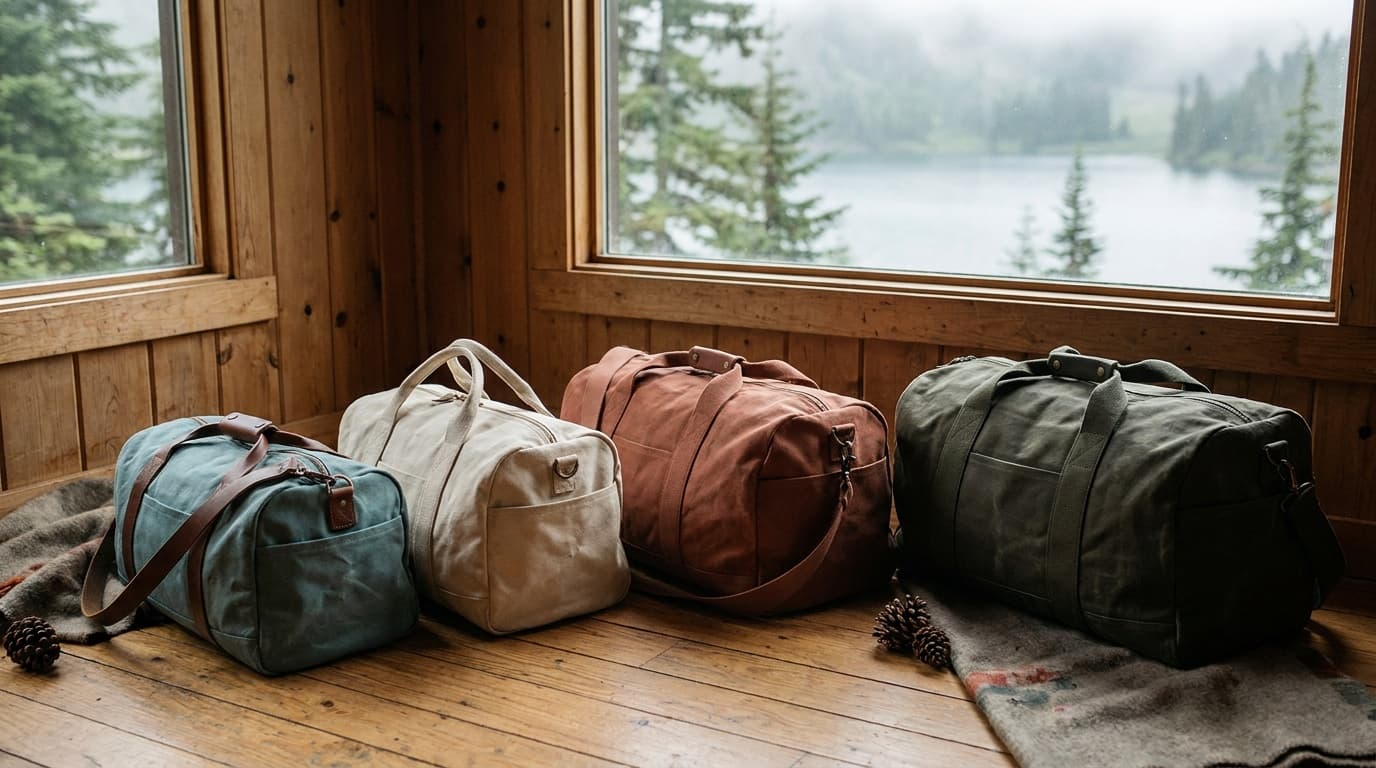
 Complete travel loadoutOne-bag travel kitBuild the complete kit
Researched, not hands-on tested
Updated Jun 3, 2026Our recommendations draw on manufacturer documentation, retailer listings, owner feedback, and comparisons with alternatives.
As an Amazon Associate I earn from qualifying purchases. We may earn a commission from links here, at no extra cost to you. How we research →