
Getting the wrong adapter is a minor nuisance. Using a plug adapter when you needed a voltage converter is how you destroy a hair dryer in under three seconds. Here is how to avoid both mistakes.
Adapter vs. converter: the distinction that actually matters
An adapter changes the shape of the plug. It does not touch the voltage coming out of the wall.
A converter changes the voltage itself, stepping 220–240V down to 110–120V (or up, for the reverse trip).
Confusing the two is the most common and most damaging mistake travelers make. If your device requires 120V and you plug it into a 240V outlet through only a plug adapter, the device will fail, and in some cases it will burn.
The good news: most modern electronics handle both voltages automatically. Smartphone chargers, laptop bricks, tablet chargers, and camera battery chargers are almost universally rated "Input: 100–240V." Those devices need only a plug adapter abroad, full stop.
The exception is high-heat appliances. Hair dryers, steam irons, and most electric shavers are almost always single-voltage (120V). Using one in a 240V country without a converter will destroy it instantly. The practical advice: buy a travel-rated hair dryer explicitly rated for 1,600–2,000W dual-voltage, or use hotel amenities and skip the converter entirely.
How to read your charger label in 30 seconds
Check before you pack
Look at the charger brick
Turn over the power brick (not the device itself) and find the fine-print input specification. It is usually on the face opposite the prongs.
Find the input voltage
You are looking for the "Input:" line. "100–240V" means dual-voltage and you need only a plug adapter. "120V" or "110V" only means single-voltage and you need a converter for 220–240V countries.
Note the wattage
If you are buying a USB-C adapter with a built-in charger port, match the wattage to your heaviest device: 30W for phones, 65W for tablets and thin laptops, 100–140W for larger laptops.
Cross-check your destination
Look up whether your destination uses 110V or 220–240V. Over 50 countries run on 110–127V (primarily North America and Japan), but most of the world runs on 220–240V at 50Hz. If you are traveling to Europe, Asia, Africa, Australia, or the Middle East, assume 220–240V.
Plug types by region: the five families that cover most of the world
The IEC classifies 15 plug types worldwide (Types A through O). In practice, five families cover the vast majority of destinations:
- Type A/B: North America, Japan, Mexico, Central America. Over 50 countries accept Type A without an adapter.
- Type C/F: Continental Europe, most of Asia, most of Africa, South America. Type C is the most widely accepted plug globally alongside Type A.
- Type G: United Kingdom, Ireland, Kenya, Malaysia, Singapore, UAE. The UK plug standard (BS 1363) requires a fuse inside every plug, which adds a layer of protection that most other plug types lack. Fused Type G adapters are worth seeking out.
- Type I: Australia, New Zealand, China, Argentina.
- Type D/M: India and parts of southern Africa.
A universal adapter like the EPICKA TA-105 covers the first four of these families with its A, C, G, and I plugs. It does not fit Type D or Type M: EPICKA's manual says it will not work in India, Nepal, South Africa, Eswatini, or Lesotho unless your lodging has the newer Type C or Type N sockets. For those trips, pack a dedicated D or M plug adapter and check your specific itinerary before you travel.
A universal travel adapter changes plug shape only. It does not protect against voltage differences and it is not a surge protector. Those are three separate jobs.
USB-C wattage and GaN charging
USB Power Delivery 3.1 (announced May 2021) extended the maximum wattage over USB-C from 100W to 240W. The 140W level uses a 28V Extended Power Range profile and requires a PD 3.1-rated cable to deliver that wattage safely. For most travelers, the practical tiers are:
- 30W: Fast-charges modern smartphones comfortably.
- 65W: Covers tablets and thin-and-light laptops (most MacBook Air and equivalent Windows ultrabooks).
- 100–140W: Required for larger laptops with higher-draw power bricks.
GaN (gallium nitride) chargers deliver these wattages in a smaller, cooler package than traditional silicon-based chargers. A GaN 65W dual-port charger is often smaller than a single-port 30W silicon charger. For travel, where bag space and weight are real constraints, GaN, built into combination units like the TESSAN GaN 65W Travel Adapter, is worth the small price premium at 65W and above. Below 30W the size difference is negligible and does not justify the premium on its own.
Safety and certification: the one shortcut you cannot take
A travel adapter sits between a foreign wall socket and your most expensive electronics. The failure mode for a cheap uncertified adapter is not a slow degradation: it is a thermal event.
UL (Underwriters Laboratories) and ETL are the two primary US safety marks for travel adapters. Uncertified adapters sold cheaply online routinely skip thermal fuses, regulated voltage outputs, and surge protection. The certification mark on the adapter is the fastest proxy for whether those protections exist.
Two additional points worth remembering:
A universal travel adapter is not a surge protector. If you are traveling with sensitive equipment (a camera, an external drive, a medical device), pack a separate travel surge protector strip rated for 100–240V input. The adapter handles plug shape; the surge protector handles spikes.
UK Type G adapters with a built-in fuse are worth the slight premium over unfused alternatives. The BS 1363 standard's fuse requirement is one of the stronger safety features in any plug standard globally.
Frequently asked questions
Do I need a voltage converter or just an adapter?
Check the input label on your device's power brick. If it says "100–240V," the device handles both North American and European voltage automatically: you need only a plug adapter to match the wall socket shape. If it says "120V" only, you need a voltage converter for any country running on 220–240V. Nearly all modern phone chargers, laptop chargers, tablets, and camera chargers are rated 100–240V. High-heat appliances like hair dryers and irons are almost always single-voltage and do need a converter, or should be replaced with a dual-voltage travel model.
What is GaN and does it actually matter for travel?
GaN (gallium nitride) is a semiconductor material that lets charger components operate at higher frequencies than traditional silicon. The practical result: a GaN charger delivering 65W or 100W runs cooler and is physically smaller than a silicon charger at the same wattage. For travel, where bag space and weight matter, GaN is worth the small price premium at the 65W level and above. Below 30W the size difference is negligible.
Can I use one universal adapter for every country?
A quality universal adapter covers the four major plug families: Type A/B (Americas, Japan), Type C/F (Europe, most of Asia and Africa), Type G (UK and Commonwealth), and Type I (Australia, New Zealand). Those four families cover well over 95 percent of destinations. A handful of countries use Type D or Type M (India and parts of southern Africa): check your specific destination before you travel. One adapter is enough for most trips, but it changes plug shape only. It does not protect against voltage differences and does not replace a surge protector.
Where these numbers come from
| Claim | Source | Checked |
|---|---|---|
| EPICKA TA-105 fits Type A, B, C, E, F, G, H, I, J, K, L, N, O sockets; does not work in India, Nepal, South Africa, Eswatini, or Lesotho unless lodging has newer Type C or N sockets | EPICKA, TA-105 user manual | 2026-09-25 |
| Current TA-105 Amazon listing excludes South Africa and India | Amazon listing B078S3M2NX | 2026-09-25 |
| India uses Type D and M; South Africa C, M, and N | WorldStandards, plug and voltage by country | 2026-09-25 |
For specific product recommendations, see our guide to the best travel adapters. Browse the full travel gear hub or read how we research and rate the products we cover.
Recommended gear
Our current top picks from the Best universal travel adapters: 4 picks by charging wattage guide, if you are ready to buy.

EPICKA
EPICKA Universal Travel Adapter TA-105
Best Budget
Kit Score 7.7/10
$19.99 Price checked Oct 23, 4:16 PM CDT
Best for: Budget-conscious travelers carrying phones and USB-A devices who do not need laptop fast-charging.
- Massive owner review base confirms consistent real-world reliability across dozens of countries
- USB-C ports are 15W each with no Power Delivery: modern iPhones and MacBooks will not fast-charge
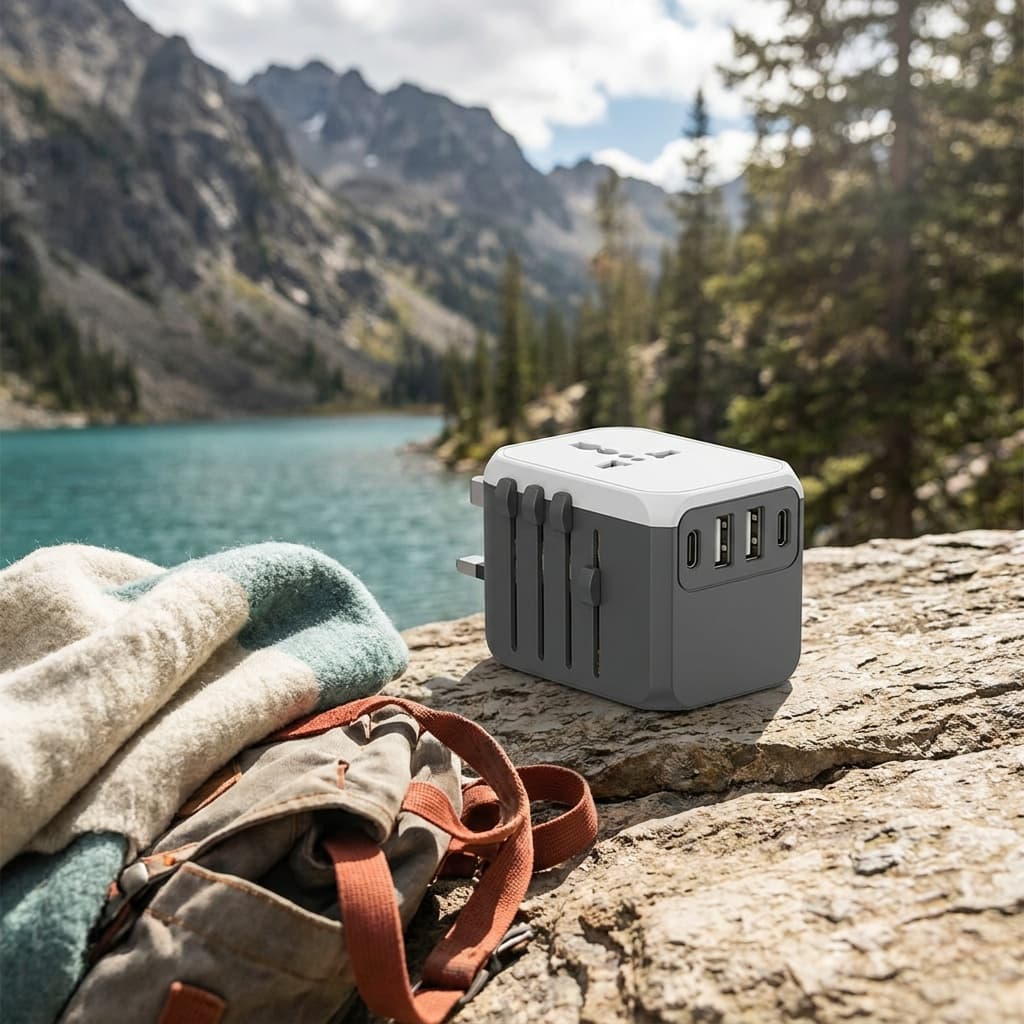
- Country coverage
- 200+ countries (Type A, C, G, I); no Type D or Type M
- USB-A ports
- 2 x USB-A, 2.4A each on the current Amazon listing (the TA-105 manual shows 4)
- USB-C ports
- 3 x USB-C, 5V/3A each (15W, no PD) on the current Amazon listing (the TA-105 manual shows 1)
- AC outlet
- 1 universal socket, 2400W max at 240V
- Safety
- Replaceable 10A fuse plus 1 spare per the current listing (the TA-105 manual lists an 8A-breaking fuse), safety shutters, plug lock system; AC output 10A max; manual rules out appliances over 1,600W
- Design
- Not GaN; standard design with slide-out plugs
About this pick
The TA-105 is one of the most-reviewed travel adapters on Amazon, with a slide-out plug system covering 150-plus countries and six simultaneous charging slots. It charges phones and tablets reliably, though its USB ports are 5V only (15W per USB-C port) with no Power Delivery.
Strengths
- Massive owner review base confirms consistent real-world reliability across dozens of countries
- Five USB ports plus the AC socket let a whole family charge phones, Kindles, and cameras from one outlet
- 10A fuse, safety shutters, and three certifications (CE, FCC, RoHS) give genuine protection at an entry price
Weaknesses
- USB-C ports are 15W each with no Power Delivery: modern iPhones and MacBooks will not fast-charge
- Larger and heavier than GaN alternatives; takes up noticeable carry-on space
Kit Score breakdown

CEPTICS
Ceptics Universal Travel Adapter 11-KU
Best Value
Kit Score 8.5/10
$22.99 Price checked Oct 23, 4:16 PM CDT
Best for: Travelers who want real USB-C fast charging for a phone or small laptop without paying a GaN premium.
- 45W PD USB-C port fast-charges iPhones, iPads, and mid-range laptops at meaningful speed for this price tier
- No GaN: shared total USB output is lower than the single-port 45W peak when multiple ports are in use simultaneously

- Country coverage
- 200+ countries (Type A, C, G, I)
- USB-C ports
- 2 x USB-C: 1 PD/QC 3.0 port up to 45W (single-port peak), 1 standard
- USB-A ports
- 3 x USB-A, up to 2.4A each
- AC outlet
- 1 universal socket, 250V/8A max
- Safety
- Built-in 8A fuse plus spare, safety shutters, CE/RoHS certified
- Dimensions
- 3.0 x 2.2 x 2.1 in, 5.8 oz
About this pick
The 11-KU packs a 45W Power Delivery USB-C port into a compact all-in-one design that covers 200-plus countries, making it the most capable fast-charging option at a sub-$35 price. An LED indicator shows live voltage (115V or 230V), a useful safety cue in unfamiliar hotels.
Strengths
- 45W PD USB-C port fast-charges iPhones, iPads, and mid-range laptops at meaningful speed for this price tier
- LED voltage indicator and included spare 8A fuse add practical safety depth most competitors skip at this price
- 4.7/5-star owner average with long-haul traveler reports confirming durability across multiple trips
Weaknesses
- No GaN: shared total USB output is lower than the single-port 45W peak when multiple ports are in use simultaneously
- Reassembling the slide-out plugs into travel position takes practice
Kit Score breakdown

TESSAN
TESSAN GaN 65W Universal Travel Adapter WTA07
Best Overall
Kit Score 8.3/10
$54.99 Price checked Oct 23, 4:16 PM CDT
Best for: Travelers who carry a laptop alongside multiple phones and tablets and want one adapter to replace their laptop brick.
- 65W GaN USB-C charges a 13-inch MacBook Air at full speed; a phone reaches 65 percent charge in roughly 30 minutes on a single port
- No Type D (India) or Type M (South Africa) support, a real gap for South Asia and southern Africa trips

- Country coverage
- 150+ countries (Type A, C, G, I)
- USB-C ports
- 3 x USB-C: C3 up to 65W PD, C1 and C2 up to 15W each
- USB-A ports
- 2 x USB-A: A1 and A2 up to 15W each
- AC outlet
- 1 universal socket, 2500W max at 250V
- Safety
- Double 10A fuse (replaceable), dynamic thermal sensors, flame-retardant housing
- Dimensions
- 2.13 x 1.97 x 3.03 in, 6.04 oz (171 g), GaN technology
About this pick
The TESSAN GaN 65W WTA07 delivers laptop-grade charging speed through a dedicated 65W PD USB-C port while keeping the footprint under 6.1 oz. Dual replaceable 10A fuses and thermal sensors make it one of the better-protected options in its price tier.
Strengths
- 65W GaN USB-C charges a 13-inch MacBook Air at full speed; a phone reaches 65 percent charge in roughly 30 minutes on a single port
- Double replaceable 10A fuse plus thermal sensors: a spare fuse ships inside the unit, so a blown fuse in a remote hotel does not end the trip
- Independent reviews (including Coolsmartphone) confirm no overheating when running a laptop, phone, and earbuds simultaneously
Weaknesses
- No Type D (India) or Type M (South Africa) support, a real gap for South Asia and southern Africa trips
- The two secondary USB-C ports (C1 and C2) are capped at 15W each; full 65W is available on C3 only
Kit Score breakdown
See all picks in Best universal travel adapters: 4 picks by charging wattage
Keep going
Complete loadoutCarry-on travel kitA one-week suitcase system with the bag, organization, laundry, toiletries, security, scale, and power.

Researched, not hands-on tested
Updated Sep 25, 2026Our recommendations draw on manufacturer documentation, retailer listings, owner feedback, and comparisons with alternatives.
As an Amazon Associate I earn from qualifying purchases. We may earn a commission from links here, at no extra cost to you. How we research →