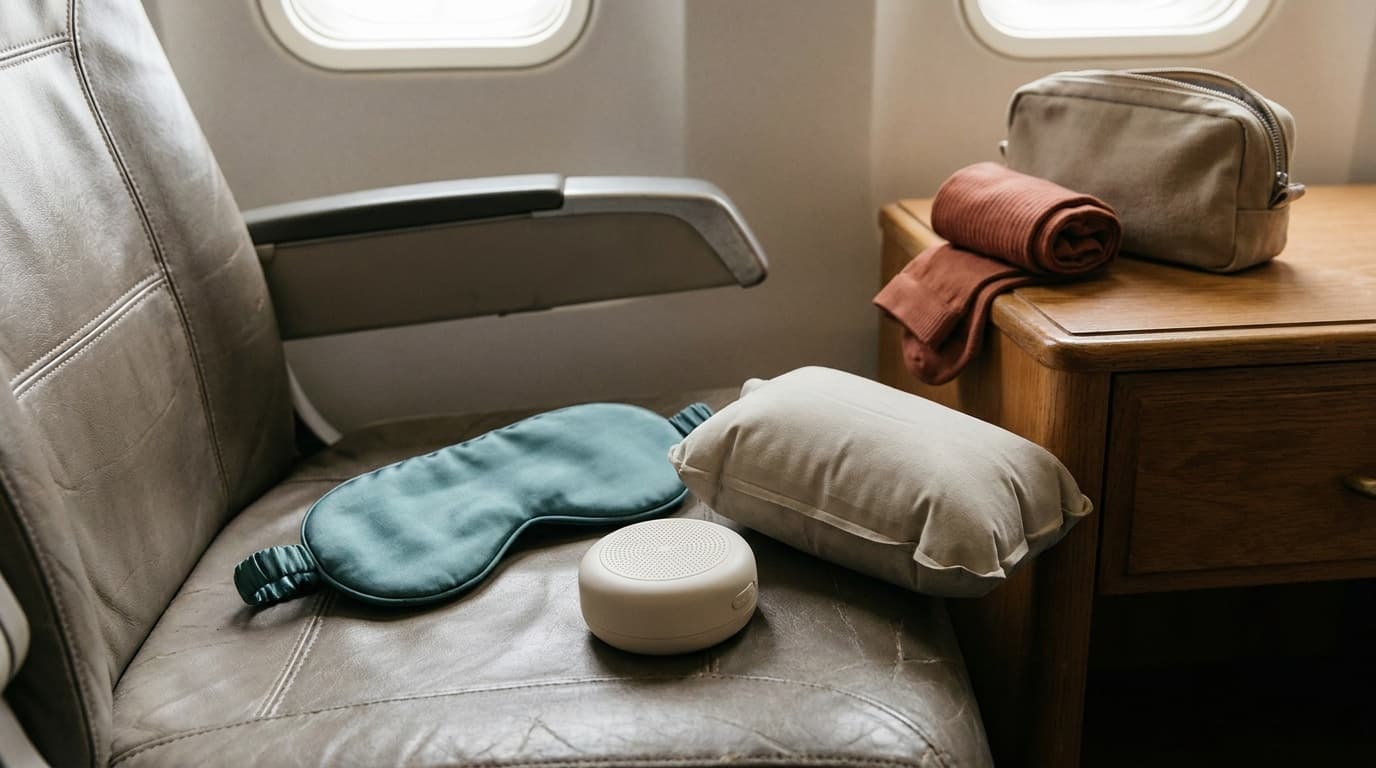
A sleep mask is not just a comfort item. The science is clear: ambient light reaching your closed eyelids can meaningfully disrupt your sleep chemistry, and the right mask closes that gap.
Why a mask actually works
Your eyelids are not a reliable light barrier. Research on eyelid spectral transmittance shows that closed eyelids attenuate circadian-effective light by roughly 100x, but individual variation spans an order of magnitude: some people's eyelids let through 10x more light than others. That means for a meaningful share of sleepers, even a dimly lit room is enough to reach the photoreceptors that drive your circadian clock.
Even a basic mask that cuts 95% of incident light meaningfully reduces the circadian signal that would otherwise reach your eyes. The case for wearing one is not just about blocking the reading lamp across the aisle.
Contoured vs flat: the core tradeoff
A contoured (3D cup) mask uses a molded shell to create an air gap between the mask surface and your eyelids. A flat mask rests directly on the eyelids.
The practical difference matters most during REM sleep. During rapid eye movement, your eyes move actively under your lids. A flat mask pressing on the eyelid surface can interfere with that movement, which is why contoured designs dominate longer-wear use. The air gap also lets you blink and open your eyes briefly without the mask surface dragging across your cornea.
Flat masks have real advantages: they fold to nearly nothing, weigh under 20 grams, and pack into any corner of a bag. For a three-hour flight where you want something and nothing else, a thin flat silk mask like the Alaska Bear Mulberry Silk Sleep Mask is a reasonable call.
The gap between your eyelid and the mask surface is not a luxury feature. It is what makes the mask comfortable for more than an hour.
Getting total blackout
No industry standard defines "blackout." Every brand uses the term. What determines actual light seal is geometry, not materials.
A mask needs to close four contact zones: the nose bridge, both temples, and the forehead. The nose bridge is where most masks fail. A flat mask with no nose shaping leaves a gap at each nostril corner that funnels light directly into the eye. Contoured masks that include a molded or adjustable nose bridge cover, like the MZOO Luxury Sleep Eye Mask, close this gap significantly better.
How to test a mask for real blackout
Stand in daylight
Put the mask on indoors, then face a window or bright lamp. Any light you see is a seal failure.
Check the nose gap first
Press lightly along the nose bridge edge. Most leakage is here, not at the temples.
Turn your head side to side
Temple gaps open when you rotate. A mask that seals facing forward may leak when your head is turned.
Lie on your side
For side sleepers, the seal changes when the pillow presses against one side of the mask. Test in position.
Strap comfort and fit
An elastic strap that is too tight causes headaches and marks. Too loose and the mask shifts within the first 20 minutes. Fixed elastic loops, which most budget masks use, cannot be adjusted once manufactured. A buckle-adjustable strap is the single most meaningful quality upgrade available and it costs almost nothing in manufacturing terms.
For hair: wider flat straps distribute pressure across more of the skull and are less likely to tangle. Thin elastic cords concentrate pressure on one line. Velcro closures will grip fine hair and cause pulling on removal. A smooth buckle slider solves both problems.
Side-sleeper fit
The challenge for side sleepers is not strap tension. It is cup-to-pillow clearance.
When you press your head into a pillow, the pillow compresses around the mask. A tall, rigid contoured shell sits proud of your face and the pillow edge loads against the outer rim, rotating the cup inward toward your eye socket. Over a full night this causes pressure, leaves marks, and can cause blurred vision on waking as the cup has shifted to press on the eyeball.
The options that work for side sleepers:
- Low-profile contoured cups that do not sit far off the face
- Soft (not rigid) cup shapes that compress slightly under pillow pressure without transmitting force to the eye
- Masks with independently adjustable or detachable cups that can be repositioned if they drift, like the Manta Pro Sleep Mask
- Thin flat masks, which have no cup to lever against the orbital bone
A wider back strap distributes pressure across the skull rather than concentrating it on a single line, which also helps for extended side sleeping.
Materials and breathability
Face-contact material comparison
Silk (mulberry or tussah)
Lowest friction against skin, moderately breathable, good for sensitive skin. The reference standard for smooth, cool wear.
Polyester satin
Looks and feels similar to silk but traps more heat. A reasonable budget material in cooler climates.
Cotton
Most breathable, absorbs moisture, best for hot sleepers. More surface friction than silk; note if you are sensitive to texture.
Memory foam
Best structural support for contoured shells, delivers the tightest light block at the edges, least breathable. Runs warm.
For warm climates or long-haul flights where cabin temperature varies, the practical combination is a silk or cotton face lining paired with a structured foam shell. This gives you the structural blackout performance of foam without the heat retention against your skin.
Avoid synthetic polyester shells next to the skin if you run warm. The breathability difference between a silk-lined mask and a polyester-lined mask is noticeable after the first hour.
Travel-specific priorities
Cabin light levels during cruise typically run 50–150 lux, enough to suppress melatonin through eyelids in sensitive sleepers. On a daytime flight where you are trying to sleep across time zones, nose-bridge seal and strap adjustability matter more than material softness.
For carry-on use, a contoured mask that folds flat or comes with a clamshell case protects the cup shape in a bag. Avoid masks with metal adjustment hardware in the strap band if you want hassle-free security screening.
For side sleepers flying overnight, the seat recline reduces pillow depth, which actually helps: there is less pillow mass pressing against the cup. A standard contoured mask that causes problems in a deep pillow at home may work well in a plane seat.
For longer trips, weigh the mask against your other kit before buying. A silk flat mask is under 15 grams. A full contoured mask with a clamshell case can be 80–120 grams. If you are at the margin of a carry-on limit, the flat mask earns its place.
For a curated set of options across these categories, see our guide to the best sleep masks for travel.
Does a sleep mask actually improve sleep, or is it just a comfort item?
The research says it does more than comfort. A 2012 study in BMC Research Notes found that light reaching closed eyelids suppressed melatonin by 36–56% depending on the time of night. A 2015 randomized controlled trial of ICU patients showed that wearing an eye mask significantly improved sleep depth, time to fall asleep, and number of awakenings compared to controls. The effect is physiological, not just psychological: blocking ambient light reduces the circadian signal that would otherwise reach your retina through your eyelids.
I sleep on my side. Will a contoured mask work for me, or will it get knocked off?
It depends on the cup profile. A tall, rigid contoured shell will often rotate as you press your head into a pillow, shifting the cup rim against your eye socket. The better options for side sleepers are low-profile contoured cups, soft (non-rigid) cup shapes, or masks with independently adjustable cups that can be repositioned if they shift. A thin flat mask is also a viable choice if complete blackout is not your priority. Test any mask by lying on your side and pressing your head into a firm surface before trusting it for a full night.
What is the difference between silk, satin, and memory foam for the face contact layer?
Silk is the softest, has the lowest friction against skin, and is moderately breathable. It is the best choice for skin sensitivity or acne-prone skin. Satin refers to a weave pattern, not a fiber: polyester satin mimics silk's smoothness but traps more heat. Cotton is the most breathable and absorbs moisture, making it the better pick for hot sleepers, though it has more surface friction than silk. Memory foam provides the best structural support for contoured cup shapes and the tightest edge seal, but it is the least breathable material and runs warm. For travel in warm destinations or on long-haul flights where cabin temperature varies, a silk or cotton face layer paired with a structured foam shell is a practical middle ground.
Browse all travel gear reviewed on Kit Authority, or read about how we research and rate the products we cover.
Recommended gear
Our current top picks from the Best sleep masks for travel: our top 4 picks guide, if you are ready to buy.
Best for: Travelers who prioritize complete blackout and zero eye pressure above all else, at a price that does not sting if the mask gets left in a hotel room.
- Deep molded cups create zero eye pressure and prevent fabric contact with lashes
- Bulkier than flat silk masks, takes up slightly more carry-on space
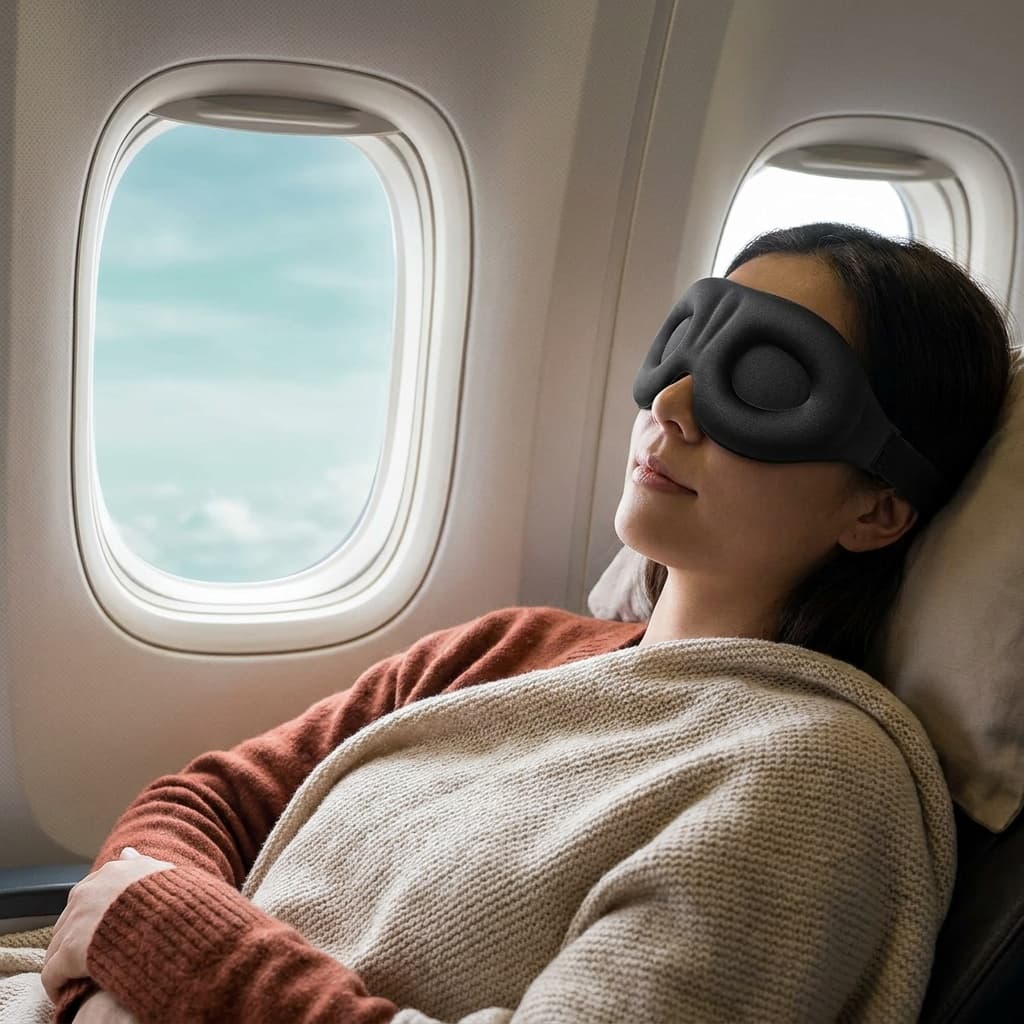
- Design type
- 3D contoured molded foam cups
- Strap
- Adjustable elastic, 19"–28", no velcro
- Light blocking
- 100% blackout claimed; patented nose bridge
- Side-sleeper fit
- Curved sides reduce temple pressure
- Pack size
- Compact; includes travel pouch
- Materials
- Memory foam + breathable polyester cover
About this pick
A 3D contoured foam mask with deep eye cups that keep fabric off lashes and eyelids, delivering genuine blackout performance well under $20. The no-velcro adjustable strap and curved temple design make it a consistent recommendation from sleep reviewers and nearly 100,000 verified buyers who need real darkness on planes and in bright hotel rooms.
Strengths
- Deep molded cups create zero eye pressure and prevent fabric contact with lashes
- Patented nose bridge blocks light leakage even when face-down on an airplane seat
- No-velcro strap adjusts 19"–28" and does not snag hair
Weaknesses
- Bulkier than flat silk masks, takes up slightly more carry-on space
- A small number of reviewers with wider noses report minor light leakage at the bridge
Kit Score breakdown
NIDRA
Nidra Contoured Sleep Mask
Editor's Choice
Kit Score 7.8/10
$29.99 Price checked Oct 23, 6:22 AM CDT
Best for: Frequent flyers who want a proven, editor-recommended contoured mask that packs flat without sacrificing full blackout.
- Long-running Wirecutter recognition, per the brand, reflects consistent performance across many face shapes
- Hand wash and air dry only; heat can damage the memory foam
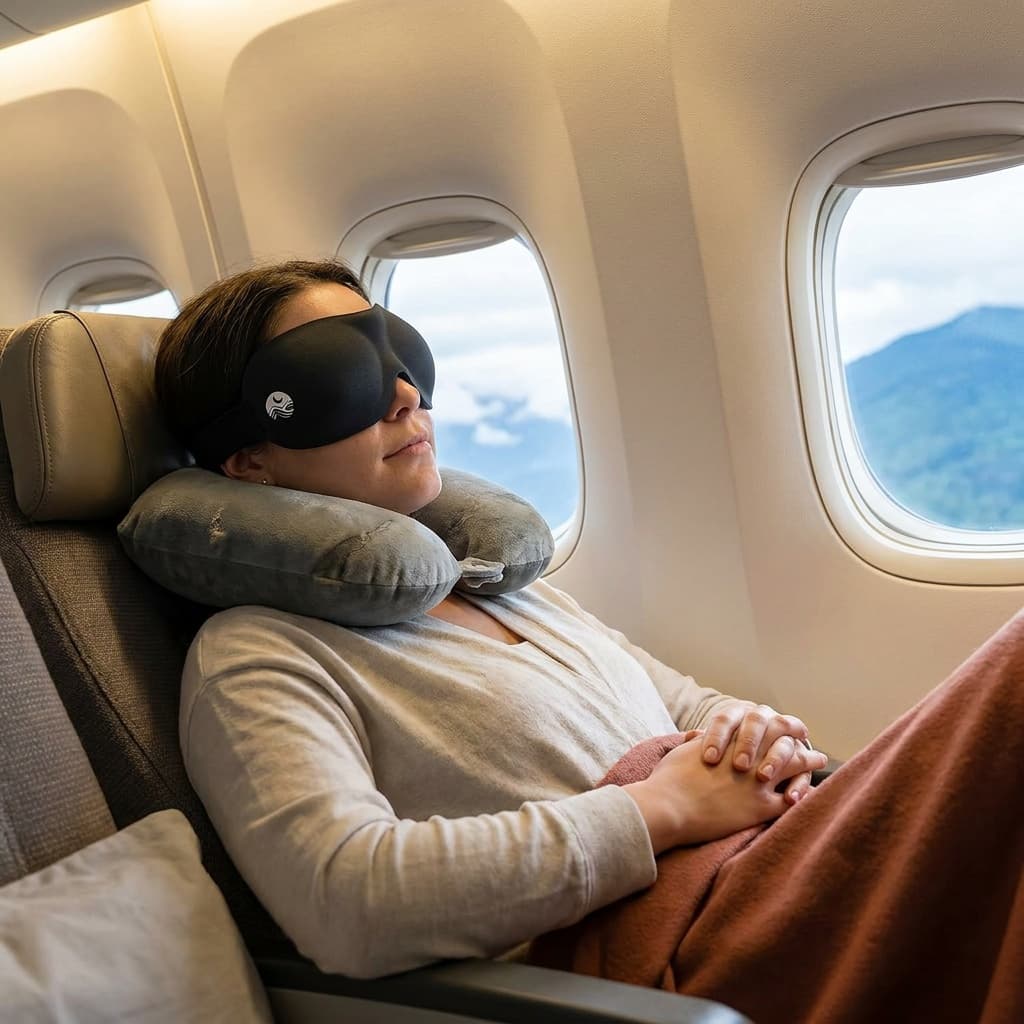
- Design type
- Deep 3D contoured memory foam cups
- Strap
- Adjustable velcro strap, fits 14–26 in heads
- Light blocking
- 100% blackout claimed by the maker
- Weight
- About 1 oz (28 g)
- Pack size
- Compact pouch included
- Sizes
- Standard and Small available
About this pick
Nidra's patented deep 3D memory foam cups curve away from the eyes and lashes, and the brand reports a multi-year run as NYT Wirecutter's top sleep mask pick. At about 1 oz with a velcro strap that fits 14 to 26 inch heads and a Small size for narrower faces, it is an easy default for frequent flyers who want a proven contoured mask.
Strengths
- Long-running Wirecutter recognition, per the brand, reflects consistent performance across many face shapes
- About 1 oz, so it adds almost nothing to a carry-on
- Available in Standard and Small sizes to improve fit on narrower faces
Weaknesses
- Hand wash and air dry only; heat can damage the memory foam
- Lower Amazon star count (4.2) compared to MZOO reflects fit variability across face shapes
Kit Score breakdown
Best for: Hot sleepers or people with non-standard face shapes who have found fixed-cup masks leak light and need a fully adjustable, ventilated premium option.
- Independently adjustable eye cups eliminate the fit compromise that affects fixed-cup masks on non-average face shapes
- At $85, several reviewers and independent testers note the blackout performance does not justify the premium over $17–$30 alternatives
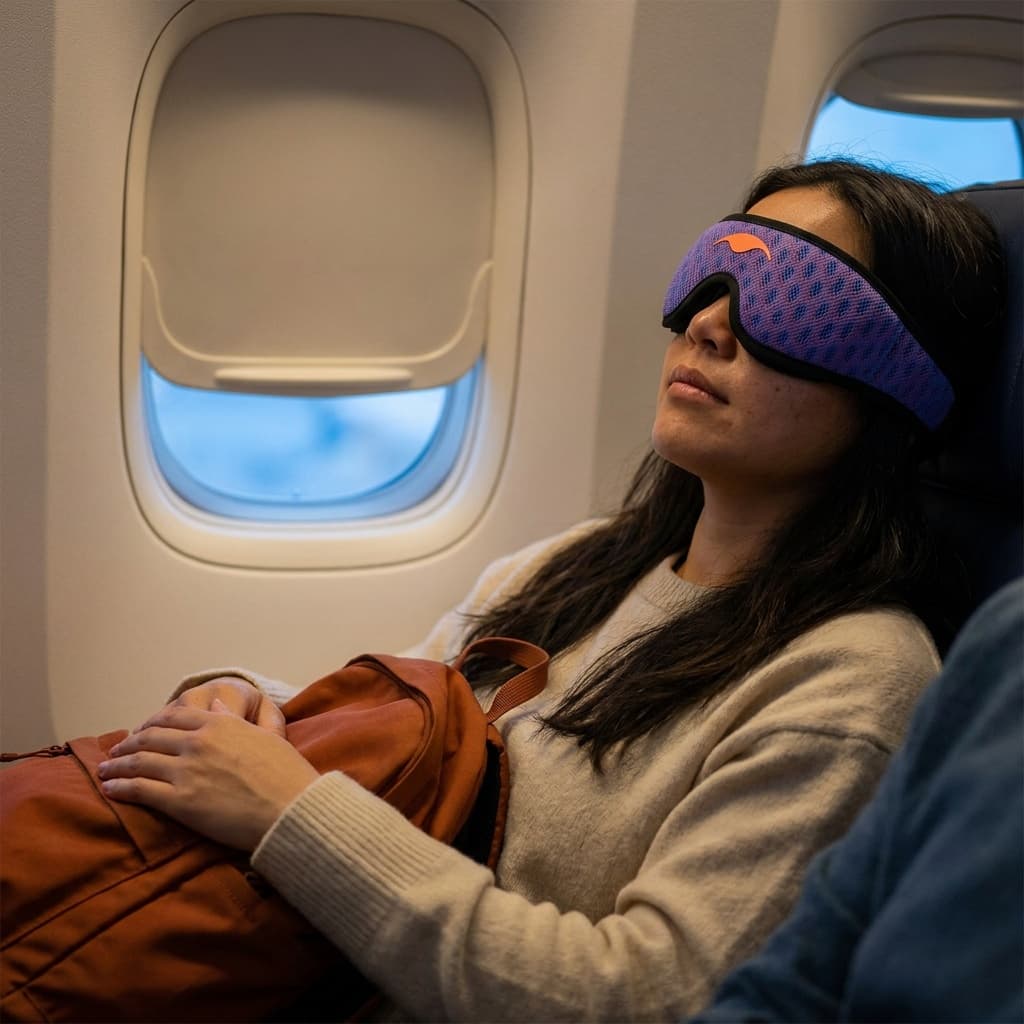
- Design type
- Adjustable detachable C-shaped eye cups
- Strap
- Angled strap sits above the ears; anti-slip silicone grip; 73 cm circumference
- Light blocking
- 100% blackout; cups position independently
- Fabric
- Perforated Tactel, moisture-wicking
- Care
- Machine washable, cold, in a mesh bag; air dry flat
- Includes
- Carry pouch
About this pick
Manta's Pro mask uses C-shaped eye cups that slide anywhere along the strap to fit different face shapes, with perforated moisture-wicking fabric designed for hot sleepers and side sleepers who find standard contoured masks too warm. The premium price is the main objection in owner reviews, with several independent comparisons noting that the blackout performance is matched by masks costing far less.
Strengths
- Independently adjustable eye cups eliminate the fit compromise that affects fixed-cup masks on non-average face shapes
- Perforated Tactel fabric and ventilation channels run cooler than solid foam alternatives
- C-shaped cups taper flat at the temples, making side sleeping genuinely comfortable without pressure
Weaknesses
- At $85, several reviewers and independent testers note the blackout performance does not justify the premium over $17–$30 alternatives
- Velcro cup attachment can shift during active side sleeping, allowing occasional light leakage until readjusted
Kit Score breakdown
See all picks in Best sleep masks for travel: our top 4 picks
Keep going
Complete loadoutLong-flight comfort kitFive packable pieces for neck support, darkness, quieter cabins, leg comfort, and more consistent sleep away from home.

Researched, not hands-on tested
Updated Jun 4, 2026Our recommendations draw on manufacturer documentation, retailer listings, owner feedback, and comparisons with alternatives.
As an Amazon Associate I earn from qualifying purchases. We may earn a commission from links here, at no extra cost to you. How we research →