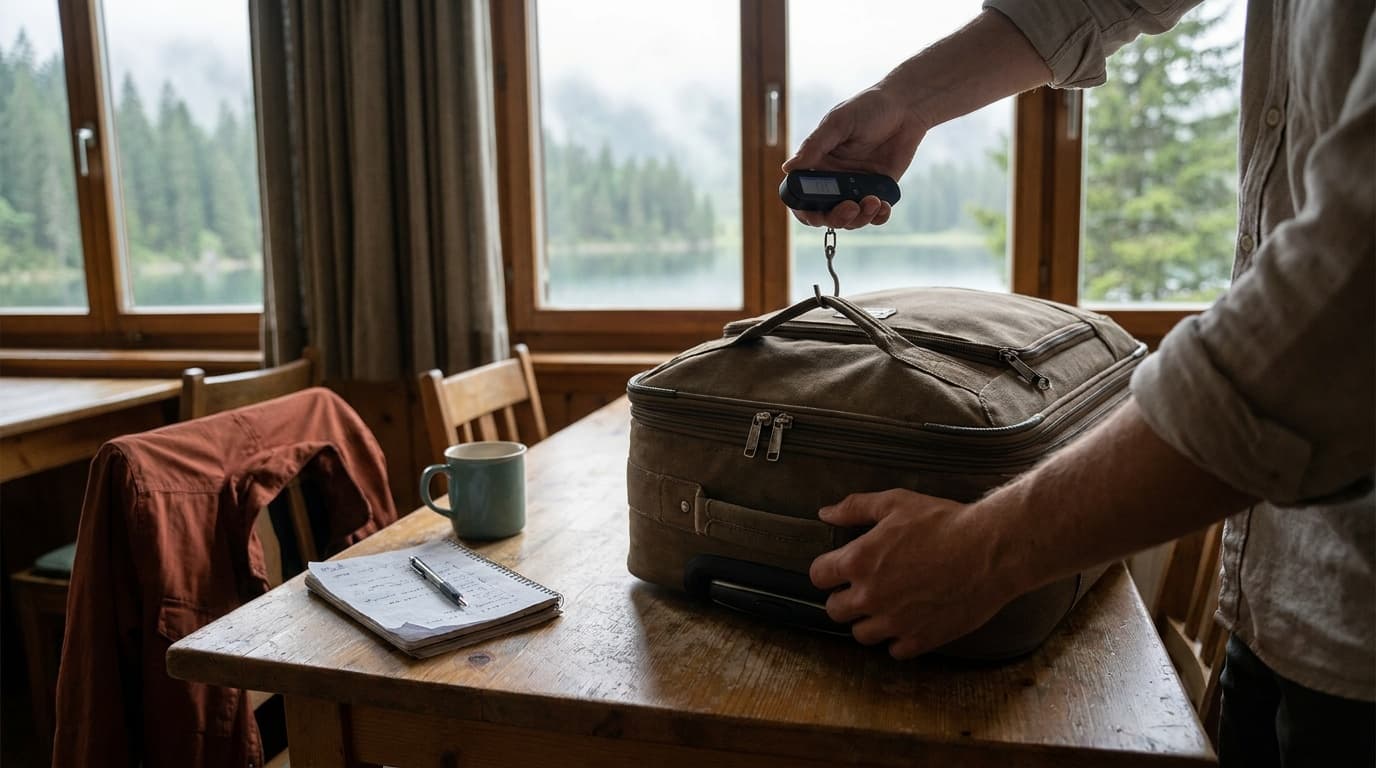
A decent handheld luggage scale is accurate to about 1% of the reading, roughly 0.2 kg (half a pound) on a full 23 kg (50 lb) checked bag. That is the tolerance Dr.meter publishes for its PS02; most brands, Etekcity included, publish only the display step (0.1 lb or 50 g), which is not the same thing as accuracy. Weigh with a slow, steady lift and leave a 0.5 to 1 kg buffer under the airline limit, and a slightly different scale at the airport never costs you a fee.
Decide whether you need a new scale
Test the scale you already own before shopping. Hang a known 10 lb or 10 kg weight twice using a slow lift.
- Both readings land within 0.1 to 0.2 kg of the known weight: keep your scale. Leave a 0.5 to 1 kg airline buffer and spend nothing.
- The readings disagree with each other: replace the battery and repeat the test. Technique or low power is more likely than a permanently bad sensor.
- The readings agree but miss by more than 0.5 kg: replace the scale. The Etekcity EL11 is the straightforward occasional-travel pick.
- You weigh heavy bags or struggle to read a moving display: choose the Dr.meter PS02 for its sturdier handling, backlit display, and auto-hold. Those are usability upgrades, not permission to pack to the exact limit.
Our quick picks
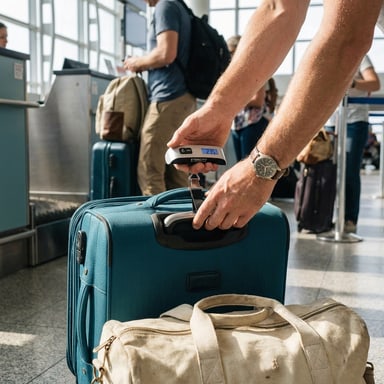
Etekcity EL11 Digital Luggage Scale
Nearly 71,000 Amazon reviews at 4.7 stars: one of the most validated luggage scales in the category
Best for: Budget-conscious travelers who trust review volume over premium features and don't need a backlit screen.
Buy on Amazon →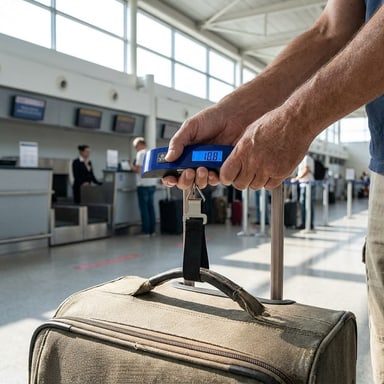
Dr.meter PS02 Luggage Scale
Backlit display plus data-hold makes solo weighing easy in any lighting
Best for: Frequent flyers who want a proven, backlit scale that holds the reading without a helper.
Buy on Amazon →How accurate are luggage scales?
Two numbers get mixed up on scale listings. The display increment is the smallest step the screen shows. The accuracy, or tolerance, is how far the reading is allowed to be from the true weight. The Etekcity EL11 shows 0.1 lb (50 g) steps on a 110 lb (50 kg) capacity, but Etekcity does not publish an accuracy figure. The Dr.meter PS02 is one of the few handheld scales with a stated tolerance: +/- 1%, with the same 110 lb (50 kg) capacity. On a bag you are trying to keep under the 50 lb (23 kg) checked limit that American and Delta both use on standard fares, 1% is about 0.23 kg, or half a pound, which is small enough to plan around.
That tolerance is the spec under ideal conditions: a steady hold, room temperature, a fresh battery, weight inside the scale's rated range. Real bathroom or kitchen behavior creeps in at the edges. Hang a 25 kg suitcase on a scale rated to 50 kg and you are well inside its sweet spot. Try to read a 1 kg packing cube on the same scale and the error that matters shifts, because a 50 g display step is 0.2% of 25 kg but 5% of 1 kg.
Why two readings disagree: it is usually the lift, not the scale
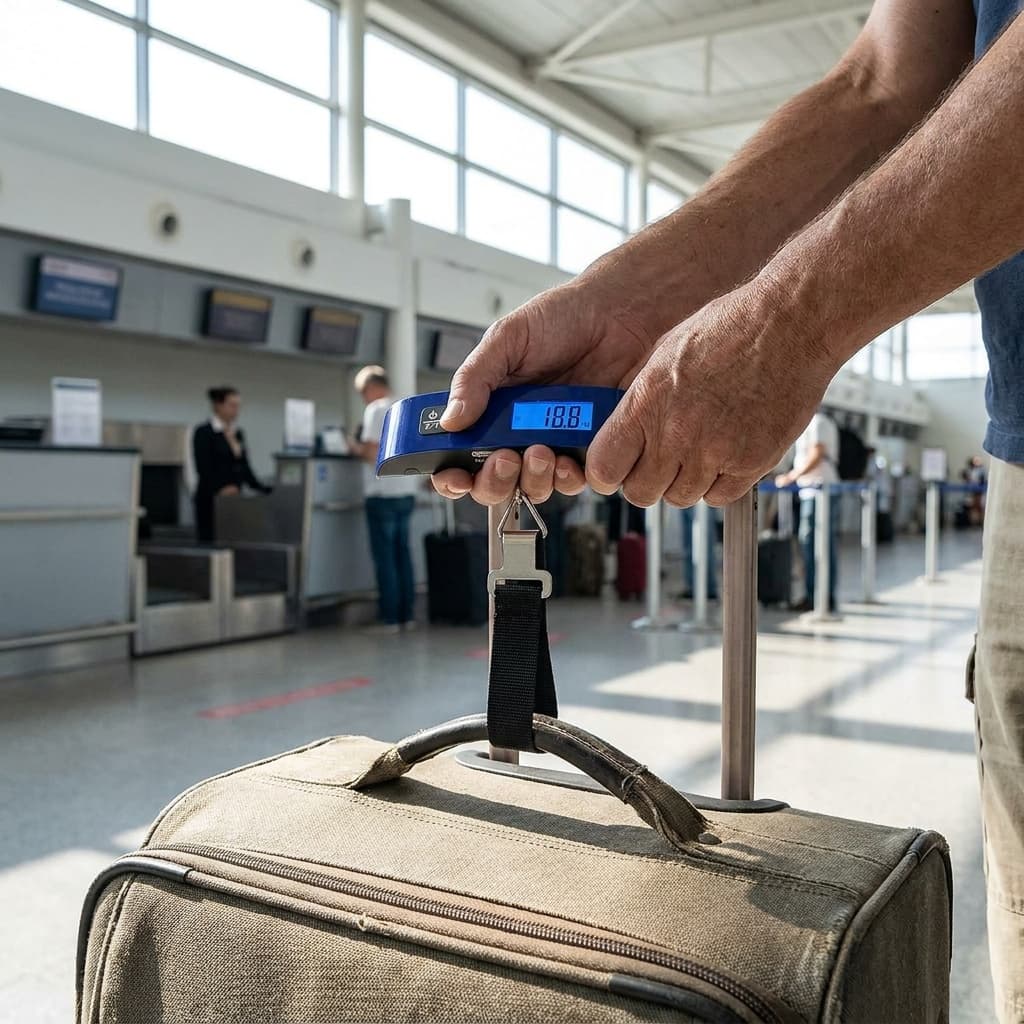
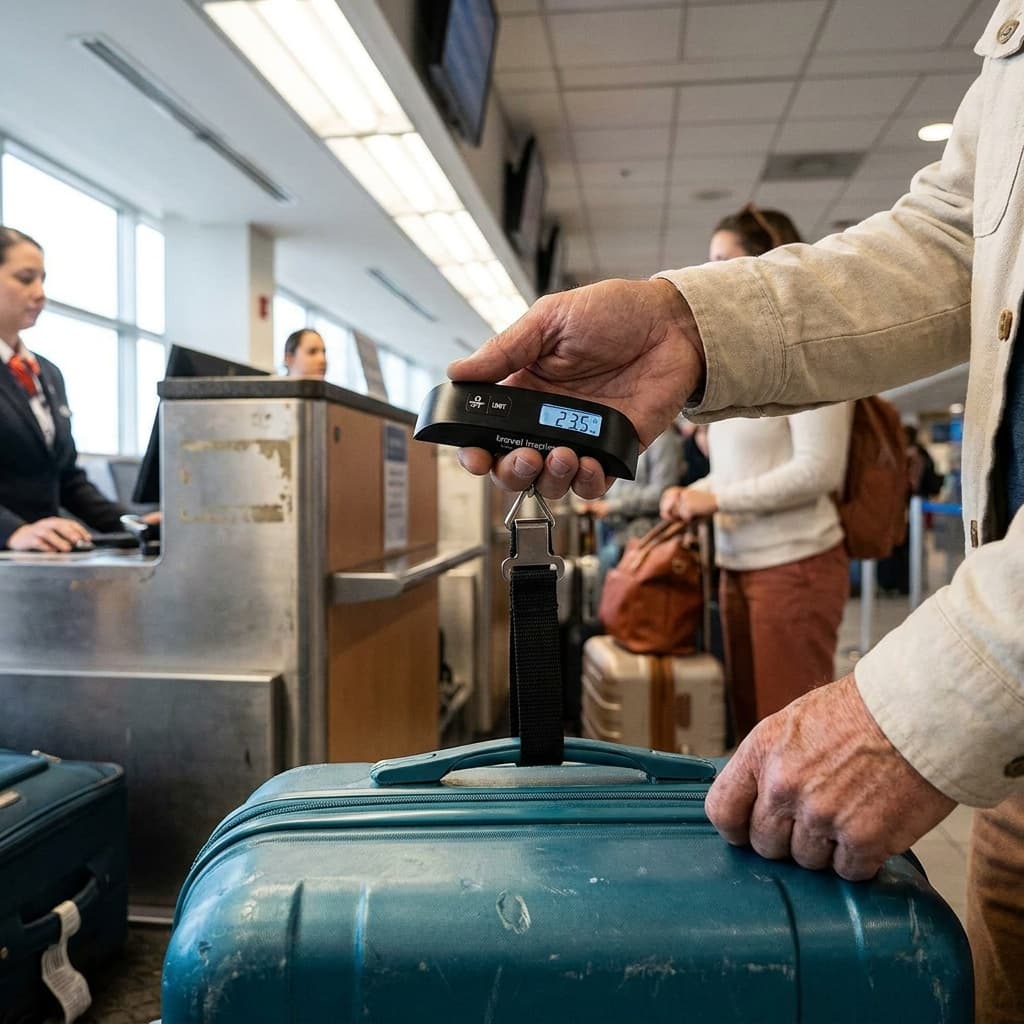
The most common reason a scale gives you two different numbers in a row is how you lifted the bag. A hook-style scale measures force. Jerk the bag up fast and you add acceleration on top of gravity, so the scale briefly sees more than the bag actually weighs and may lock that spike in. Lift slowly and let the bag hang dead still, and the reading settles on the real number.
Swinging matters too. A bag that is still rocking on the hook keeps the reading bouncing, so the value you note down depends on exactly when you glanced. Temperature and a weak battery can nudge a digital sensor a little, but those shifts are small next to a bad lift.
A steady three-second hold beats a fast yank every time, because the scale is measuring force, not just mass.
This is also why the airport scale and your home scale can differ by a few hundred grams and both be "right." The airport uses a flat platform scale that the bag sits on motionless, which removes lift error entirely. Your handheld version is measuring the same bag a noisier way.
The airport scale is also a regulated instrument. NIST's weights and measures FAQ lists "the luggage scale at the airport" as a commercial application, because it computes a charge based on weight, and commercial scales have to meet the state's legal metrology rules. Those rules come from NIST Handbook 44, which puts general commercial and postal scales in accuracy Class III and allows a maintenance tolerance of one scale division on loads up to 500 divisions. On a check-in scale that reads in 0.1 kg steps, a 23 kg bag is 230 divisions, so the scale is allowed to be off by 0.1 kg and still pass inspection. That is the same order as your handheld's tolerance, which is why the buffer below matters more than which scale is "right."
How to weigh a bag so the number is trustworthy
Good technique closes most of the gap between your scale and the one at check-in. Work through these steps and the reading you get at home is the one you can plan around.
How to weigh luggage correctly
Zero it empty
Power on the scale with nothing attached and let it settle to zero (tare) before you hook anything up.
Hook through a solid handle
Attach the strap or hook to the bag's strongest grab handle so the full weight pulls straight down, not at an angle.
Lift slow and steady
Raise the bag in one smooth motion until it hangs clear of the floor, then stop moving and hold.
Wait for the lock
Let the bag hang dead still for two to three seconds until the reading freezes, then note it.
Weigh twice
Take a second reading. If the two agree within 0.1 to 0.2 kg, trust them; if they swing wildly, your lift is the problem.
How much buffer should you leave under the airline limit?
Never pack right up to the line. Leave 0.5 to 1 kg of headroom under your airline's stated allowance. That buffer absorbs three things at once: your scale's tolerance, the airport scale's own tolerance, and small last-minute additions like a filled water bottle, a paperback, or a damp towel you forgot about.
The stakes are lopsided. Being 0.3 kg under costs you nothing. Being 0.3 kg over can trigger an overweight fee. American's published fees on US and Canada routes are $30 for a bag from 51 to 53 lb, $100 from 54 to 70 lb, and $200 from 71 to 100 lb; Ryanair charges €/£13 per extra kilo at the airport. Or you repack at the counter while the line builds behind you. A kilo of breathing room is cheap insurance.
If you are flying a strict carry-on weight airline (many low-cost carriers cap the cabin bag at 7 to 10 kg), tighten that buffer to a hard rule and weigh the bag fully packed, with the personal item you plan to carry, not half loaded.
Calibrating and checking your scale
Most handheld luggage scales cannot be recalibrated by the user, but you can and should verify them. The goal is not a lab-grade calibration, it is confidence that the number is close.
Grab an object whose weight you already know and hang it: a labeled gym dumbbell or kettlebell, a few sealed water bottles (1 liter of water weighs almost exactly 1 kg), or a bag of flour or sugar with the weight printed on it. Hang it, read it, and compare. If a 10 kg dumbbell reads 9.9 to 10.1 kg, your scale is doing its job. If it reads 11 kg, retire it.
Do this check when the scale is new, after it has been knocked around in a drawer for a year, and before any trip where the weight limit is tight. A weak battery is the most common cause of a scale that drifts over time, so swap it if readings start wandering.
When a cheap scale is good enough (and when to spend more)
For most travelers, an inexpensive handheld digital scale is genuinely good enough. If it passes the known-weight check and you leave a sensible buffer, you will clear check-in without drama. Few brands publish an accuracy rating at all, and a finer display step does not make a scale more accurate, so your buffer does more for you than a pricier scale.
Spend more when you have a specific reason: you fly carry-on weight airlines constantly and want the tightest possible margin, you want a sturdier hook and strap for heavy bags near the 50 kg rating, or you want a backlit display and auto-hold that locks the reading, as on the Dr.meter PS02, so you are not squinting at a swinging bag. Those are convenience and durability upgrades more than accuracy ones.
The one scale to avoid is any unit that fails its known-weight check or feels flimsy at the hook, since the hook is where heavy bags fail.
Frequently asked questions
Are cheap luggage scales accurate enough for flying?
Yes, for most travelers. A budget handheld scale that reads within 0.1 to 0.2 kg is plenty accurate when you weigh the bag correctly and leave 0.5 to 1 kg of buffer under your airline's limit. Verify it once against a known weight, like a labeled dumbbell or sealed water bottles, and you can trust it.
Why does my luggage scale give a different reading each time?
It is almost always the lift, not the scale. Jerking the bag upward adds acceleration that the scale reads as extra weight, and a swinging bag keeps the number bouncing. Lift slowly, hold the bag dead still for two to three seconds, and wait for the reading to lock. Two careful readings should agree within 0.1 to 0.2 kg.
How do I know if my luggage scale is accurate?
Hang an object whose weight you already know. A labeled gym weight, a bag of flour, or sealed water bottles all work, since 1 liter of water weighs almost exactly 1 kg. If a 10 kg reference reads between 9.9 and 10.1 kg, the scale is fine. If it is off by half a kilo or more, change the battery and retest, then replace the scale if it still drifts.
Where these numbers come from
| Claim | Source | Checked |
|---|---|---|
| 50 lb / 23 kg standard checked-bag limit; $30 (51–53 lb), $100 (54–70 lb), $200 (71–100 lb) overweight fees on US/Canada routes | American Airlines, oversize and overweight bags | Sep 2026 |
| 50 lb / 23 kg standard checked-bag limit | Delta, baggage overview | Sep 2026 |
| €/£13 per extra kilo excess baggage fee at the airport | Ryanair, fees | Sep 2026 |
| Etekcity EL11: 110 lb (50 kg) capacity, 0.1 lb (50 g) increments, CR2032 battery, 2-year limited warranty; no accuracy tolerance published | Etekcity, EL11 luggage scale | Sep 2026 |
| Dr.meter PS02: 110 lb (50 kg) maximum, 10 g minimum load, accuracy up to +/- 1%, backlit LCD, data hold | Dr.meter luggage scale listing on Amazon, ASIN B0BJ2WDYRW (linked in the picks above) | Sep 2026 |
| Airport luggage scales are commercial weighing devices that must meet state legal metrology rules | NIST, Weighing and Scales FAQs | Sep 2026 |
| Class III covers general commercial and postal scales; maintenance tolerance is 1 division up to 500 divisions of test load (Table 6, Table 7a) | NIST Handbook 44, Section 2.20 Scales | Sep 2026 |
We did not test these scales ourselves. Accuracy and increment figures are the manufacturers' listed specs, and the 0.23 kg figure is simply 1% of a 23 kg bag; the technique and buffer advice above is how to make those specs hold up in a real bag.
For specific model picks, see our guide to the best luggage scales. Browse all travel guides or read how we research and rate gear.
Recommended gear
Our current top picks from the Best Luggage Scales in 2026: Top Digital Picks guide, if you are ready to buy.
DR.METER
Dr.meter PS02 Luggage Scale
Best Overall
Kit Score 8.8/10
$9.99 Price checked Oct 23, 4:16 PM CDT
Best for: Frequent flyers who want a proven, backlit scale that holds the reading without a helper.
- Backlit display plus data-hold makes solo weighing easy in any lighting
- Hook-only design means you need to thread the handle through a luggage strap rather than clip a looped strap around it
- Capacity
- 110 lb / 50 kg
- Accuracy
- Rated ±1% (10 g minimum load)
- Display
- Backlit LCD with data-hold
- Attachment
- Hook (rubber-grip handle)
- Battery
- CR2032 (included), auto-off
- Scale weight
- 0.44 oz
About this pick
The Dr.meter PS02 pairs a bright backlit LCD with a data-hold function that freezes the reading the moment you set your bag down, making it one of the easiest scales to read solo. At 0.44 oz, it disappears in a toiletry pouch and reappears reliably every trip.
Strengths
- Backlit display plus data-hold makes solo weighing easy in any lighting
- 4.6 stars across 10,500+ Amazon reviews points to consistent real-world accuracy
- Rubber-paint textured handle reduces slippage under load
Weaknesses
- Hook-only design means you need to thread the handle through a luggage strap rather than clip a looped strap around it
- CR2032 requires a coin for battery replacement, not tool-free
Kit Score breakdown
TRAVEL INSPIRA
travel inspira Portable Luggage Scale
Best Value
Kit Score 8.7/10
$8.49 Price checked Oct 23, 4:16 PM CDT
Best for: Travelers who want a top-selling scale with a generous warranty and easy-read backlit display at a budget price.
- One of Amazon's top-selling luggage scales with nearly 7,000 recent verified-purchase ratings and confirmed-accurate readings per reviewers
- No published accuracy tolerance (only the 0.1 lb display step), unlike the Dr.meter PS02's +/- 1% rating
- Capacity
- 110 lb / 50 kg
- Display increment
- 0.1 lb / 50 g (no accuracy tolerance published)
- Display
- Backlit LCD with 2-minute data lock
- Attachment
- Hook (rubberized handle)
- Battery
- CR2032 (included), auto-off
- Scale weight
- 3.5 oz
About this pick
The travel inspira sits near the top of Amazon's luggage scale bestseller list and earns it with a rubber-grip handle, backlit LCD, and a data-lock function that holds the reading for a full two minutes. At 3.5 oz it weighs almost nothing in a bag.
Strengths
- One of Amazon's top-selling luggage scales with nearly 7,000 recent verified-purchase ratings and confirmed-accurate readings per reviewers
- Two-minute data-lock window gives plenty of time to read the display after setting the bag down
- 2-year limited warranty is longer than most competitors at this price
Weaknesses
- No published accuracy tolerance (only the 0.1 lb display step), unlike the Dr.meter PS02's +/- 1% rating
- Rubber-paint finish can show wear with heavy daily use over time
Kit Score breakdown
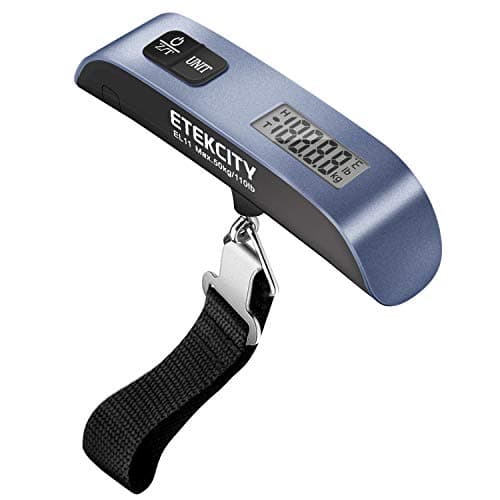
ETEKCITY
Etekcity EL11 Digital Luggage Scale
Best Budget
Kit Score 8.4/10
$9.86 Price checked Oct 23, 4:16 PM CDT
Best for: Budget-conscious travelers who trust review volume over premium features and don't need a backlit screen.
- Nearly 71,000 Amazon reviews at 4.7 stars: one of the most validated luggage scales in the category
- No backlit display: harder to read in dim hotel rooms or low-light baggage areas
- Capacity
- 110 lb / 50 kg
- Display increment
- 0.1 lb / 50 g (no accuracy tolerance published)
- Display
- LCD with 2-minute auto-hold (no backlight)
- Attachment
- Hook (rubber-paint handle)
- Battery
- CR2032 (included), 2-min auto-off
- Scale weight
- 57 g (2 oz)
About this pick
The EL11 holds a 4.7-star rating from nearly 71,000 reviewers, making it one of the most widely validated luggage scales available. The auto-hold locks the reading for two minutes after lift, and a built-in thermometer adds a marginal but handy ambient-temperature readout.
Strengths
- Nearly 71,000 Amazon reviews at 4.7 stars: one of the most validated luggage scales in the category
- Two-minute auto-hold window and overweight alert cover all practical use cases
- Temperature sensor adds a small bonus for packing in climate-sensitive conditions
Weaknesses
- No backlit display: harder to read in dim hotel rooms or low-light baggage areas
- Hook-only attachment; no strap option for bags with shorter or rigid handles
Kit Score breakdown
See all picks in Best Luggage Scales in 2026: Top Digital Picks
Keep going
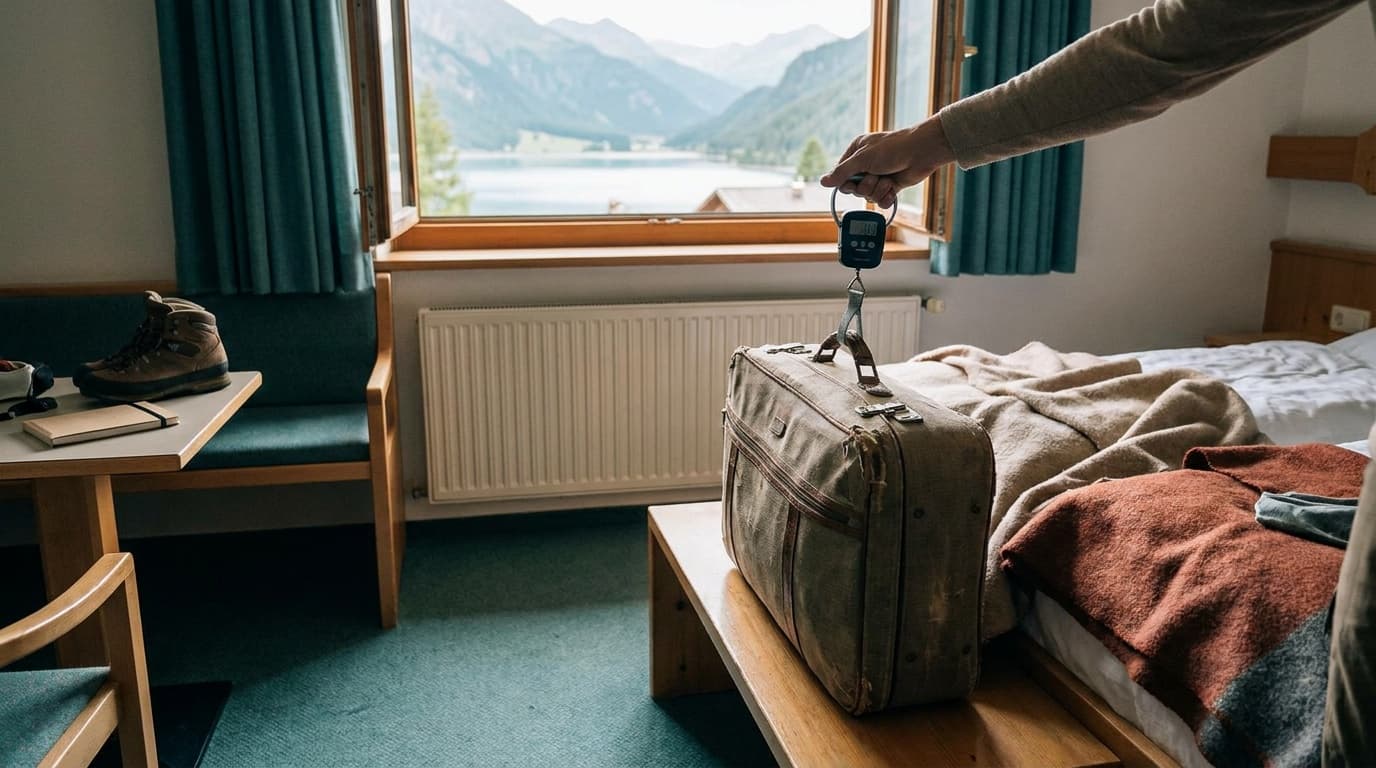
Complete loadoutCarry-on travel kitA one-week suitcase system with the bag, organization, laundry, toiletries, security, scale, and power.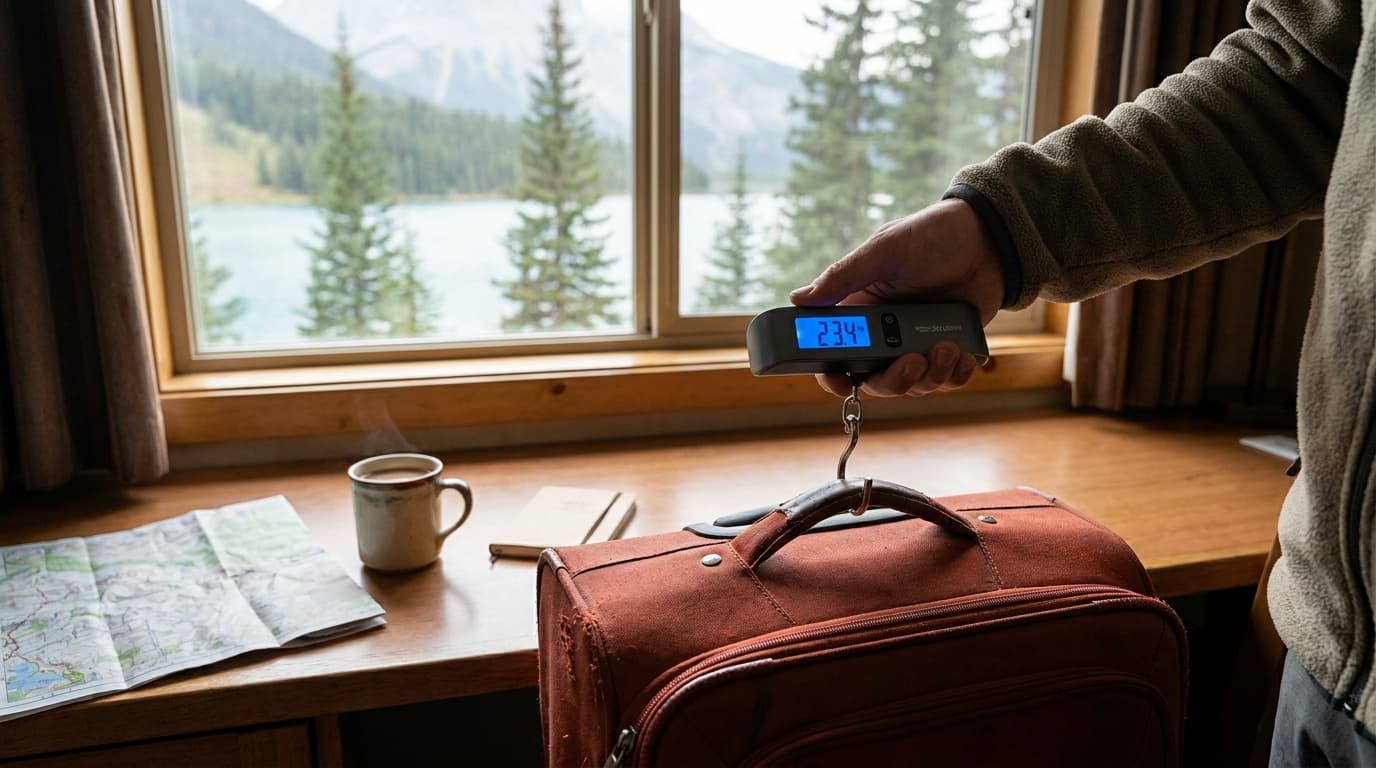
Researched, not hands-on tested
Updated Oct 7, 2026Our recommendations draw on manufacturer documentation, retailer listings, owner feedback, and comparisons with alternatives.
As an Amazon Associate I earn from qualifying purchases. We may earn a commission from links here, at no extra cost to you. How we research →