Will you be warm enough?
A sleeping bag rating only tells half the story. Your pad, what you wear, and how you sleep decide the rest. Enter your setup and get one number: the coldest night it should handle.
Comfortable down to about
Your bag is the limit here. Your pad is keeping up, so warmth comes down to the bag, a liner, or what you sleep in.
25 °F
bag + clothing (weak link)
20 °F
pad supports
Add a forecast low above to check this setup against your trip.
Why your pad matters as much as your bag
Most "will I be warm enough" advice stops at the bag rating. But heat escapes in two directions: up and out through the bag, and straight down into the ground through whatever you are lying on. A 15 °F bag on a thin summer pad sleeps more like a 35 °F bag, because the cold ground wins. That is why this tool reports the warmer of the two: your true comfortable low is set by the weaker link, not the better one.
Sleeping-pad R-value by temperature
A quick reference for how cold a pad can handle on its own. R-values are additive, so two pads stack toward a higher number.
| R-value | Comfortable to | Best for |
|---|---|---|
| Under 2 | about 50 °F | Summer |
| 2 to 3.9 | about 32 °F | Cool / 3-season |
| 4 to 5.4 | about 20 °F | Cold |
| 5.5 and up | about 0 °F | Winter / snow |
Bands follow the ASTM F3340 R-value test and published guidance from REI, Exped, and Switchback Travel. Treat them as approximate.
How we get this number
We start from your bag's comfort rating (converting a lower-limit number up by about 10 degrees, since comfort runs warmer than limit), adjust for whether you sleep cold or warm, and credit a liner or base layers. Separately, your pad's R-value sets how cold the ground side can get. The comfortable low you see is the warmer of those two, because the weaker link governs the system.
This is general guidance, not a guarantee. Wind, moisture, fatigue, and food all move the real number. When a night is close, carry an extra layer. See how we research and rate.
A bag that covers most answers
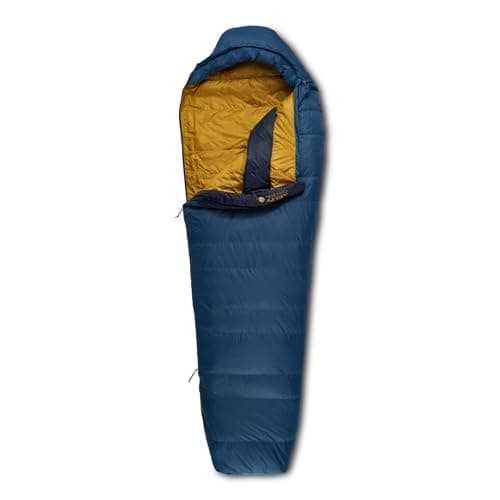
For most 3-season campers the calculator lands somewhere a 20 degree bag handles with margin. The Kelty Cosmic Down 20 is our best-value pick at that rating. See all sleeping bag picks →
Best for: Campers and entry-level backpackers who want real down insulation and long-term durability without paying premium-bag prices.
- Genuine down insulation at a fraction of premium-bag pricing
- ISO Comfort sits at 31°F, so cold sleepers should size up in temperature rating
- Temperature Rating
- 20°F / ISO Comfort 31°F / ISO Limit 21°F
- Insulation
- 550-fill DriDown (water-treated)
- Shell
- Recycled 50D polyester taffeta
- Liner
- Recycled 20D nylon taffeta
- Weight (Regular)
- 2 lb 7 oz
- Packed Size (Regular)
- 8 x 13 in (10.7L)
About this pick
The Kelty Cosmic 20 combines 550-fill DriDown, trapezoidal baffles, and a draft collar in a packable three-season design. Its published ISO comfort rating is 31F for the regular bag, a more useful buying number than the 20F model name.
Strengths
- Genuine down insulation at a fraction of premium-bag pricing
- Durable 50D shell handles rougher treatment better than most budget bags
- Compact enough to double as a backpacking bag for lighter trips
Weaknesses
- ISO Comfort sits at 31°F, so cold sleepers should size up in temperature rating
- Recycled taffeta lining is not the softest against skin
Kit Score breakdown
Researched, not personally tested: picks come from specs, verified-owner reviews, and expert sources, scored into the Kit Score. As an Amazon Associate I earn from qualifying purchases. We may earn a commission from links here, at no extra cost to you. How we research →
Frequently asked questions
What R-value sleeping pad do I need?
For summer, an R-value under 2 is fine. For 3-season trips aim for about 2 to 4, for cold nights 4 to 5.5, and for winter or sleeping on snow you want 5.5 or higher. As a rough guide, a pad keeps you comfortable down to about 50F at R2, 32F at R4, 20F at R5, and near 0F above R5.5.
What is R-value on a sleeping pad?
R-value measures how well a sleeping pad resists heat loss to the ground, and higher is warmer. It is the most overlooked part of staying warm: a warm bag on a thin pad still sleeps cold, because the ground pulls heat straight out of your back. R-values add together, so you can stack two pads to reach a higher number.
What is the difference between a bag's comfort and lower-limit rating?
Under the ISO 23537 standard, the comfort rating is the temperature a cold sleeper stays comfortable, and the lower limit is where a warm sleeper can sleep about eight hours without waking. Women's bags usually show the comfort rating and men's bags the lower limit. If you sleep cold, plan around the comfort number.
Do I need a warm pad if I already have a warm bag?
Yes. Your sleep system is only as warm as its weaker link, and the pad handles the cold coming up from the ground that the bag cannot. If your pad's R-value is too low for the night, a warmer bag barely helps. Raise the R-value, or add a second pad, before buying a heavier bag.
How accurate are sleeping-bag temperature ratings?
Treat them as a guide, not a promise. Ratings come from a standardized lab test on a heated mannequin, but real warmth also depends on your pad, what you wear, how fed and rested you are, wind, and humidity. Most people plan to the comfort rating and carry one extra layer.
More free tools
 Stove Fuel CalculatorHow much fuel to pack for the trip, by meals and people.
 Hiking Water CalculatorHow much water to carry for the distance and the heat.
 Pack-Size SelectorWhat size pack (in liters) your trip actually needs.
Embed this tool on your site (free)
Paste this where you want the tool to appear. It is free to use with a small credit link back to Kit Authority.
<iframe src="https://kitauthority.com/embed/sleeping-bag-warmth" title="Sleeping-Bag Warmth Calculator" width="100%" height="640" style="border:0;width:100%;max-width:680px" loading="lazy"></iframe>
<script>window.addEventListener("message",function(e){if(e&&e.data&&e.data.type==="ka-embed-height"){var f=document.querySelector('iframe[src="https://kitauthority.com/embed/sleeping-bag-warmth"]');if(f){f.style.height=e.data.height+"px";}}});</script>