The wrong camping chair ruins a site more reliably than bad weather. The right one disappears into the background while you actually enjoy where you are.
Chair type drives everything else
Before you compare features, pick a category. Each one represents a different tradeoff locked in at the design stage.
The four chair categories
Low / ground-level
Seat height 8–13 inches, minimal back support, smallest packed footprint. Best for ultralight backpacking or festivals where pack space matters more than comfort.
Standard car-camping
Seat height 14–20 inches, full-back or high-back options, 8–15 lbs. The default choice for drive-in sites, base camps, and tailgates where you are not carrying the chair very far.
Packable / ultralight
Under 3 lbs, pole-and-fabric construction, collapses to a stuff sack. Covers the crossover trip where you drive to a trailhead and hike in. Chairs like the Helinox Chair Zero L (1 lb 7 oz) and Chair One High-Back (2 lb 8.8 oz) live here.
Heavy-duty / oversized
400–800 lb capacity, 13 or more lbs, maximum seat width and padding. For base camping where comfort is the whole point and weight is irrelevant.
Back support: seat height matters as much as back height
Two things combine to determine how your spine feels after an hour around the fire: how high off the ground you are sitting, and whether the chair back reaches your upper spine.
Seat height of 17 inches or more lets most adults stand without rounding the lower back or straining the knees. Below that threshold, your knees rise above your hips, which tilts the pelvis and collapses the lumbar curve. Getting up from a 10-inch ground chair also demands meaningful core and quad effort, and that adds up over a weekend.
High-back designs extend support to the upper spine and neck, which matters for sessions longer than 30 minutes. The tension in an unsupported upper back travels down and compounds existing lumbar strain. Low-back chairs end at mid-back and pack significantly smaller, so if you only sit for short stretches, you give up little.
Taut, non-sagging fabric is the most underrated back-support feature. A chair that cups or sags pulls the lower back into a C-curve regardless of how high the back panel sits.
Weight vs. comfort: the tradeoff is real but predictable
Ultralight chairs under 2 lbs are designed for backpackers who sit for short periods. The seat is narrower, the back is lower, and there is little padding. For occasional evening fire-sitting, they work. For extended sitting over 30–45 minutes, most people shift and fidget.
The crossover sweet spot for most camp-and-hike trips is the 2–5 lb range. Pole-frame chairs in this band, such as the REI Flexlite Camp Dreamer at 3 lbs 5 oz or the Helinox Chair One High-Back at 2 lbs 8.8 oz, deliver reasonable comfort without a weight penalty that makes you leave the chair in the car.
Standard car-camping chairs like the Kijaro Dual Lock (8–12 lbs) add padding, cup holders, and recline. If you are driving to every site and never lifting the chair more than 20 feet, the extra weight costs you nothing.
Packed size: a separate variable from weight
A 5-lb chair that folds flat in a briefcase-style frame may not fit a loaded car trunk. A 2-lb chair that collapses to a 14-inch tube slides into any pack's side pocket or daisy chain.
Match the packed form factor to how you are actually transporting the chair:
Matching form factor to transport
Backpack or loaded hike-in
Choose a tube or stuff-sack form factor. A 14-inch collapsed length fits alongside a sleeping bag; a flat-fold frame does not.
Car trunk or truck bed
Flat-fold frames are efficient here. They stack, they do not roll around, and the extra weight is not a factor.
Rolling cart or camp cart
Almost any form factor works. Prioritize comfort and capacity over packed size.
Carry by hand from parking to site
A bag with a carry strap is the practical minimum. Briefcase-style frames have built-in handles; stuff-sack chairs need a separate sling.
Stability on soft ground
Stability comes from leg geometry and foot contact area, not chair weight. Wide-splayed legs distribute load over a larger footprint and resist sinking. Narrow vertical pole-frame legs concentrate all the load on a small tip and sink readily in sand, grass, and soft soil.
If you camp in conditions where sinking is likely and your chair has narrow pole legs, aftermarket anti-sink disc feet solve the problem without replacing the chair. At 70 mm (about 2.75 inches) in diameter, clip-on disc feet like Chair Buddies create 6–8 times more ground-contact area than a bare pole tip. Most sets cost $15–20.
Weight capacity: buy more margin than you think you need
Always choose a chair rated at least 50 lbs above your body weight. Dynamic loading, standing up, leaning forward to grab something, or catching yourself from a stumble, momentarily multiplies the force on the frame beyond your static weight.
Budget chairs rated at 225–250 lbs are marginal for anyone over 200 lbs. Most quality mid-range chairs are rated 300–325 lbs, which covers the majority of adults with a workable margin. Heavy-duty models stretch from 400 lbs to outliers like the ALPS Mountaineering King Kong at 800 lbs.
Four catalog chairs compared
Four chairs in our catalog cover the main categories: two heavy steel-frame chairs, one mid-weight steel chair, and one packable pole-frame chair. The table gives each maker or reviewer figure next to OutdoorGearLab's measured figure where one exists, because the two often disagree. The Kijaro Dual Lock, for example, is listed at a 20 in seat height, and OutdoorGearLab measured 15 in at the middle of the seat.
| Chair | Weight | Weight capacity | Heaviest sitter at a 50 lb margin | Seat height | Packed size |
|---|---|---|---|---|---|
| ALPS Mountaineering King Kong (heavy-duty steel) | 14.1 lb measured (13 lb reported) | 800 lb | 750 lb | 15 in measured (19 in reported) | 39 x 8 x 8 in measured |
| YETI Trailhead (heavy-duty steel) | 13.3 lb measured (13 lb 4.8 oz reported) | 500 lb | 450 lb | 16.75 in measured and reported | 43 x 9 x 12 in measured |
| Kijaro Dual Lock (standard steel) | 9.8 lb measured (9.5 lb per Kijaro) | 300 lb | 250 lb | 15 in measured (20 in per Kijaro) | 45 x 7 x 7 in measured |
| Helinox Chair One High-Back (re) (packable pole frame) | 2 lb 9.5 oz assembled, 2 lb 13.5 oz packed with case (Helinox) | 320 lb | 270 lb | About 10 in (Helinox FAQ); 11.5 in (CleverHiker) | 18 x 5.5 x 4.5 in (Helinox) |
The "heaviest sitter" column applies this page's own rule, capacity minus 50 lb. Capacity figures are the makers' ratings, not test results. Kijaro and Helinox figures come from the makers' own pages. The King Kong and YETI makers block automated fetches, so their "reported" figures come from CleverHiker's spec lists.
Three things stand out.
- Listed seat heights run higher than measured ones. Measured at the middle of the seat, none of the four reaches the 17 in this page uses as a threshold. The YETI comes closest at 16.75 in. If seat height is your constraint, compare the measured figure, not the one on the product page.
- Weight and packed length trade directly. The two heaviest chairs weigh 13 to 14 lb and pack about 3.3 to 3.6 ft long. The Helinox weighs under 3 lb and packs to 18 in. What you give up for that is seat height and 480 lb of capacity compared with the King Kong.
- Capacity does not track weight. The Kijaro weighs 9.8 lb and is rated 300 lb, while the Helinox weighs under 3 lb and is rated 320 lb. Check capacity against your own weight rather than assuming a heavier chair is a stronger one.
Which type for which use
- Drive-up campsite and long sits: a steel-frame chair. The King Kong suits heavier sitters or anyone who wants margin; the Kijaro is the lighter, lower-capacity option at 9.8 lb measured. Weight matters little when the chair goes from trunk to fire ring, or rides along in a camping wagon (see our best camping wagons guide).
- Hike-in trips and festivals: a pole-frame chair. The Helinox packs to 18 x 5.5 x 4.5 in at under 3 lb, with a seat about 10 to 11.5 in off the ground and a 320 lb rating. CleverHiker's reviewer found its four narrow feet less stable on hard, uneven ground and better planted on soft dirt.
- Heavier sitters: start from the capacity column. With a 50 lb margin, the Kijaro suits sitters up to 250 lb, the Helinox 270 lb, the YETI 450 lb, and the King Kong 750 lb.
- Cooking and dining at a table: your seat height decides which table height is comfortable. Our how to choose a camping table guide covers matching table height to the task.
For named picks across these categories, see the best camping chairs roundup.
Frequently asked questions
What seat height should I look for if I have a bad back or bad knees?
Look for a seat height of 17 inches or more. Lower seats, under 14 inches, force your knees above your hips, which rotates the pelvis and rounds the lower back. Getting up from a 10-inch ground chair also requires core and quad effort that stresses the lower back. Pair the higher seat with a high-back design that supports your upper spine, and check that the fabric is taut rather than hammock-style sag.
How do I stop my camping chair legs from sinking into sand or soft grass?
Two levers: leg geometry and foot area. First, choose a chair with wide-splayed legs rather than narrow vertical poles, since a wider base spreads your weight over more ground. Second, add anti-sink disc feet: at 70 mm diameter they give each leg 6–8 times more ground contact than a bare pole tip. Most aftermarket disc sets run $15–20 and clip onto existing legs without tools.
Is an ultralight packable chair actually comfortable for a weekend camping trip?
For occasional evening sitting around a fire, yes. For extended sitting over 30–45 minutes, most ultralight chairs under 2 lbs will have you shifting: the seat is narrower, the back is lower, and there is little padding. If you are car camping or base camping and only pack light for day hikes, a 4–6 lb mid-weight chair balances portability with comfort better than the lightest options. Save the sub-2-lb chairs for trips where every ounce of pack weight genuinely counts.
Where these numbers come from
The ALPS Mountaineering and YETI sites blocked our automated checks on 2026-10-16, so their rows rely on independent reviews, and the table says which figures are measured and which are reported. The "heaviest sitter" column is our arithmetic.
| Claim | Source | Checked |
|---|---|---|
| King Kong: 13 lb, 800 lb limit, 19 in seat, reported by a reviewer; described as more than 3 ft long packed | CleverHiker, ALPS Mountaineering King Kong review | 2026-10-16 |
| King Kong: measured 14.1 lb, 15 in seat (middle), 39 x 8 x 8 in folded; 800 lb is the maker's rating | OutdoorGearLab, ALPS Mountaineering King Kong review | 2026-10-16 |
| Kijaro Dual Lock: 9.5 lb, 300 lb capacity, 20 in seat height | Kijaro, Dual Lock Chair | 2026-10-16 |
| Kijaro Dual Lock: measured 9.8 lb, 15 in seat (middle), 45 x 7 x 7 in folded | OutdoorGearLab, Kijaro Dual Lock review | 2026-10-16 |
| YETI Trailhead: 13 lb 4.8 oz, 500 lb, 16.75 in seat, reported by a reviewer | CleverHiker, YETI Trailhead review | 2026-10-16 |
| YETI Trailhead: measured 13.3 lb, 16.75 in seat (middle), 43 x 9 x 12 in folded; 500 lb listed | OutdoorGearLab, YETI Trailhead review | 2026-10-16 |
| Helinox Chair One High-Back (re): 2 lb 9.5 oz assembled, 2 lb 13.5 oz packed with case, 320 lb, 18 x 5.5 x 4.5 in packed; the FAQ gives a seat height of about 10 in while the spec list shows the 34.5 in overall height | Helinox, Chair One High-Back (re) | 2026-10-16 |
| Helinox Chair One High-Back (re): reviewer lists 2 lb 8.8 oz, 320 lb, 11.5 in seat; narrow feet less stable on hard ground, better planted in dirt | CleverHiker, Helinox Chair One High-Back (re) review | 2026-10-16 |
We have not sat in these chairs. Measured figures are OutdoorGearLab's, and reported figures are a reviewer's or a maker's.
Once you know your category and seat-height requirements, the specific model comparison gets straightforward. See our guide to the best camping chairs for tested picks across all four categories.
For more on what to bring to the site, browse all camp gear guides, or read how we research and rate to understand how we source and verify the numbers we publish.
Recommended gear
Our current top picks from the Best camping chairs for comfort, support, and all-day sitting guide, if you are ready to buy.
Best for: Car campers and tailgaters who want all-day comfort without any weight or packability trade-offs.
- 800-pound capacity covers nearly every body type and is the highest in its class
- At roughly 15 pounds and 39 inches packed, it is a car-camping-only proposition
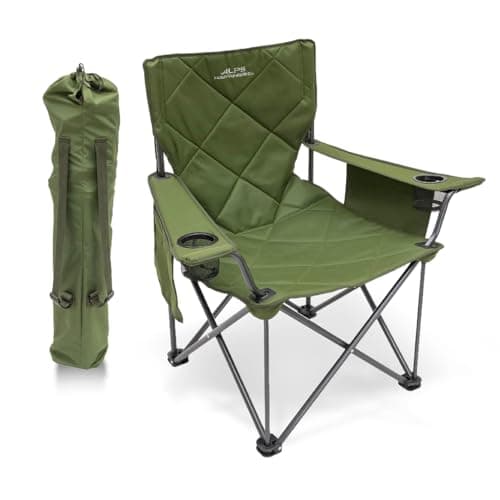
- Weight
- 14.7 lbs (6.65 kg)
- Weight capacity
- 800 lbs
- Seat height
- 19 in
- Packed size
- 39 x 8 x 8 in (manufacturer spec)
- Frame
- Powder-coated steel
- Fabric
- 600D polyester, quilted
About this pick
The King Kong is a wide, padded quad chair with an 800-pound capacity and a lifetime warranty. It sets up in seconds and holds its shape for hours of campsite lounging, whether you weigh 130 pounds or 300.
Strengths
- 800-pound capacity covers nearly every body type and is the highest in its class
- Padded, quilted seat delivers noticeably better comfort than bare-mesh alternatives
- Multiple storage pockets and cup holders built into the armrests
Weaknesses
- At roughly 15 pounds and 39 inches packed, it is a car-camping-only proposition
- Padding absorbs water in rain and dries slowly
Kit Score breakdown
KIJARO
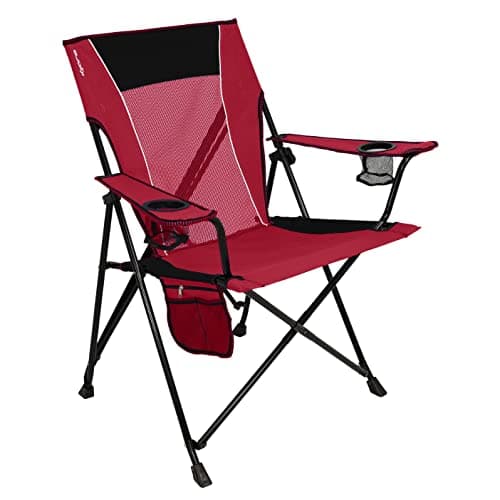
Kijaro Dual Lock Folding Camp Chair
Best Value
Kit Score 8.0/10
$64.86 Price checked Oct 23, 4:16 PM CDT
Best for: Drive-up campers who sit for long stretches and want structured back support without paying a premium price.
- Dual-lock mechanism keeps the seat taut and the back upright, providing genuine lumbar support
- Packed length of 45 inches is long and unwieldy in smaller vehicles
- Weight
- 9.4 lbs
- Weight capacity
- 300 lbs
- Seat height
- 19 in
- Packed size
- 45 x 7 x 7 in (manufacturer spec)
- Frame
- Steel with dual-lock joints
- Fabric
- 600 x 300D ripstop polyester with mesh back
About this pick
The Dual Lock uses locking joints that keep the seat taut when open and the chair compact when folded. The result is no-sag seating with a firm lumbar-supporting backrest that resists the forward slump most camp chairs produce after 30 minutes.
Strengths
- Dual-lock mechanism keeps the seat taut and the back upright, providing genuine lumbar support
- 19-inch seat height is among the tallest tested, making entry and exit straightforward
- Breathable mesh back panel reduces heat buildup on warm evenings
Weaknesses
- Packed length of 45 inches is long and unwieldy in smaller vehicles
- Narrow feet can sink into sand or soft turf
Kit Score breakdown

Best for: Backpackers and festival-goers who refuse to sacrifice back support for packability and want one chair that handles every trip.
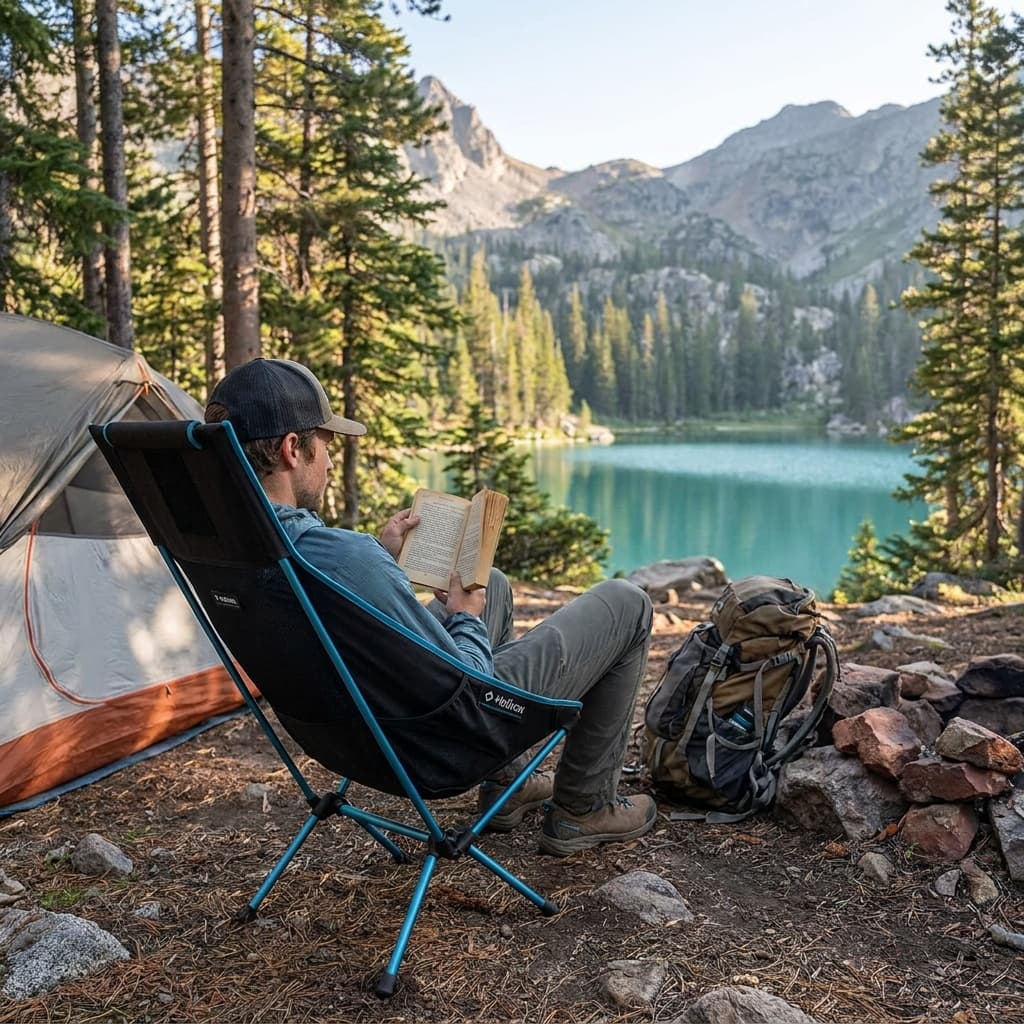
- Packs to 18 x 5.5 x 4.5 inches and weighs 2.6 lbs, fitting inside most day packs
- No cup holders or armrests; trade-offs required for the ultralight format
- Weight
- 2.6 lbs
- Weight capacity
- 320 lbs
- Seat height
- 10 in assembled; 35 in back height
- Packed size
- 18 x 5.5 x 4.5 in
- Frame
- DAC anodized aluminum alloy, shock-corded
- Fabric
- Recycled bluesign-certified 300D polyester with mesh ventilation
About this pick
The Chair One Highback (re) packs to the size of a water bottle carrier and weighs 2.6 pounds, yet supports 320 pounds with a full high back that reaches shoulder height. The redesigned tension system distributes weight across the entire frame rather than concentrating it at four contact points.
Strengths
- Packs to 18 x 5.5 x 4.5 inches and weighs 2.6 lbs, fitting inside most day packs
- High back reaches shoulder level and cradles the upper back and neck, unlike standard ultralight chairs
- 5-year warranty on a frame built from repurposed aluminum factory scraps
Weaknesses
- No cup holders or armrests; trade-offs required for the ultralight format
- Low seat height can be awkward to exit for those with knee or hip concerns
Kit Score breakdown
See all picks in Best camping chairs for comfort, support, and all-day sitting
Keep going
Complete loadoutCar-camping starter kitThe first-trip essentials across shelter, sleep, cooking, lighting, seating, and water, with the extras left out.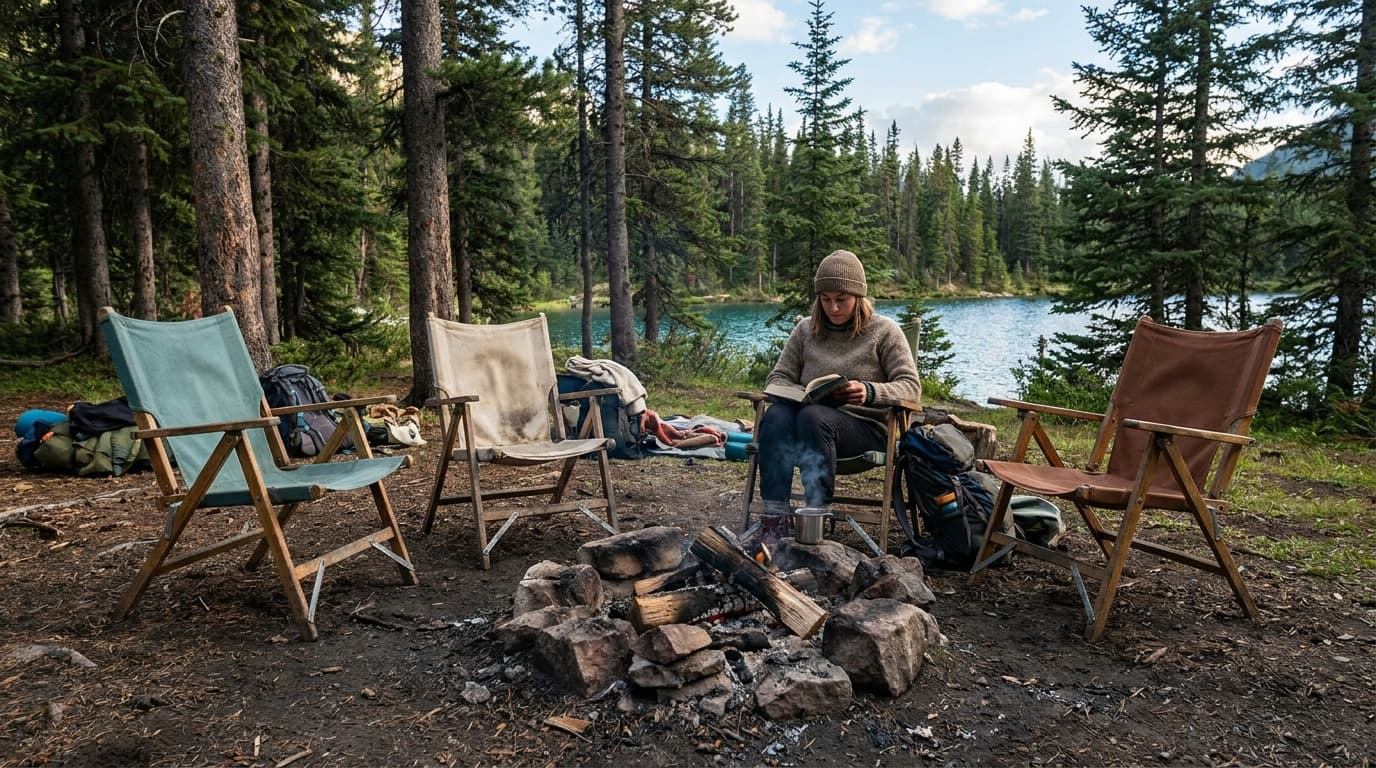
Researched, not hands-on tested
Updated Oct 16, 2026Our recommendations draw on manufacturer documentation, retailer listings, owner feedback, and comparisons with alternatives.
As an Amazon Associate I earn from qualifying purchases. We may earn a commission from links here, at no extra cost to you. How we research →